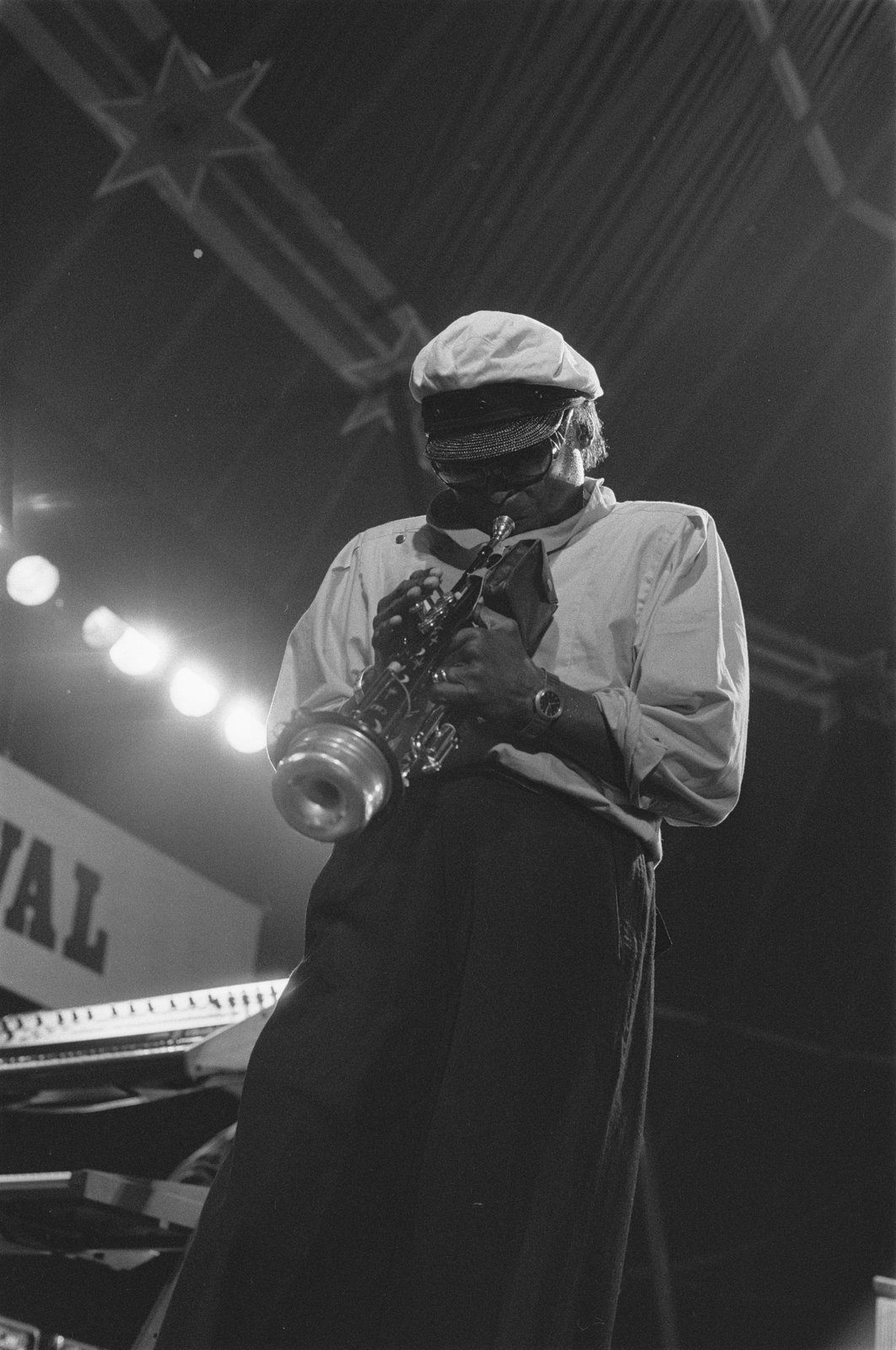
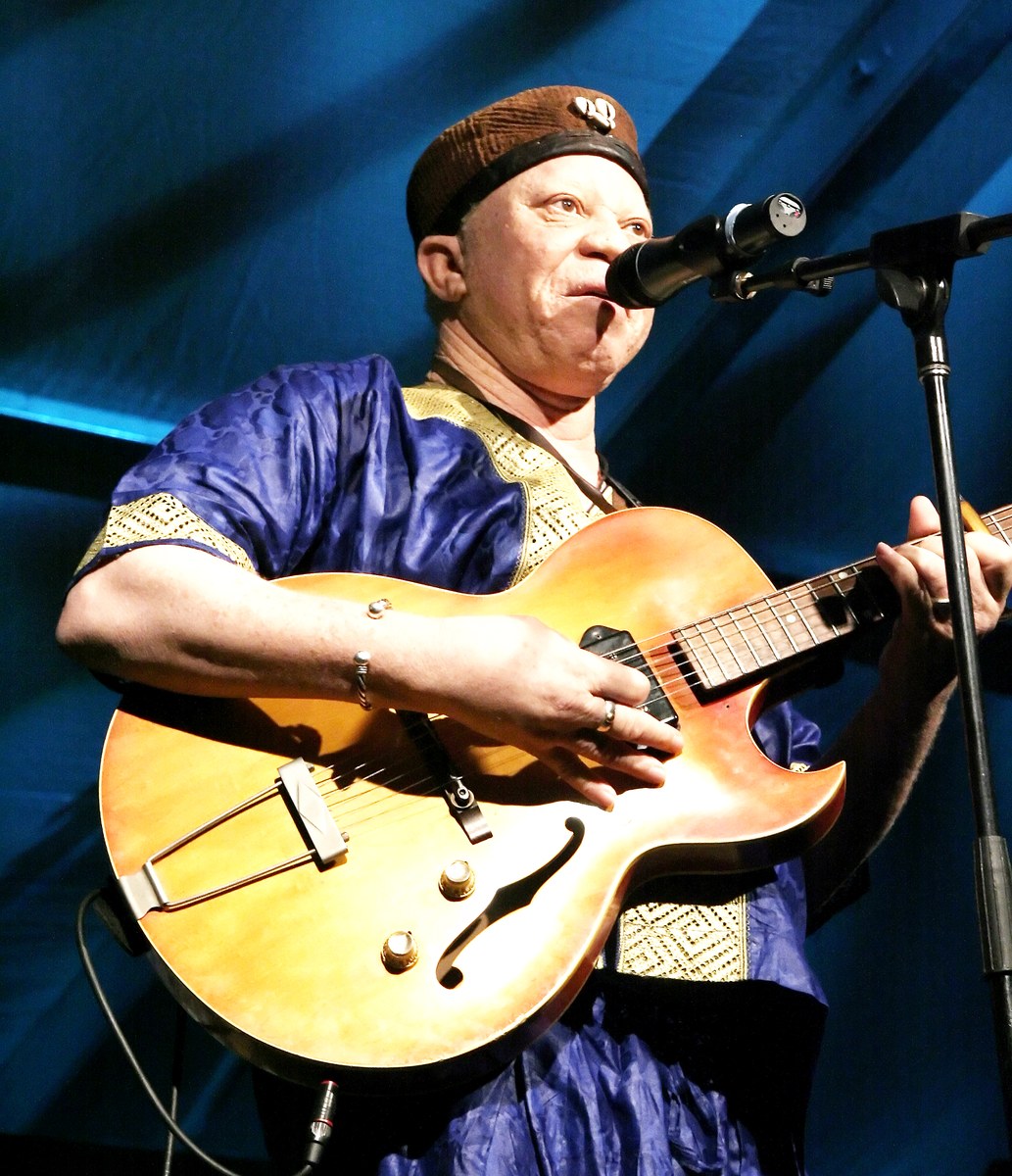

Photo by John Leeson, Toronto Jazz Festival, 29 June 2008, via Wikimedia Commons, CC BY 2.0 · Photograph 'Salif Keita' by John Leeson, taken at the Toronto Jazz Festival (Beaches International Jazz Festival) on 29 June 2008, Flickr photo 52440868864, published on Wikimedia Commons as 'Salif Keita - 52440868864.jpg' (uploaded 30 September 2023). Commons page: Flickr source URL, author John Leeson, licence CC BY 2.0, with a FlickreviewR pass on 30 September 2023 (reviewed licence cc-by-2.0). The live Flickr page was re-checked on 31 October 2026: photographer John Leeson, photo title 'Salif Keita', licence value 4 (CC BY 2.0) with the creativecommons.org/licenses/by/2.0 link, and an empty photo-licence-history list, so no licence change is recorded. Original 2304 x 2676 pixels (Canon EOS Digital Rebel XT); the stored file is a 1033 x 1200 downscale, never upscaled and not cropped. A live performance photograph of the singer. The lead's suggested lead (the 207 x 319 US State Department photograph) was not used because it is too small. · CC BY 2.0
가수 · 현대
살리프 케이타
b. 1949
주요 업적 분야
아직 성격 매칭에 포함되지 않았습니다 — 기록된 근거가 성격 모델 전체를 다루기에는 충분하지 않습니다. 이 페이지의 다른 모든 내용은 자유롭게 확인하실 수 있습니다.
핵심 특성
주요 업적
만데 음악 전통을 재즈, 리듬 앤 블루스 등 국제적인 양식과 결합해 아프로팝 댄스 음악 장르를 개척했고, 아프리카의 황금 목소리로 불리게 되었다.
레일 밴드와 레 앙바사되르 뒤 모텔의 리드 싱어로서, 말리 대중음악의 토대를 놓은 이 밴드들에서 가장 사랑받는 가수 가운데 한 사람이 되었다.
1987년 파리에서 녹음한 솔로 데뷔 음반 《소로》로 세계에 이름을 알렸고, 2001년 바마코로 돌아온 뒤 낸 《모푸》(2002)는 큰 호평을 받았다.
삶의 장면들
1973년 그는 말리의 현대성을 자기 방식으로 노래하고 싶어 레일 밴드를 떠나 경쟁 밴드인 레 앙바사되르로 옮겼고, 1974년 두 밴드의 경기장 대결은 지금도 회자된다.
이는 자신의 작곡에 대한 주도권을 중시해 자리 잡은 밴드를 떠난 음악가의 모습과 부합한다. 자율성 욕구
파리에서 《소로》를 작업할 때 프로듀서는 케이타가 데모나 마이크 테스트에서도 마지막인 것처럼 노래했다고 회상한다.
이는 준비 단계에서도 전력을 다해 노래하는 장인적 태도와 부합한다. 숙련 지향
전환점
1984년 무렵 그는 아비장에서 파리로 옮겨 솔로 활동을 시작했고, 그 결과 나온 《소로》(1987)는 지역의 스타를 국제적인 가수로 바꾸어 놓았다.
이는 더 넓은 청중을 위해 거처와 음악을 바꾸는 것을 마다하지 않은 예술가의 면모와 부합한다. 적응력
비슷한 인물
전체적인 프로필이 이 사람과 닮은 사람들이에요.
출처
- Salif Keita (Q313318), verified live via the Wikidata API (2026-10-31): label 'Salif Keita', description 'Malian singer-songwriter, referred to as the "Golden Voice of Africa"', born 25 August 1949, no death date, Korean label present, image 'Mali Salif Keita2 400.jpg'. Orientation only; not used as support for any row.
- The Editors of Encyclopaedia Britannica, 'Salif Keita', Britannica (revised 21 August 2025), read in full. CANONICAL SIGNIFICANCE SOURCE: a Malian singer-songwriter known for blending Mande traditions with jazz, rhythm and blues and other international styles to pioneer the Afropop dance-music genre; the move to Bamako, the Rail Band, Les Ambassadeurs du Motel in Abidjan, the move to Paris and the 1987 debut Soro, Amen (1991), the return to Bamako in 2001 and Moffou (2002), the 2005 foundation, La difference (2009), Tale (2012) and Un Autre blanc (2018) with the announced retirement from recording. Encyclopedia entry; it is editorial and uncited, and it also covers private-life context that is not scored.
- Banning Eyre, 'Les Ambassadeurs du Motel de Bamako' (review of a two-CD compilation), Afropop Worldwide, 12 September 2014, read in full: Keita's 1971 arrival with the Rail Band, his wish to write songs that expressed Malian modernity in his own way, the 1973 move to the rival Les Ambassadeurs, the 1974 stadium showdown between the two bands, the band's variety repertoire, the 1977 trip to Abidjan, and the track-by-track account of his vocals and composing credits. Specialist music journalism by an author who has also interviewed Keita; it draws on sleeve notes and on Keita's own interviews.
- Nigel Williamson, 'Les Ambassadeurs du Motel de Bamako' (five-star review), Songlines, November/December 2014, read in full (one paragraph): the band and the Rail Band as the foundation of popular Malian music, the 1975-1977 recordings, Keita singing exactly half of the 18 tracks, and the contribution of the singer Ousmane Dia and of the guitarists, organist and horn section. Independent review that places Keita as part of an ensemble.
- Lucas Keen, 'The story of Salif Keita's Soro' (a conversation with the producer Francois Breant), Pan African Music magazine, 14 December 2021, read in full: the 1987 album recorded at Studio Harry Son in Paris, the pan-African team of players, Breant's account of Keita singing demos and mic tests 'like it was the last time of his life', the use of synthesisers to imitate traditional instruments, the cultural advice Keita and the executive producer gave, and the claim that the record baffled listeners who expected African music to be 'a museum'. An anniversary feature built mainly on the producer's recollection, so it is an insider and retrospective account.
- Robert Christgau, Consumer Guide review of Salif Keita, 'Soro' (Mango, 1987), read in full (about 250 words, grade B): calls him one of Africa's great singers but judges him short of Youssou N'Dour's purity and range, says he compensates with experience, feeling and authority, and says the Paris arrangements 'sacrifice a quantum of groove for dramatic effects'. Contemporary critical counter-voice from a US rock critic; short and opinionated.
- Banning Eyre, 'Salif Keita Gives His Blessing And Takes A Final Bow With Un Autre Blanc', NPR All Things Considered, 20 March 2019, read in full (the page text of the review): about 25 albums over a 40-year career, Soro as the album that introduced his voice, the retirement from recording, and the guests on the final album (Angelique Kidjo, Ladysmith Black Mambazo). Short broadcast review; the audio was not listened to.
- Banning Eyre, 'Salif Keita Speaks Out on His Career, Mali's Crisis and Retirement', Afropop Worldwide, 22 December 2014, read in full (about 3,000 words of interview): the Tale album and its arranger, the ten reunion shows with Les Ambassadeurs, his naming of the Rail Band guitarists Djelimady Tounkara and Kante Manfila as his teachers, his loyalty to his long-time guitarist, his stated plan to retire, and his views on young Malian music. Interview, so mainly first-person; the passages on national politics are context and are not scored.
- Banning Eyre, 'Salif Keita talks going acoustic with So Kono', Afropop Worldwide, 23 April 2025, read about two thirds (introduction and the song-by-song portion): his earlier retirement statements and the return to a solo acoustic album recorded in a hotel room in Japan in 2023, the producer's persuasion, and the dedications to a patron, a friend and his former guitarist. Interview, mostly first-person; the political discussion is context and is not scored.
- Frank Bessem, 'Salif Keita (& les Ambassadeurs)', Musiques d'Afrique (musiques-afrique.net), read in full: a career outline from the Rail Band (1970) and Les Ambassadeurs (1973) through the Abidjan years, the 1984 move to France, Soro, the return to Bamako and the semi-acoustic Moffou, a note that he created the Moffou club, cultural centre and recording studio to promote young artists, a discography, and the opinion that the later Paris albums 'lack more and more the African feel'. Enthusiast web guide by a single author; it is used for the outline, the Moffou venture and one critical judgement.