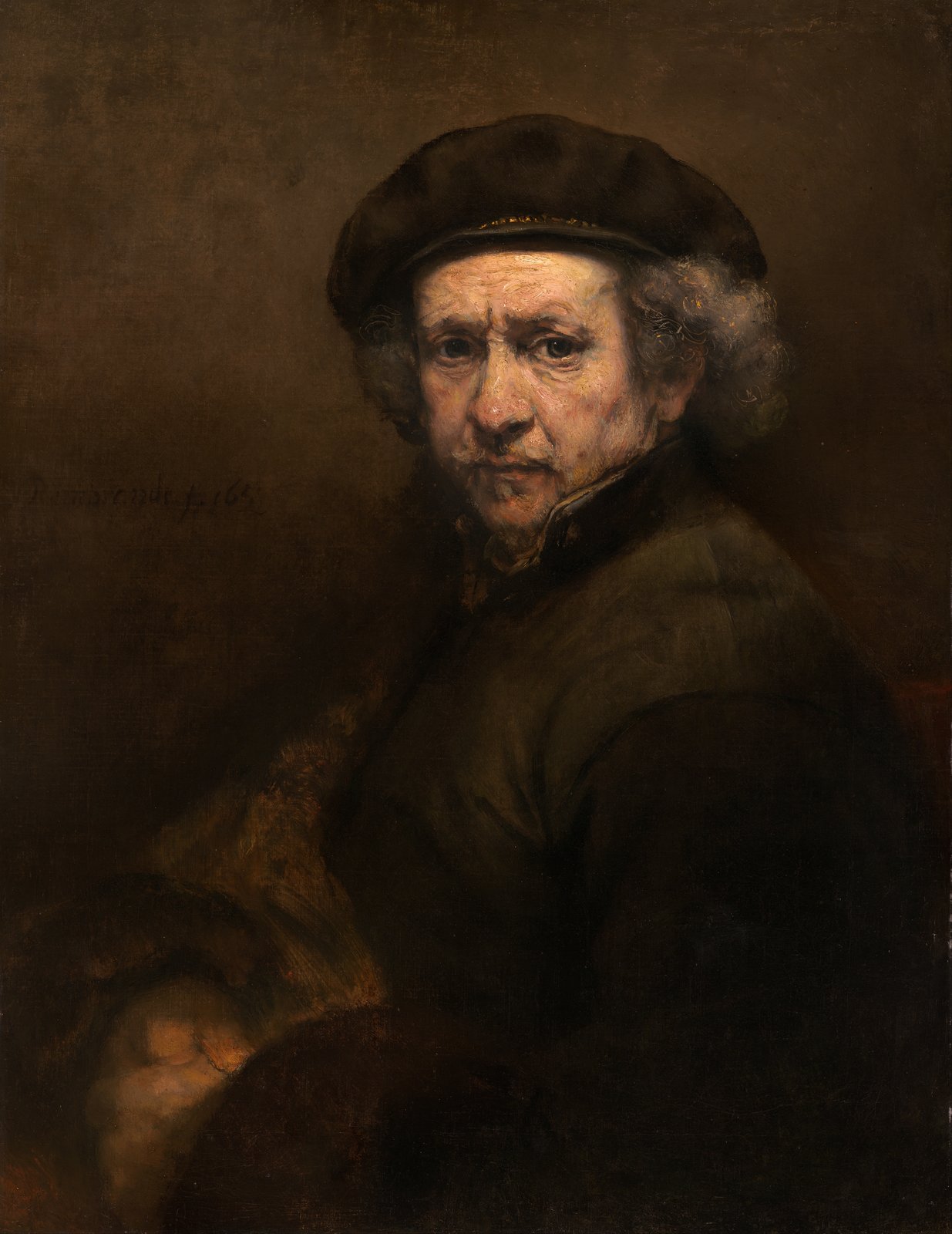
Rembrandt van Rijn, Self-Portrait with Beret and Turned-Up Collar, 1659, National Gallery of Art, Washington (a self-portrait painted by the artist; public domain, author died 1669) · National Gallery of Art, Washington (accession 1937.1.72), via Wikimedia Commons (Google Art Project) · Public domain (author died 1669)
핵심 특성
주요 업적
렘브란트는 〈세 개의 십자가〉와 〈군중 앞에 선 그리스도〉를 비롯한 대형 드라이포인트 원판 몇 점을 여러 상태(state)에 걸쳐 거듭 고쳐 작업했다. 빅토리아 국립미술관(NGV)에 따르면 그는 닳은 원판의 넓은 부분을 지우고 새로운 요소를 더해 이후 상태의 강조점과 분위기를 달리했으며, 1640년대 중반부터는 수입된 중국·일본 종이에 '고급' 인쇄본을 찍기도 했다.
렘브란트는 1620년대 말부터 1630년대에 걸쳐 여러 모습으로 자화상을 그렸고, 이후의 일부 자화상은 앞선 거장들을 분명하게 참조한다. H. 페리 채프먼은 라이덴 컬렉션 도록(The Leiden Collection Catalogue)에 실은 글에서, 글래스고에 있는 1632년 자화상이 루벤스의 1623년 자화상을 본떴고 런던에 있는 1640년 자화상이 1639년 암스테르담에서 본 라파엘로와 티치아노의 초상화를 참조했다고 설명한다.
삶의 장면들
콘스탄테인 하위헌스는 1629~31년경에 쓴 자전적 글에서 렘브란트와 얀 리번스를, 아직 이탈리아 유학 여행이 필요하다고 여기지 않은 자신만만한 젊은 화가들로 묘사했다. 그는 두 사람이 지금이 한창때라 먼 여행에 쓸 시간이 없고, 군주들이 수집하는 종류의 최상급 이탈리아 그림은 이탈리아 밖에서도 볼 수 있다고 답했다고 전하며, 이를 재능 넘치는 화가들의 '한 줌의 어리석음'이라고 평했다.
이 기록은 독립적 사고(independent_thinking) 점수와 부합한다. 후원자가 분명히 못마땅해했음에도 근거를 들어 머무르기로 한 결정으로 읽을 수 있지만, 두 사람의 논리는 하위헌스의 글에만 남아 있다. 독립적 사고
요아힘 폰 잔드라르트는 1675년에 렘브란트가 회화, 소묘, 판화와 외국의 진기한 물건을 매우 좋아해 그런 것들을 많이 갖고 있었다고 썼다. 1656년에 작성된 그의 소유물 목록이 이 수집품에 관한 주된 기록이며, 이를 토대로 한 렘브란트 하우스 도록에 대한 학술 서평은 그 수집이 특히 종이 위의 미술, 곧 루카스 판 레이던과 라파엘로의 판화에서 뛰어났고, 작업실에서 쓰인 조각상, 진기한 물건, 무기, 의상도 그 목록에 올라 있다고 설명한다.
이는 호기심(curiosity) 점수와 부합한다. 스튜디오와 함께 갖춘 대규모 수집품이지만, 사료는 수집 동기보다 소장품의 내용을 더 많이 기록한다. 호기심
전환점
렘브란트는 1631/32년에 라이덴에서 암스테르담으로 옮겼고, 이후 경력의 나머지는 이 도시에서 이어졌다. 채프먼에 따르면 그는 아직 시민이 아니어서 자기 작업실을 열 수 없었기 때문에 화가 겸 화상인 헨드릭 에일렌뷔르흐의 집에 머물며 그의 공방을 이끄는 방식으로 일을 시작했고, 1633년에는 암스테르담으로 완전히 옮겨 있었다.
비슷한 인물
전체적인 프로필이 이 사람과 닮은 사람들이에요.
출처
- Rembrandt -- orientation only (dates 15 Jul 1606 Leiden - 4 Oct 1669 Amsterdam, Dutch nationality, painter/printmaker/draughtsman); not used as support for any scored row. Fetched and read.
- Rembrandt (Q5598) -- identity verified live: label 'Rembrandt', description 'Dutch painter and printmaker (1606-1669)', born 15 Jul 1606, died 4 Oct 1669, instance of human, Korean label read via the wbgetentities API, P18 'Rembrandt van Rijn - Self-Portrait - Google Art Project.jpg'. Orientation only.
- Constantijn Huygens, Mijn jeugd (Dutch translation by C.L. Heesakkers, 1987), chapter 'Rembrandt en Lievens' on DBNL -- INDEPENDENT FIRSTHAND account by a court secretary who visited the Leiden painters (Huygens's autobiography was written c.1629-31). Full chapter read in the Dutch text: his comparison of Rembrandt and Jan Lievens, his remark that Rembrandt concentrates devotedly on small paintings, his criticism that the two had not found an Italian study trip necessary and the reasons they gave, and his observation of their dedication and perseverance. The translation is copyright-protected, so only paraphrase is used here. The portrait-commission anecdote in the same chapter concerns Lievens and was not used.
- Joachim von Sandrart, Teutsche Academie (1675), vol. II book 3, chapter XXII 'Rembrand von Ryn', pp. 326-327, Sandrart.net online edition (German text with the edition's editorial commentary) -- NEAR-CONTEMPORARY account by a painter who, per the edition's own commentary, lived in Amsterdam 1637-45 and knew Rembrandt; the edition flags that Sandrart's remarks on Rembrandt's social conduct were probably colored by rivalry and by Sandrart's ideal of the learned artist. Both pages read directly in the German original: Rembrandt's not having visited Italy, his stance against the rules of art, his diligence, his etchings and pupils, his collecting of art and curiosities, his manner of painting old people. Only the behavioral passages are used; the remarks on his social circle and finances were not scored.
- H. Perry Chapman, 'Rembrandt and The Leiden Collection' (2017), The Leiden Collection Catalogue, 4th ed., ed. Arthur K. Wheelock Jr. et al. (online) -- scholarly essay by a Rembrandt specialist (secondary; the publisher is a private collection, not subject-affiliated). Full essay text read: Leiden years, emulation of Lastman, Lievens and Rubens, the Uylenburgh period, the 1632 and 1640 self-portraits, pupils, Gerrit Dou, and the 1656 inventory reference to eight Lievens paintings. The essay itself labels some points 'undocumented but plausible' (e.g. a shared studio with Lievens); those are not used.
- Milwaukee Art Museum, 'Chronology' page for the exhibition Friends and Rivals: Jan Lievens and Rembrandt, organized by the National Gallery of Art, Washington, with the Rembrandt House Museum (curators Arthur Wheelock and Laurie Winters) -- institutional exhibition chronology: Huygens-prompted friendly competition producing parallel works by Rembrandt and Lievens in 1628-31, and the move to Amsterdam in 1631/32. The page's remark that Rembrandt 'seems to backdate some paintings' is hedged and was not used. Read in full.
- National Gallery of Victoria, Melbourne, exhibition page 'Rembrandt: True to Life' (unsigned exhibition text) -- institutional account of his etching practice (erasing and renewing drypoint plates, plate tone, imported Chinese and Japanese paper and vellum from the mid-1640s), his drawing classes from the mid-1640s, his 1639 etched self-portrait posed on Titian, Raphael and Dürer, and the 1656 inventory's albums of sketches. Undated and unsigned, so weighted as a weaker institutional source. Read in full.
- Rijksmuseum, Amsterdam, story '10 things to know about Rembrandt's etchings' (unsigned, undated) -- institutional account of his etching method and of The Adoration of the Shepherds (c.1657) reworked across eleven states with darkening lines, an added fence and impressions on Chinese and Japanese paper. Weak on provenance (no author or date), so used only as corroboration alongside src_rembrandt_hind and src_rembrandt_ngv. Read in full.
- Arthur M. Hind, Rembrandt, With a Complete List of His Etchings (New York: Frederick A. Stokes, 1912), Project Gutenberg eBook #31183 -- scholarly print-curator study (secondary, independent). Introduction read on drypoint (begun about 1639), successive states of the Three Crosses and Christ Presented to the People, and the observation that the etchings were largely uncommissioned. A century old; used only for the observation of plate states.
- Amy Golahny (Lycoming College), review of Rembrandt's Treasures (ed. Bob van den Boogert, Rembrandt House Museum/Waanders, 1999), Historians of Netherlandish Art Reviews, November 2001 -- scholarly review of the catalogue built on the 1656 inventory: the collection was exceptional in art on paper, with statuary, curiosities, weaponry, costumes and anatomical models used in his studio. The reviewer notes the exhibition was an evocation rather than a reconstruction. Read in full.