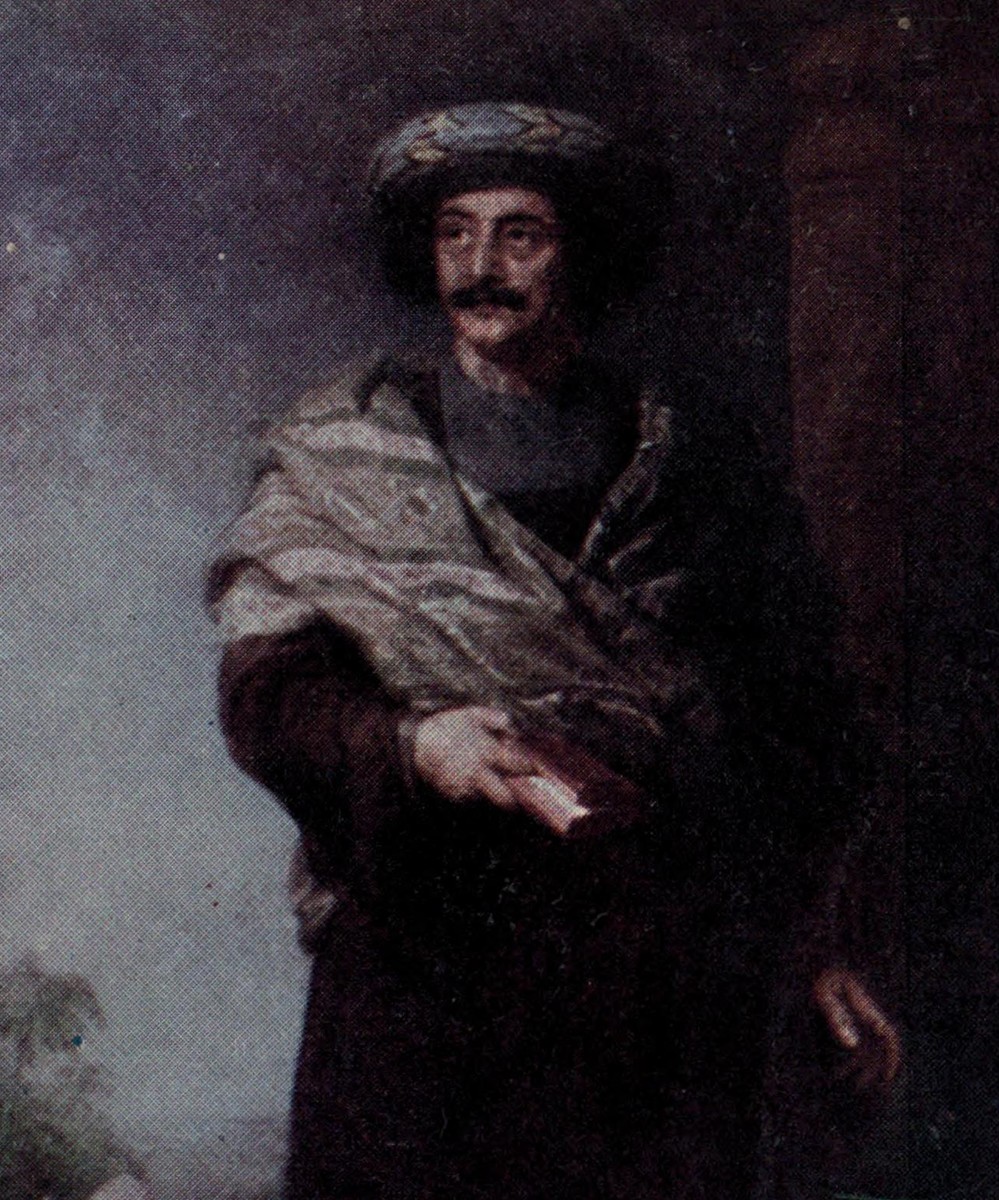

Henry Perronet Briggs, portrait of Rammohun Roy, plate in Collet, Life and Letters of Raja Rammohun Roy, 2nd edition (Calcutta, 1914) · Colour plate of the full-length portrait of Roy by Henry Perronet Briggs (the painting hangs in the Bristol Museum according to Collet), reproduced as the frontispiece of Sophia Dobson Collet, 'The Life and Letters of Raja Rammohun Roy', second edition (Calcutta, 1914), Internet Archive scan from University of California Libraries (copyright status listed as not in copyright). Painter died in 1844 and the plate was published in 1914, so the image is public domain by age in the United States. The plate caption names only the sitter; the attribution to Briggs rests on Collet's text (a full-length portrait by Briggs in the Bristol Museum, which Dr Lant Carpenter, who knew Roy, judged the best portrait extant) and on a matching Commons file credited to Briggs. Cropped from the upper part of the plate (about 1290 x 1550 pixels in the 2132 x 3730 page scan) and downscaled to 999 x 1200; no upscaling. The date of the painting is not stated in the sources read. · Public domain (painting by an artist who died in 1844; reproduction published in 1914)
핵심 특성
주요 업적
브리태니커는 그를 종교·사회·교육 개혁가로 소개하며 '근대 인도의 아버지'로 불리기도 한다고 전한다. 그는 아트미야 사바(1815), 앵글로-힌두 학교(1822), 베단타 대학(1826), 브라흐모 사마지(1828)를 세웠다.
그는 두 편의 대담집(1818년, 1820년)을 펴내 사티(순장 관습)에 반대했고, 브리태니커에 따르면 그의 글은 1829년 정부의 사티 금지 조치에 힘을 실었다.
그는 영어 중심의 서양식 교육을 주장하여 과학을 포함한 교과를 가르치는 앵글로-힌두 학교를 열었고, 인도 최초기의 주간신문 두 곳을 창간하고 편집했다.
삶의 장면들
정통파 인사들이 그와 함께 힌두 대학 위원회에 앉기를 꺼리자 그는 위원회에서 물러났지만, 알렉산더 더프의 증언에 따르면 밖에서 계속 학교를 위해 힘썼다.
이는 자신의 자리보다 사업의 성공을 우선하는 태도와 부합한다. 선제적 행동력
선교사 조슈아 마시먼이 그의 『예수의 가르침』을 비난하자 그는 『기독교 대중에게 보내는 호소』로 응수했고 이후 제2차, 마지막 호소문을 잇따라 발표했다.
이는 비판을 피하지 않고 공개적으로 맞서 답하는 태도와 부합한다. 갈등 감내
전환점
1827년 그와 다른 벵골인들은 유니테리언 협회에 대한 지원을 끊었고, 1828년 그는 협력자 윌리엄 애덤의 바람과 달리 브라흐모 사마지를 창설했다.
이는 가까운 협력자와 갈라서더라도 자신의 조직 노선을 택하는 독립적 태도와 부합한다. 독립적 사고
비슷한 인물
전체적인 프로필이 이 사람과 닮은 사람들이에요.


넬슨 만델라

엘리자베스 케이디 스탠턴

왕가리 마타이

제인 구달

말랄라 유사프자이
출처
- Ram Mohan Roy (Q335269), verified live via the Wikidata API (2026-10-30): label 'Ram Mohan Roy', description 'Indian religious, social, and educational reformer, and humanitarian', born 1772-05-22, died 1833-09-27; Korean label '람 모한 로이'. Orientation only; not used as support for any row.
- Wikipedia, 'Ram Mohan Roy', fetched for orientation only (names, dates, main institutions). Never counted as a source for any row.
- Encyclopaedia Britannica, 'Ram Mohan Roy' (Britannica Editors, last updated October 2026), read in full. CANONICAL SIGNIFICANCE SOURCE: calls him a religious, social and educational reformer sometimes called the father of modern India, founder and editor of two of India's earliest weekly newspapers, founder of the Atmiya Sabha (1815), the Anglo-Hindu School (1822), the Vedanta College (1826) and the Brahmo Samaj (1828), and says his writings emboldened the 1829 prohibition of suttee. Concise tertiary entry that is admiring in places; its description of his 1829 mission to England is context only here.
- Dictionary of Unitarian and Universalist Biography, 'Roy, Rammohun', read in full: a scholarly biographical entry covering his Persian and Bengali tracts, the Atmiya Sabha, the two conferences on sati (1818, 1820), the lawsuits and hostility from orthodox opponents, the Precepts of Jesus controversy with the missionary Joshua Marshman, his work with William Adam, the Anglo-Hindu School and Vedanta College, and the Brahmo Samaj, including Adam's sceptical view of his motives. Independent of the Brahmo Samaj and of Collet; written from a Unitarian standpoint.
- Sophia Dobson Collet (completed by a friend; second edition ed. Hem Chandra Sarkar), 'The Life and Letters of Raja Rammohun Roy' (Calcutta, 1914), Internet Archive scan from University of California Libraries, read for the preface, the introduction on education (including Alexander Duff's 1853 evidence on the founding of the Hindu College), the chapter list, the passage on Roy's offer of the Brahmo Sabha hall to Duff, the description of his person and the Briggs portrait footnote, and the frontispiece plate. An insider, admiring biography (first edition 1900, compiled by a Unitarian admirer); used for dated episodes and quoted evidence only.
- Humanists UK, Humanist Heritage, 'Rammohun Roy (1772-1833)', read in full: a short institutional profile describing his newspapers, his protest against press censorship, his campaign against sati and child marriage, the Brahmo Samaj, and his reception by British freethinkers and Unitarians. Admiring heritage page written to claim a link to organised humanism.
- World History Commons, 'Sati: Petition, Orthodox Hindus' (the petition of the orthodox Hindu community of Calcutta against the Suttee Regulation, 14 January 1830, with editorial annotation), read in the first part: the opposing view that sati was sanctioned by custom and scripture and that the regulation was an interference in religion. Used as the counter-voice to his campaign; a document of the opposing party, not a source about Roy's conduct.