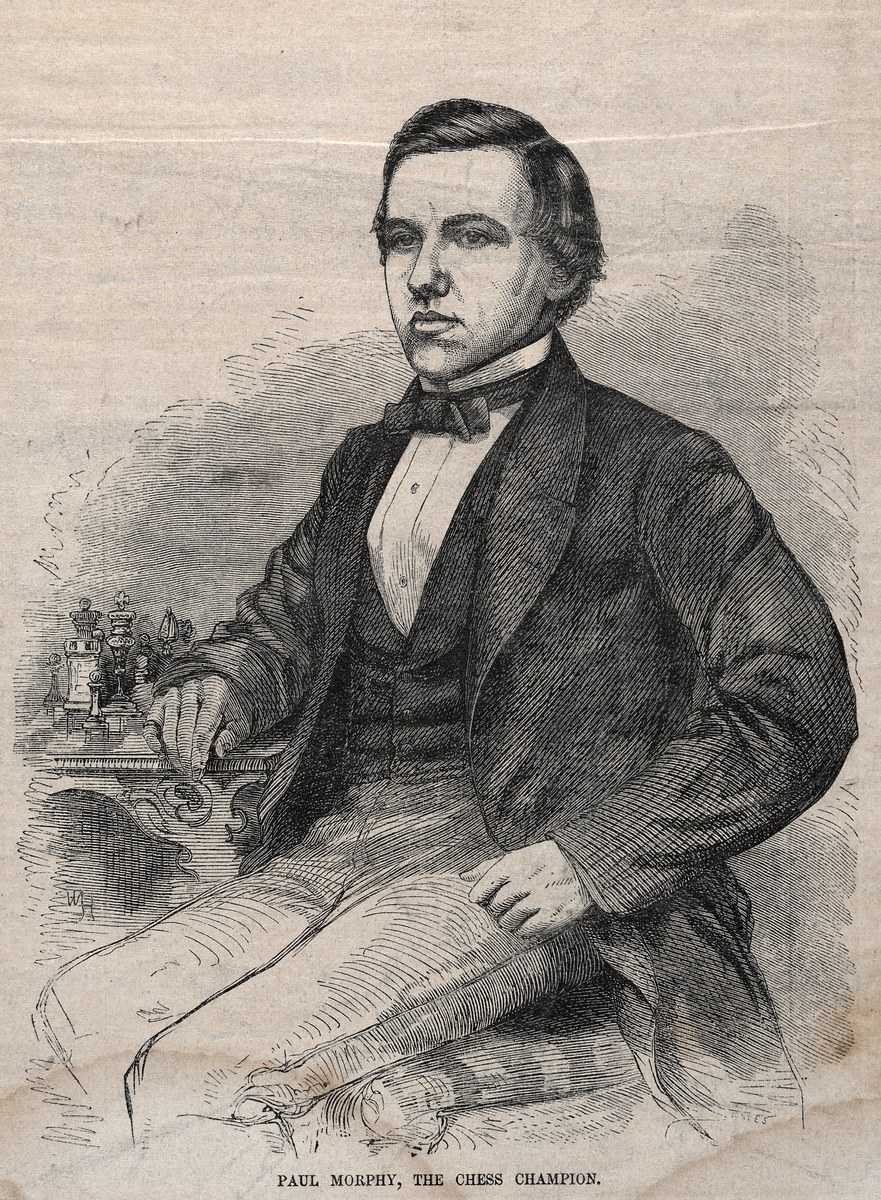

Winslow Homer, Paul Morphy, The Chess Champion, 1859, wood engraving, Cleveland Museum of Art, Purchase from the J. H. Wade Fund, 1942.1472, CC0 · Wood engraving 'Paul Morphy, The Chess Champion' by Winslow Homer, 1859; Cleveland Museum of Art, Purchase from the J. H. Wade Fund, accession 1942.1472, released under the museum's Open Access (CC0) programme. The museum's print image was 1832 x 2495 pixels; this project reduced it to 881 x 1200 pixels, never enlarging it · CC0 (Cleveland Museum of Art Open Access); engraver died 1910
운동선수 · 19세기
폴 모피
1837–1884
주요 업적 분야
아직 성격 매칭에 포함되지 않았습니다 — 기록된 근거가 성격 모델 전체를 다루기에는 충분하지 않습니다. 이 페이지의 다른 모든 내용은 자유롭게 확인하실 수 있습니다.
핵심 특성
주요 업적
1857년 제1회 미국 체스 대회에서 우승한 뒤 1858~59년 유럽에서 아돌프 안데르센을 비롯해 맞선 주요 마스터들을 꺾으며, 2년이 채 안 되는 공개 활동 기간에 당대 최강자로 불렸다.
브리태니커는 그가 공격에 앞서 기물 전개를 우선하는 원칙에 처음 의존한 선수라고 평가하며, 세계 체스 명예의 전당은 성급한 공격보다 장기적인 전략적 전개를 중시한 혁신적 선수로 소개한다.
1858년 파리에서 강한 상대 여덟 명과 동시에 눈을 가린 채 대국해 여섯 판을 이기고 두 판을 비겼으며, 1986년 미국 체스 명예의 전당, 2001년 세계 체스 명예의 전당에 올랐다.
삶의 장면들
1857년 대회 직후 그는 폰 하나와 선수를 양보하는 조건으로 전국 누구와도 대결하겠다고 도전장을 냈다.
상대가 오기를 기다리기보다 먼저 맞설 상대를 찾아 나선 경쟁자의 모습과 일치한다. 경쟁 성향
시간 제한이 없어 한 수에 한 시간 넘게 걸리기도 한 1857년 대회에서 그는 최고 선수들보다 오래 앉아 두며 한 판만 지고 우승했다.
서술이 개괄적이긴 하지만, 긴 대국에서도 집중을 이어 간 모습과 일치한다. 몰입
전환점
1859년 미국으로 돌아온 그는 세계 누구에게나 폰과 선수를 양보하겠다고 제안했고, 응하는 사람이 없자 공개 체스 활동을 접었다.
열린 도전을 중심으로 이어진 경쟁 활동이, 받아들이는 사람이 없자 끝난 흐름과 일치한다. 경쟁 성향
비슷한 인물
전체적인 프로필이 이 사람과 닮은 사람들이에요.
출처
- Paul Morphy (Q105589), verified live via the Wikidata API (2026-11-02): label 'Paul Morphy', description 'US chess player (1837-1884)', born 1837-06-22, died 1884-07-10, citizenship United States, Korean label present. Orientation only; not used as support for any row.
- Encyclopaedia Britannica, 'Paul Charles Morphy' (print view, revised 6 July 2025), read in full: American chess master who, in a public career of less than two years, became the world's leading player; won the first American championship tournament (New York, 1857); in Europe defeated Adolf Anderssen and every master who would face him (Howard Staunton avoided a match); played eight strong players blindfolded in Paris, winning six and drawing two; on returning in 1859 offered to face any player at odds of pawn and move and, when nobody responded, abandoned public chess; credited with being the first to rely on the principle of development before attack. CANONICAL SIGNIFICANCE SOURCE. The article's closing remarks on his later years were not used.
- World Chess Hall of Fame, 'Paul Charles Morphy' inductee biography (inducted U.S. Hall of Fame 1986, World Hall of Fame 2001), read in full: won the First American Chess Congress in 1857 (the second official U.S. champion), defeated leading European players in 1858 and was hailed as world champion although no formal title competition existed, returned in 1859 as an acclaimed national hero and did not play serious chess again, and is described as a revolutionary player who valued long-term strategic development over premature attacks while still winning by spectacular sacrifices. A hall-of-fame biography, so admiring; its remarks on his later life were not used.
- Charles L. Cutler, 'Paul Morphy, Chess Prodigy', American Heritage (August 1972, vol. 23 no. 5), read in full: a magazine biography drawing on his uncle's and niece's recollections and his secretary's account; covers his boyhood play, education before twenty, the 1857 New York congress (no time limit, long thinking, a challenge issued at odds of pawn and move), the Staunton evasions, the 1858 Paris blindfold display against eight opponents (his secretary's report of about ten hours at the board without food or water), the Anderssen match won 7-2 with 2 draws, and the 1859 return to New York. A popular history that relies on partisan witnesses (his secretary Frederick Edge, his uncle); the passages on his later life and mental state were deliberately not used.
- Edward Winter, 'The Real Paul Morphy by Charles Hertan', Chess Notes feature (updated to June 2026), read in full: a critical chess-historian's review of the 2024 Hertan biography; says David Lawson's 1976 'The Pride and Sorrow of Chess' remains the foundational Morphy scholarship and that Hertan largely recycles it with a one-sided stance against Staunton; cites Lawson on Morphy's family having opposed a money match and on the stakes problem in the 1858 Staunton negotiations; describes Staunton's Shakespeare contract; and says Morphy's associate F. M. Edge contributed to the breakdown of negotiations and that Morphy went to lengths to avoid meeting Staunton at the Birmingham tournament, giving what Winter calls a phoney excuse. Independent specialist criticism; Winter is a pro-Staunton historian, so his own view is treated as one side. Passages about Morphy's final years were not used.
- Russian Chess Federation, 'Person of day - 22 June' feature on Paul Morphy (ruchess.ru), read in full: summarises the 1857 congress win, the 1858 European tour, Staunton formally accepting then avoiding a match, Morphy's match scores against English masters (Barnes +19 -7 =1, Boden +5 -1 =3, Bird +10 -1 =1, Levi +6 -0 =0, Medley +3 -0 =0, Owen +4 -1 =0, Loewenthal =9 -3 =2), Harrwitz (+5 -2 =0) and Anderssen (+7 -2 =2) in December 1858, his post-return announcement of pawn-and-move odds, and Botvinnik's and Alekhine's assessments of his open-game mastery. A federation summary with a different national viewpoint; its closing sentence on his later years was not used and the figures are not independently audited.