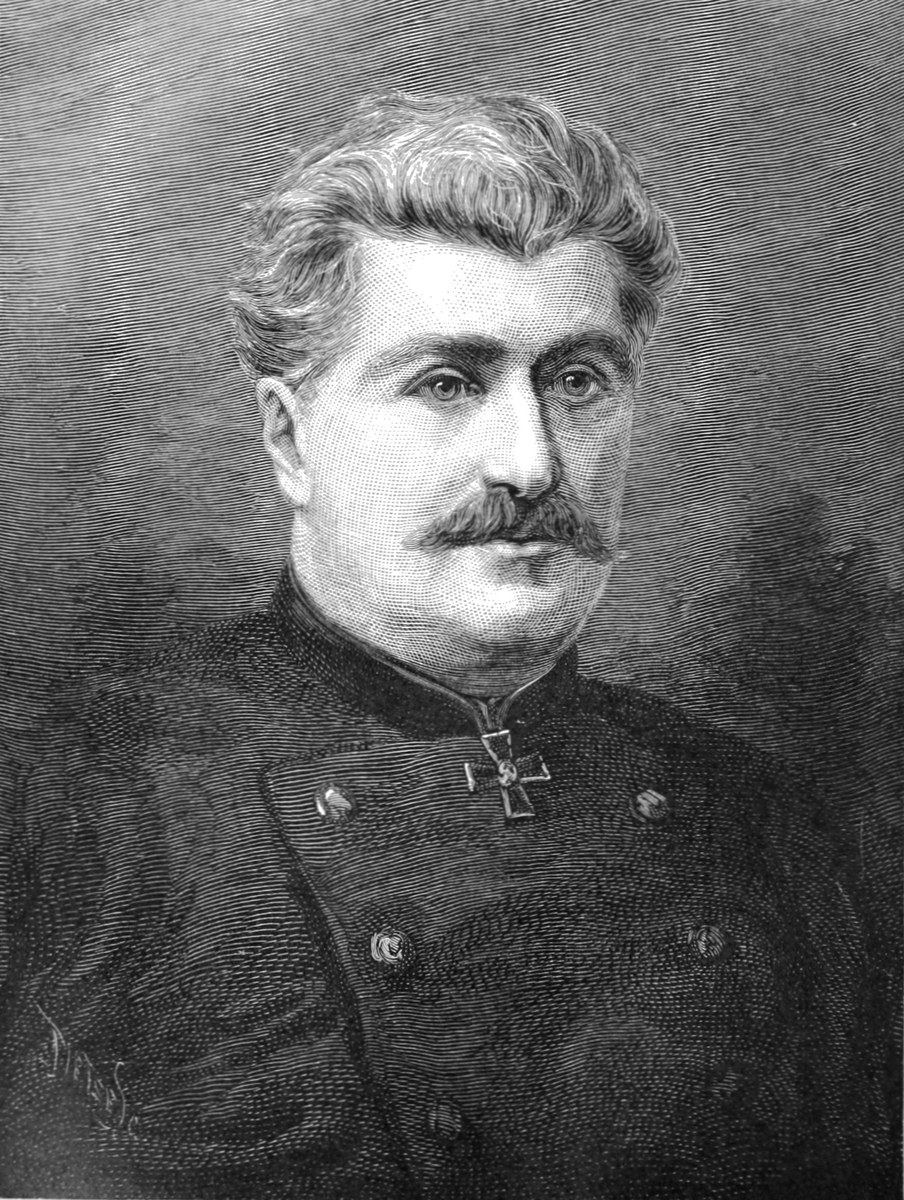

Engraving in Popular Science Monthly, vol. 30 (January 1887), via Wikimedia Commons (public domain) · Wood engraving of Nicholas Prejevalski published as the illustration to 'Sketch of Nicholas Prejevalski', Popular Science Monthly, volume 30 (January 1887), page 304 (plate D304), engraver not identified (a signature at lower left is illegible). Hosted on Wikimedia Commons as 'PSM V30 D304 Nicholas Prejevalsky.jpg' from the Internet Archive scan of the volume; I opened the Wikisource article that carries it. Rights basis: first published in the United States in 1887, so in the public domain in the United States by publication date regardless of the engraver; no institutional notice conflicts (the periodical's own pages are the source and carry no restriction). The Commons file page gives only a generic old-work tag, so the basis rests on the documented 1887 publication. Original scan 1759 x 2335 pixels, downscaled with no cropping to 904 x 1200; never upscaled. An engraving is a depiction made in his lifetime from an unstated source, not a documented sitting, so it is classed as a historical depiction like other engravings in this roster. · Public domain (published 1887)
핵심 특성
주요 업적
러시아 군 장교 출신 탐험가로, 1870년부터 1885년까지 네 차례의 원정을 이끌며 당시 유럽인에게 거의 알려지지 않았던 몽골, 고비, 타림 분지, 티베트 북부 고원 일대의 경로를 측량했다.
그의 동식물 채집품은 서구 과학에 새로운 종을 알렸으며, 야생 낙타와 오늘날 '프르제발스키 말'로 불리는 야생마가 그 가운데 포함된다.
두 번째 원정에서 롭노르 지역에 이르러 지도보다 더 남쪽에 있는 호수를 보고했으며, 지리학자 리히트호펜은 이 비정에 이의를 제기했다. 영국 왕립지리학회는 1879년 그에게 금메달을 수여했다.
삶의 장면들
첫 원정에서 낙타를 산 뒤 수중에 약 40파운드밖에 남지 않았지만, 그는 사냥으로 식량을 구할 수 있다고 보고 되돌아가지 않고 계속 나아가기로 했다.
이는 재정이 빠듯한 원정에서 위험을 감수하려는 성향과 부합하지만, 본인의 기록을 요약한 당대 서술이라는 한계가 있다. 위험 감수
첫 원정에서 그의 일행은 고원을 건너는 동안 하루 네 차례 기상 관측을 하고 아홉 곳에서 자기 편차를 기록했다.
이는 이동 중에도 꼼꼼하게 관측을 이어 간 태도와 부합하지만, 수치는 본인의 보고를 통해 전해진 것이다. 디테일 지향
전환점
1867년 그는 동시베리아 이르쿠츠크로의 전속을 자청해 우수리 지역을 탐사했으며, 당대의 한 전기는 탐험가로서의 이력이 이 시기에 시작되었다고 본다.
이는 지리 교사에서 스스로 나서 현장 탐사로 옮겨 간 전환과 부합한다. 호기심
비슷한 인물
전체적인 프로필이 이 사람과 닮은 사람들이에요.
출처
- Nikolay Przhevalsky (Q192442), verified live via the Wikidata API (2026-10-31): label 'Nikolay Przhevalsky', description 'Russian soldier, explorer, & geographer (1839-1888)', born 1839-03-31, died 1888-10-20 or 1888-11-01 (Old and New Style), citizenship Russian Empire, Korean label 니콜라이 프르제발스키. Orientation only; not used as support for any row.
- Encyclopaedia Britannica, 'Nikolay Przhevalsky' (full article read, about 5,000 characters). CANONICAL SIGNIFICANCE SOURCE: a Russian traveler who, by the extent of his explorations, route surveys and plant and animal collections, added vastly to geographic knowledge of east-central Asia; journeys from 1870 across Mongolia and the Gobi, to the Tien Shan, Takla Makan and Altun Mountains, to within 170 miles of Lhasa, and in 1883 to Ysyk-Kol; his natural history discoveries include the wild camel and Przewalski's horse; two travel books were translated into English; he died at Karakol.
- EBSCO Research Starters, 'Przhevalsky Explores Central Asia' (read in full, about 7,500 words of article text). Modern reference summary of the four journeys of 1871-1885: the Qilian Shan and Choibseng base, the Lop Nur and Tarim basin, the third journey's wild-horse specimen, the survey of about three thousand miles and several tons of specimens, his dramatic travel writing, and the ill health that cut one expedition short. Also the counter-voice: it says the expeditions were partly meant to serve Russian expansion (a secondary aim never realised), that his contempt for the Chinese and Eurocentric, imperialist 1885 outline were repudiated by Russian policy makers, that Chekhov later revised his admiring view, and that rumours about his private life are unproven. Bibliography points to Rayfield's 'The Dream of Lhasa' (1976), which was not opened.
- Colonel Henry Yule, 'Introductory Remarks' to N. Prejevalsky, 'Mongolia, the Tangut Country, and the Solitudes of Northern Tibet' (translated by E. Delmar Morgan; Sampson Low, London, 1876), read as the Internet Archive full-text scan of volume 1 (about 25 pages of the introduction). Contemporary independent assessment by the leading British authority on Asian geography: it places the journey against the state of knowledge of High Asia, calls Prejevalsky's exploration the boldest, most persevering and most extensive of the Russian incursions, says his narrative is accurate like a photograph but without much selection, retells the party's near-exhausted funds on the first journey, and records that Prejevalsky's attacks on the missionary Huc's narrative included two points where Prejevalsky was himself mistaken.
- 'Sketch of Nicholas Prejevalski', Popular Science Monthly, volume 30 (January 1887), read in full (about 4,000 words, Wikisource transcription). Contemporary periodical biography written while he was alive; it summarises the first three journeys with their instrument observations, collections and hardships, quotes his own narrative, reports that the geographer Petermann ranked the third journey very highly and that the Royal Geographical Society awarded him a gold medal in April 1879 with the quoted citation. Admiring and partly derived from his own books; the engraved portrait in this article is the portrait used here.
- N. Prejevalsky, 'From Kulja, across the Tian Shan to Lob-Nor' (translated by E. Delmar Morgan; Sampson Low, London, 1879), Internet Archive full-text scan; read: the translator's preface, Baron von Richthofen's critique of the Lop Nur identification (the independent, adversarial voice), Prejevalsky's published replies, and sampled passages of his narrative (party composition, illness of a companion, hunting and collecting). The narrative and the replies are SELF-REPORT; Richthofen's critique is an independent expert challenge to his interpretation of the lake, though not of his observations.
- Encyclopaedia Britannica, eleventh edition (1911), 'Prjevalsky, Nikolai Mikhailovich' (Wikisource transcription; read in full, about 600 words). Older reference biography with the career in order: Smolensk gymnasium, infantry regiment, general staff academy, teaching at Warsaw, Irkutsk and the Usuri in 1867-69, the first journey of 1870-73 with three men and 'ridiculously small pecuniary resources', medals, the later journeys, the collections and the fifth expedition begun in 1888. Its collection totals are older figures and are not used.
- Wikipedia, 'Nikolay Przhevalsky' (read; orientation only, never counted as a source and not used as support for any row). It was read to see the secondary scholarship cited for his reputation (critical writing by Brennecke and Schimmelpenninck van der Oye on his attitudes and imperial aims, which was not opened) and the list of honours.