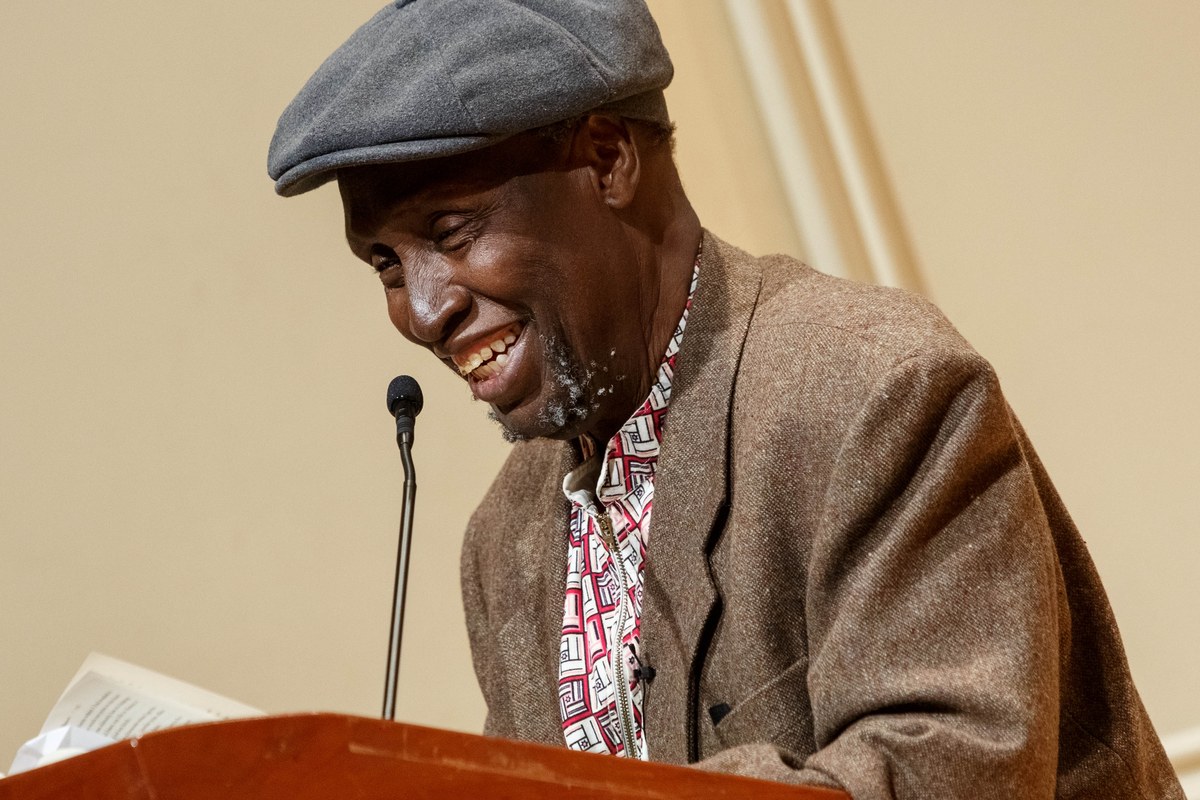

Shawn Miller / Library of Congress, 9 May 2019 (CC0). · Photograph of Ngũgĩ wa Thiong'o reading from his recent work in the Coolidge Auditorium, 9 May 2019, by Shawn Miller for the Library of Congress, posted on the Flickr account 'Library of Congress Life', whose photo page states the Public Domain Dedication (CC0) licence; Wikimedia Commons file 'Ngũgĩ wa Thiong'o 2019 (48139052733).jpg', reviewed against Flickr on 1 September 2019. Original 3600 x 2400, downscaled only, to 1200 x 800. · CC0 1.0 Universal Public Domain Dedication
작가 · 20세기
응구기 와 시옹오
1938–2025
주요 업적 분야
아직 성격 매칭에 포함되지 않았습니다 — 기록된 근거가 성격 모델 전체를 다루기에는 충분하지 않습니다. 이 페이지의 다른 모든 내용은 자유롭게 확인하실 수 있습니다.
핵심 특성
주요 업적
케냐의 소설가로, 『울지 마라, 아이야』(1964)는 브리태니커가 동아프리카 작가의 영어 장편으로는 첫 주요 작품이라 평가했으며, 이어 『한 톨의 밀알』, 『피의 꽃잎』, 2004년 『까마귀의 마법사』를 발표했다.
1986년 『정신의 탈식민화』에서 아프리카 언어 문학을 주장했고, 이후 『십자가 위의 악마』와 『마티가리』 등을 기쿠유어로 썼다. 이는 영어를 현실적으로 옹호한 치누아 아체베와의 논쟁 구도로 자주 논의된다.
그의 저작은 장편소설 8편, 희곡 5편, 회고록 5권, 논픽션 11권에 이르며, 이후 캘리포니아대학 어바인에서 영어 및 비교문학 석좌교수를 지냈다.
삶의 장면들
세 번째 소설 『한 톨의 밀알』에서 그는 직선적 줄거리를 버리고 서로 다른 시간과 장소에서 펼쳐지는 여러 서사선과 시점을 도입했다. 응구기 와 시옹오 재단은 이를 그의 형식적 방향의 전환점으로 설명한다.
이는 이전의 성공을 반복하기보다 서사 형식을 새로 다듬는 작가의 면모와 부합한다. 창의적 독창성
리즈대학은 그가 1976년 카미리이투 공동체와 함께 기쿠유어 연극을 만들었다고 기록하며, 브리태니커는 미케레 기타에 무고, 응구기 와 미리와 공동 집필한 희곡들을 열거한다.
이는 다른 작가들과 지역 공동체와 함께 연극을 만든 작가의 면모와 부합한다. 협업 성향
전환점
1980년 『십자가 위의 악마』부터 그는 소설을 영어가 아니라 먼저 기쿠유어로 썼고, 『정신의 탈식민화』에서 아프리카 문학은 아프리카 언어로 쓰여야 한다고 주장했다.
이는 자신의 신념을 실천하기 위해 큰 영어 독자층을 포기할 수 있었던 작가의 면모와 부합한다. 독립적 사고
비슷한 인물
전체적인 프로필이 이 사람과 닮은 사람들이에요.
출처
- Ngũgĩ wa Thiong'o (Q302910) -- verified live via the Wikidata API (2026-10-26): English label "Ngũgĩ wa Thiong'o", description 'Kenyan writer (1938-2025)', Korean label '응구기 와 시옹오', born 1938-01-05, died 2025-05-28, citizenship Kenya, P18 image 'Ngũgĩ wa Thiong'o 2019 (48139052733).jpg'. Orientation only; not used as support for any row.
- Encyclopaedia Britannica, 'Ngugi wa Thiong'o' (biography entry), read in full. CANONICAL SIGNIFICANCE SOURCE: his education at Makerere and Leeds, Weep Not, Child (1964) as the first major novel in English by an East African, A Grain of Wheat (1967), Petals of Blood (1977), Devil on the Cross (1980) in Kikuyu, Wizard of the Crow (2004), the plays co-written with Micere Githae Mugo and Ngugi wa Mirii, the essay collections including Decolonising the Mind (1986) arguing for African-language literature, and the memoirs. Reference biography: authoritative on works and chronology; the detention and exile passages were read but are political context and not scored.
- Hillel Italie, Associated Press, 'Ngũgĩ wa Thiong'o, Kenyan dissident and author who was giant of global literature, dies at 87' (PBS NewsHour, 28 May 2025), read in full: the obituary frames his novels, memoirs and the critique Decolonizing the Mind, his place as a perennial Nobel candidate, the 2009 Booker shortlist, the 2012 National Book Critics Circle finalist and the 2016 Pak Kyong-ni Literature Award, and a photo caption stating that Wizard of the Crow took more than six years to write. Wire-service obituary; admiring in tone.
- University of Leeds, Faculty of Arts, Humanities and Cultures, 'Commemorating Leeds alumnus Ngũgĩ wa Thiong'o' (30 May 2025, by Brendon Nicholls), read in full: he wrote A Grain of Wheat while a Leeds student, produced eight novels, three short story collections, four children's books, five memoirs, eleven non-fiction books and five plays, championed writing in African languages and multi-centred translation, increasingly foregrounded Gikuyu oral literature, story, proverbs and song, and held a distinguished professorship at the University of California, Irvine. University obituary by a scholar; admiring, and the university awarded him an honorary doctorate in 2004.
- Ngũgĩ wa Thiong'o Foundation, 'Bio' (advocacy organisation for African languages bearing his name), read in full: his schooling, the 1962 Black Hermit performance, the shift in form with A Grain of Wheat, his work at the University of Nairobi and the jointly authored 'On the Abolition of the English Department', his Gikuyu novels, his academic posts at Yale, New York University and the University of California Irvine, his editing of the journals Penpoint, Zuka, Ghala and Mutiiri, and his lectures. AFFILIATED SOURCE: written for the foundation he is associated with, so used for chronology and activities and not as sole support for any row; the account of threats against him was read and not used.
- Lucy Gasser, 'Post/colonial English: The language of African literature?' (poco.lit., 19 February 2021), read in full: a scholar's essay setting Ngũgĩ's Decolonising the Mind position against Chinua Achebe's pragmatic defence of English as a literary medium, the 1962 Makerere conference, the question of audience and publication reach, and the observation that English-language writing is more likely to reach a wide audience. INDEPENDENT SCHOLARLY COUNTER-VOICE: sympathetic to his arguments but presents the opposing Achebe position and the audience trade-off.
- Rohit Inani, 'Language Is a War Zone: A Conversation with Ngũgĩ wa Thiong'o' (The Nation, 2018), read in full: his own account of writing for Gikuyu readers, why he held that English writing reaches people only by trickle-down, his remarks that he likes Naipaul's novels and respects Achebe's contribution while disagreeing that writing in English advances African languages. SELF MATERIAL (interview): used only as corroboration alongside non-self sources, never as sole support for any row.
- Wikimedia Commons file page for the 9 May 2019 photograph by Shawn Miller of the Library of Congress (Flickr account 'Library of Congress Life'), and the live Flickr photo page, checked for the portrait only.