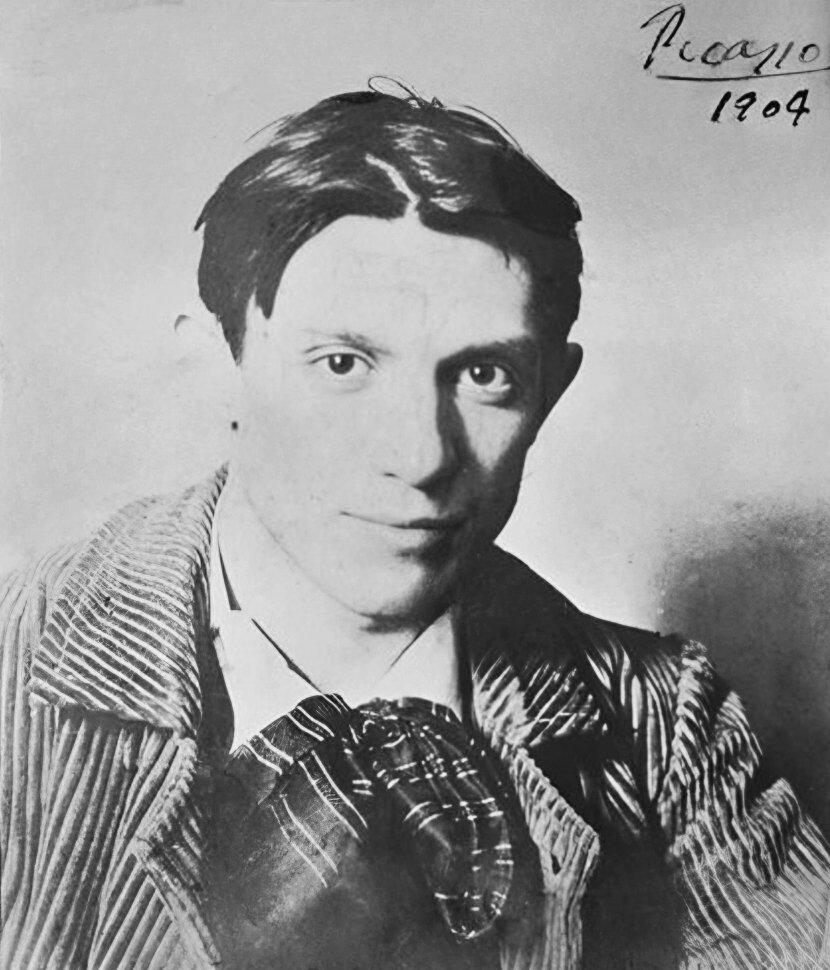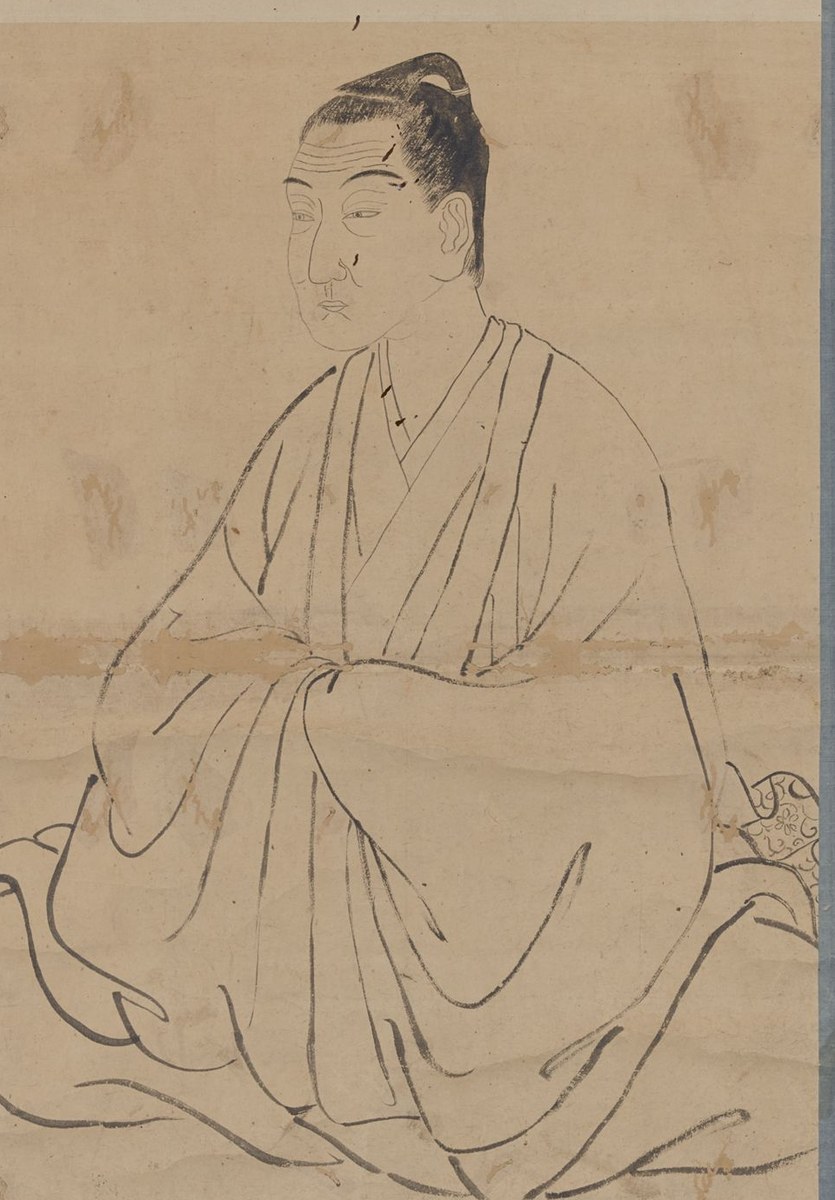

Anonymous copy after Motoori Norinaga's self-portrait, ink on paper, catalogued 1830; photograph courtesy of the Kyoto University Museum, Kyoto University, Rare Materials Digital Archive RB00033904 (cropped and resized) · Ink-on-paper hanging scroll titled 'Portrait of Motoori Norinaga', a later copy after his own self-portrait made at the age of 61 (the original is an Important Cultural Property at the Motoori Norinaga Memorial Museum in Mie); catalogued by the Kyoto University Museum as dated 1830 with an 1854 colophon, 86.5 x 35.1 cm, record RB00033904, in the Portraits of Japan collection of the Kyoto University Rare Materials Digital Archive. The catalogue note, based on the colophon, says the copy was made by Norinaga's son Haruniwa for a visitor from Mutsu and added a poem. The file is a crop of the portrait figure from the archive's 2000-pixel-wide scan of the whole scroll (6678 x 8912 master), cropped to the painted figure and downscaled to 835 x 1200 with no upscaling; the scroll mount, colour card and ruler are cropped out. · Free reuse with attribution under the Kyoto University Library Network terms (copy, adapt or redistribute in any medium without application or fee, with the holding museum named, changes indicated and a link back); not a Creative Commons licence. The work is far beyond copyright age.
학자 · 근세
모토오리 노리나가
1730–1801
주요 업적 분야
아직 성격 매칭에 포함되지 않았습니다 — 기록된 근거가 성격 모델 전체를 다루기에는 충분하지 않습니다. 이 페이지의 다른 모든 내용은 자유롭게 확인하실 수 있습니다.
핵심 특성
주요 업적
그는 일본에서 가장 오래된 역사서 《고사기》의 주석서 《고사기전》을 약 35년에 걸쳐 1798년에 완성했다. 브리태니커는 그의 《고사기》 연구가 근대 신도 부흥의 이론적 토대가 되었다고 설명한다.
그는 일본 문학의 핵심이 사물의 애수에 마음이 움직이는 '모노노아와레'에 있다고 보았고, 1758년부터 《겐지 이야기》 강의를 통해 이를 근거로 이 작품을 옹호했다.
마쓰사카에서 의사로 일하며 그는 학원 스즈노야를 이끌어 전국에서 제자를 모았고 기이번과 교토에서 강의했으며, 제자들은 《고사기전》의 출판 비용과 인쇄를 도왔다.
삶의 장면들
그는 《고사기전》 원고의 각 단계를 믿을 만한 제자와 동료들에게 돌려 보았고, 한 제자가 출판 비용을 대고 다른 제자들이 판목을 새기고 인쇄한 간행본은 노리나가와 스즈노야 학원의 공동 작업의 산물로 설명된다.
이는 제자들과의 공동 노력으로 대표 저작을 만들어 낸 학자의 모습과 일치한다. 협업 성향
1783년부터 학자 우에다 아키나리가 그의 《고사기》 해석을 무모하고 지나치게 문자 그대로라고 비판했고, 노리나가는 하나하나 반박했으며 한 학생 논문에 따르면 끝내 자기 입장을 철회하지 않았다.
이는 저명한 비판자에 맞서 자신의 입장을 지킨 학자의 모습과 일치한다. 독립적 사고
전환점
1763년 그는 마쓰사카의 여관에서 학자 가모노 마부치를 만나 이듬해 제자가 되었고, 그때부터 평생 《고사기》 연구에 몰두했다.
이는 시학과 《겐지》 연구에서 수십 년에 걸친 하나의 과업으로 옮겨 간 전환과 일치한다. 끈기
비슷한 인물
전체적인 프로필이 이 사람과 닮은 사람들이에요.
출처
- Motoori Norinaga (Q384647), verified live via the Wikidata API (2026-11-01): label 'Motoori Norinaga', description 'Japanese scholar and philosopher (1730-1801)', born 1730-06-21, died 1801-10-05, citizenship Japan, Korean label 모토오리 노리나가, image the self-portrait file. Orientation only; not used as support for any row.
- Encyclopaedia Britannica, 'Motoori Norinaga' (full article read, about 300 words). CANONICAL SIGNIFICANCE SOURCE: the most eminent scholar of Shinto and the Japanese classics; son of a textile merchant who died when he was 11, he studied medicine in Kyoto at his mother's encouragement and became a physician; influenced by the National Learning (Kokugaku) movement, he applied careful philological methods to the Kojiki, the Tale of Genji and other classics and stressed mono no aware as the central concept of Japanese literature; his study of the Kojiki gave the theoretical foundation of the modern Shinto revival; his commentary on the Kojiki, the Kojiki-den (given there as 49 volumes), was completed in 1798 after 35 years of effort. Reference work; the praise is retrospective.
- Mori Mizue, 'Motoori Norinaga', Encyclopedia of Shinto, Kokugakuin University Digital Museum, read in full (about 900 words): born 1730 in Matsusaka to a cotton-wholesaling family; unsuited to commerce, he was sent by his mother to Kyoto in 1752, where he studied Chinese classics and medicine for five years and met the work of the scholar-monk Keichu; on his return he opened a pediatric practice and led local poetry circles; lectures on the Tale of Genji from 1758 produced his position on mono no aware; he met Kamo no Mabuchi in 1763 and became his disciple by correspondence; while writing the Kojiki-den he advanced research on conjugations and the pronunciation of kanji; his academy, the Suzunoya, became influential and he travelled to lecture, including as a special lecturer to the Kii domain from 1792 and in Kyoto in 1801; manuscripts and library now at the Norinaga Kinenkan. Scholarly institutional reference by a specialist; admiring in tone.
- 'Kojikiden' (Exegesis of the Kojiki), Encyclopedia of Shinto, Kokugakuin University Digital Museum, read in full (about 600 words): completed 1798, first five fascicles printed in 1790 and the whole in 1822; he bought a copy of the Kojiki while studying in Kyoto in 1756 when the text was far less studied than the Nihon shoki; his basic stance was fixed by 1771 but the study took over thirty years, since he aimed to make the episodes reproducible as concrete events; he used inductive reasoning and attended to colloquialisms and dialects; he circulated each stage of the manuscript among trusted disciples; a disciple funded the printing and his son and another disciple cut and printed the blocks, so the printed edition is described as a product of the collaboration of Norinaga and his Suzunoya Academy; fascicle one outlines his method and appends the Naobi no mitama, which argues the superiority of the Japanese classics over Chinese texts. Scholarly institutional reference by a specialist.
- Motoori Norinaga Memorial Museum (Matsusaka), 'About Norinaga' (English page), read in full (about 900 words): a medical doctor and classical scholar who practised medicine in Matsusaka all his life while dedicating himself to the study of the Japanese classics; says he never blindly accepted the work of predecessors but went back to first principles; explains mono no aware against the Confucian view of emotions and his defence of the Tale of Genji; tells of the 1763 night-long meeting with Kamo no Mabuchi and of 34 years of study on the Kojiki, with the 44-volume Kojiki-den finished in June 1798 and its printing still in progress at his death. The museum holds his manuscripts, so the page is a self-interested, admiring institutional source; used for plain facts and cross-checked against the Encyclopedia of Shinto.
- Meghan McLaughlin, 'An Intellectual Debate: Ueda Akinari and Motoori Norinaga', Wittenberg University East Asian Studies Journal 38 (Spring 2013), read in full (14 pages): an undergraduate-journal paper that draws mainly on Burns, Young, Matsumoto and Shirane. Gives Norinaga's background and view of mono no aware and the Kojiki, and describes the dispute with the scholar-writer Ueda Akinari, who from 1783 criticised Norinaga's reading of the Kojiki: Akinari thought the Kojiki partly legend, said the language did not decay as Norinaga claimed, called his claims of Japan's superiority cultural chauvinism, and wrote that he 'recklessly' interprets the things of old; Norinaga rebutted and, per the paper, never withdrew his positions. The counter-voice source; secondary and student-level, so used only for the existence and substance of the dispute.