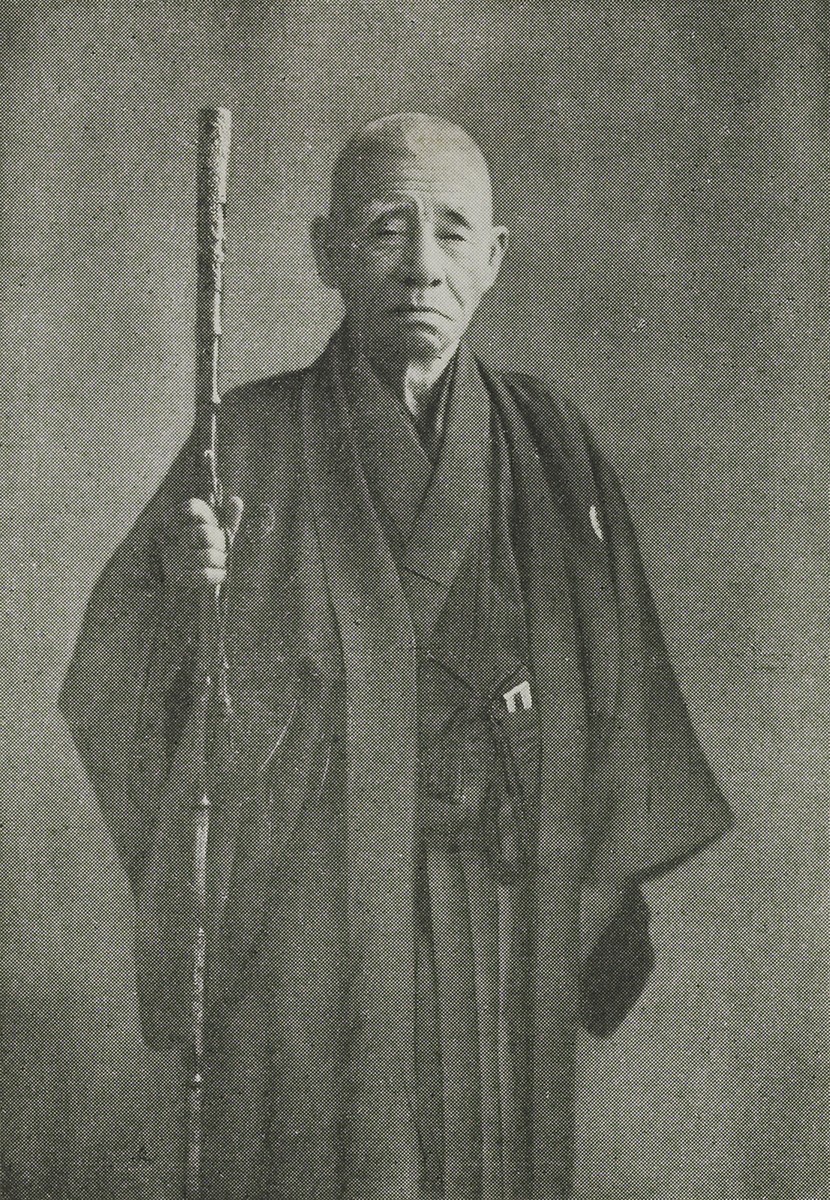
Photographer unknown, published 1953 in Otodake Iwazo, Mikimoto Kokichi; reproduced by the National Diet Library, Japan, Portraits of Modern Japanese Historical Figures. · Photographic portrait of Mikimoto Kokichi as an old man, photographer unknown, reproduced as the first image on the National Diet Library's online exhibition 'Portraits of Modern Japanese Historical Figures' (entry 396). The exhibition's data identifies the image as taken from the digitised NDL book with persistent ID 2974878, Otodake Iwazo, 'Mikimoto Kokichi' (Seinen Series no. 4, Shakai Kyoiku Kyokai, Tokyo, 1953), which the NDL catalogue lists as published in 1953 with plates; so the photograph was published in Japan in 1953, before 1956. The Library's usage notice says every portrait image in the exhibition is one whose copyright term has expired and may be reused without application, including commercially. The photograph's own date and photographer are not stated. Original 1024 x 1480 pixels, downscaled to 830 x 1200 with no cropping and no upscaling. · Public domain (copyright term expired; National Diet Library usage notice)
사업가 · 19세기
미키모토 고키치
1858–1954
주요 업적 분야
아직 성격 매칭에 포함되지 않았습니다 — 기록된 근거가 성격 모델 전체를 다루기에는 충분하지 않습니다. 이 페이지의 다른 모든 내용은 자유롭게 확인하실 수 있습니다.
핵심 특성
주요 업적
그는 일본 양식진주 산업의 토대를 세웠다. 1892년 첫 굴을 잃은 뒤 1893년 반원 양식진주에 성공했고, 1899년 양식진주 장신구를 팔기 시작했으며 1919년부터 런던에서 구형 양식진주를 팔았다.
구형 진주 기법 자체는 1907년 특허를 낸 니시카와 도키치와 미세 다쓰헤이의 공으로 여겨진다. 미키모토는 1908년 자신의 이식법으로 특허를 냈고 1916년부터 미세-니시카와 방식을 사용해 사업화했다.
그의 양식진주가 유럽에 들어오자 가짜라는 공격을 받았으나 1924년 프랑스 법원은 양식진주가 천연진주와 다르지 않다고 판결했고, 그의 생산으로 진주는 값이 내렸다.
삶의 장면들
PBS에 따르면 그는 유리, 납, 점토, 나무 등 여러 핵 재료를 시험했고 미국산 민물 조개껍데기로 만든 둥근 핵이 가장 성공률이 높다는 것을 발견했다.
이는 기술적 문제를 시행착오로 풀어 가는 방식과 일치하는 것으로 보인다. 실험 성향
1892년 11월 적조로 아고만의 실험용 굴이 모두 죽었지만, 1893년 도바만의 다른 실험장에서 반원 진주를 얻었다.
이는 큰 좌절 뒤에도 계속 나아가는 끈기와 일치하는 것으로 보인다. 끈기
전환점
1893년의 성공 뒤 그는 본격적인 진주 양식 사업 계획을 세우고 1899년 양식진주 장신구 판매를 시작하며 도쿄에 가게를 열어 실험을 시장으로 바꾸었다.
이는 기술적 성과를 누가 시키지 않아도 사업으로 전환하는 경향과 일치하는 것으로 보인다. 선제적 행동력
비슷한 인물
전체적인 프로필이 이 사람과 닮은 사람들이에요.
출처
- Mikimoto Kokichi (Q956283), verified live via the Wikidata API (2026-10-30): label 'Mikimoto Kokichi', description 'Japanese businessman (1858-1954)', born 1858 (two birth dates are recorded, 25 January and 10 March, the second being the Gregorian conversion), died 21 September 1954, citizenship Japan, Korean label present, P18 image 'MIKIMOTO Kokichi.jpg'. Orientation only; not used as support for any row.
- Kiyohito Nagai, 'A History of the Cultured Pearl Industry', Zoological Science (Zoological Society of Japan, 2013), hosted by the Japan Pearl Promotion Society, read in full (about 20 pages, via pdftotext): CANONICAL SIGNIFICANCE SOURCE. Mikimoto's 1892 red-tide loss and 1893 hemispherical-pearl success, his meeting with Professor Mitsukuri, the start of sales in 1899, the 1907 Nishikawa and Mise patent applications, Mikimoto's agreement with Nishikawa, the sale of spherical pearls in London from 1919, the 'Paris trial' and the 1924 French ruling, and the 1978 claim by C. Denis George that Saville-Kent anticipated the technique. A peer-reviewed historical review by a Japanese pearl scientist; it is sympathetic to the Japanese industry and gives Mikimoto a central place, while crediting Nishikawa and Mise with the piece and injection methods.
- PBS NOVA, 'The History of Pearls' (pbs.org), read in the cultured-pearl section: Mikimoto as the noodle maker's son with a hard-working wife Ume, his 1896 and 1908 patents, the independent discoveries by Nishikawa and Mise, the 1916 patent altered so that he could use their method, his purchase of rights to it, the claim that his expansion eclipsed the originators, and his trial-and-error tests of nucleus materials. A popular science article of uncertain authorship; it states that he 'single-handedly launched' the industry in one place and credits others in another, so it is used with that tension noted.
- Gemological Institute of America, 'History of Cultured Pearls - Part 1' (4cs.gia.edu, 30 June 2014), read in full: the three Japanese men credited with the cultured pearl (Nishikawa, Mise and Mikimoto), Mise's 1902 trials and 1907 patent, Mikimoto's January 1908 patent for his own implantation process, his 1912 South Sea experiments, his 1916 adoption of the Mise-Nishikawa method and the 1921 market arrival of round cultured pearls. Gemological institute blog; dates differ slightly from Nagai (1919 versus 1921 for the first sales).
- Museum of Archaeology and Anthropology, University of Cambridge, photograph record N.121258.HNL (collections.maa.cam.ac.uk), read in full: James Hornell's glass-negative photograph of Mikimoto and Nishikawa on Tatoku Island on 16 July 1907, Hornell's diary comment on the farm's order and prosperity, and curators' notes on Mikimoto (often cited as founder of the first cultured pearl industry), Nishikawa's 1907 piece-method patent (granted 1917), his marriage to Mikimoto's second daughter and his death in 1909. Museum catalogue entry by archive staff; it quotes Eunson's 1956 biography, which was not opened.
- National Diet Library, Japan, 'Portraits of Modern Japanese Historical Figures': entry for Mikimoto Kokichi (ndl.go.jp/portrait/datas/396), read in full: a short biographical note by Library staff (born 1858, died 1954; started pearl-oyster culture in 1890, succeeded with hemispherical pearls in 1893 under Mitsukuri's circle, opened his Tokyo shop in 1899, the round-pearl method invented by Nishikawa and others with his patent in 1908, overseas shops, member of the House of Peers from 1938). Also the source of the portrait file. Not used for scoring beyond corroboration.