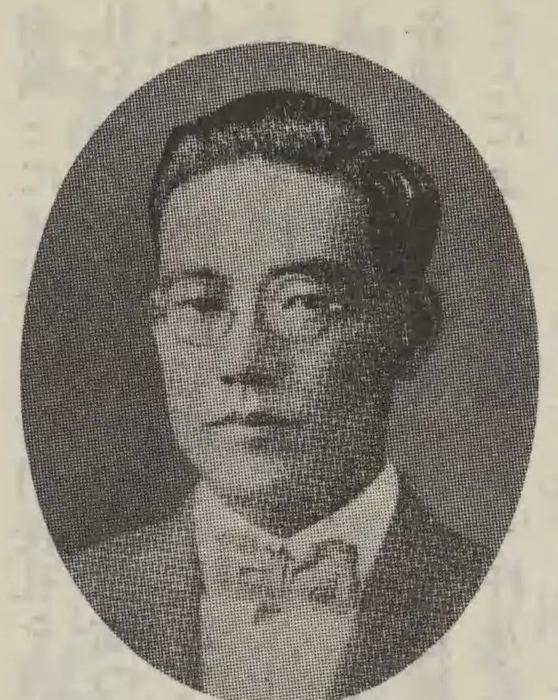

Photographer unknown, published 1937 in Osaka Hatsumei Kyokai (ed.), Teikoku hatsumeika meikan. Source: National Diet Library Digital Collections, Japan (https://dl.ndl.go.jp/pid/1207646) · Portrait photograph of Kiichiro Toyoda, photographer unknown, published in Teikoku hatsumeika meikan (Directory of Inventors of the Empire), edited by the Osaka Inventors' Association (Osaka Hatsumei Kyokai) and published by Nikkan Kogyo Shimbun Shuppanbu, Osaka, 1937, page 312 (NDL Digital Collections pid 1207646), where the oval photograph is captioned with his name above the entry for his shuttle-change automatic loom patent. The file is the oval photograph cropped from the library's 4496 x 4560 pixel page image, with no resampling or upscaling; it is a halftone book reproduction, so the grain is that of the print. · Public domain (National Diet Library Digital Collections record for this book carries the Public Domain Mark; the photograph was published in Japan in 1937)
공학자 · 20세기
토요다 기이치로
1894–1952
주요 업적 분야
아직 성격 매칭에 포함되지 않았습니다 — 기록된 근거가 성격 모델 전체를 다루기에는 충분하지 않습니다. 이 페이지의 다른 모든 내용은 자유롭게 확인하실 수 있습니다.
핵심 특성
주요 업적
일본의 엔지니어로, 1933년부터 도요타 자동직기 제작소의 자동차 부문을 이끌며 1935년 A1형 승용차 시제품을 완성했고, 1937년 이를 도요타 자동차 주식회사로 분사해 1938년 고로모 공장을 준공하면서 도요타의 자동차 사업을 일으켰다.
아버지 사키치의 연구를 토대로 팀과 함께 G형 자동직기의 핵심인 북 교환식 자동직기를 발명했으며(1925년 그의 명의로 특허 등록), 1929년 영국 플랫 브러더스가 일본·중국·미국을 제외한 지역의 특허권을 가져갔다. 역사학자 와다 가즈오는 이 대금이 도요타의 자동차 사업 자금이 되었다는 통설을 근거가 없다고 보며, 자동차 사업은 도요다 그룹의 직기 사업 수익으로 조달되었다고 설명한다.
고로모 공장에서 필요한 것을 필요한 때에 필요한 만큼만 만드는 적시 생산(저스트 인 타임)을 제안했다. 도요타의 사사는 이를 도요타 생산 방식에서 적시 생산의 출발점으로 소개하지만, 전시 물자 배급으로 중단되어 1950년대 중반에야 온전히 구현되었다고 밝힌다.
삶의 장면들
1933년 10월 그는 쉐보레 승용차를 분해해 부품을 스케치했고, 1934년 9월 완성된 도요타의 첫 시제품 엔진은 쉐보레 엔진의 60마력에 못 미치는 48~49마력에 그쳤으나 실린더 헤드를 재설계해 65마력에 도달했다.
이는 시제품을 만들고 시험하며 측정 가능한 기준에 맞춰 고쳐 나가며 배우는 엔지니어의 면모와 일치한다. 실험 성향
대공황으로 직기 사업이 타격을 입자 그는 자동차 사업 진출을 밀어붙였고, 사장 리사부로는 자동차 제조를 위험하고 가망 없는 일로 보았지만 이사회는 1933년 자동차 부문 설립을 지지했다.
이는 그룹의 수장이 반대하는 상황에서도 새로운 산업에 그룹의 자원을 거는 것을 마다하지 않는 성향과 일치한다. 위험 감수
전환점
1950년 5월 25일 인원 감축을 포함한 재건안을 둘러싼 두 달간의 노동쟁의 도중 그는 책임을 지고 사임하겠다고 밝혔고 6월 5일 사장직에서 물러났다. 이후 헬리콥터와 새 엔진을 연구하며 1952년 7월 사장 복귀가 내정되어 있었으나 1952년 3월 27일 세상을 떠났다.
이는 책임을 지고 물러나면서도 공학적 과제에 대한 연구를 계속한 창업자의 면모와 일치한다. 끈기
비슷한 인물
전체적인 프로필이 이 사람과 닮은 사람들이에요.


예카테리나 2세

엘리자베스 블랙웰

T. E. 로렌스

무스타파 케말 아타튀르크

체 게바라
출처
- Kiichiro Toyoda (Q358556), verified live via the Wikidata API (2026-11-04): English label 'Kiichirō Toyoda' (with macron), description 'Japanese businessman (1894-1952)', Japanese description 'Japanese businessman, engineer', Korean label 기이치로 토요다, born 11 June 1894, died 27 March 1952, citizenship Japan, occupations businessperson and engineer; Korean Wikipedia article title 토요다 기이치로. Orientation only; not used as support for any row.
- Toyota Motor Corporation, '75 Years of Toyota' (company history), Part 1 Chapter 2, Sections 2-4 and 6-7 (read in full: Establishment of an Automotive Production Division; Prototypes of the A Engine and Model A1; Establishment of a Research Laboratory; Establishment of Toyota Motor Co. and construction of the Koromo Plant; The Origins of Just-in-Time; Reforming and Improving Vehicle Quality). CANONICAL SIGNIFICANCE SOURCE (cross-checked against the two independent scholarly papers below): on 1 September 1933 he established the Automotive Production Division inside Toyoda Automatic Loom Works and began prototypes (a 1933 Chevrolet was taken apart and sketched in October 1933; the first prototype engine ran on 25 September 1934 at 48-49 hp against the Chevrolet's 60 hp and was redesigned to 65 hp; the Model A1 passenger car prototype was completed in May 1935 using many genuine Chevrolet parts); he recruited experienced car engineers; he founded a research laboratory in Shibaura, Tokyo in May 1936; Toyota Motor Co. was registered on 28 August 1937 and the Koromo Plant was completed on 3 November 1938; the history says he proposed just-in-time production when the Koromo Plant opened but that wartime rationing suspended it and the concept was not fully realised until the supermarket method of 1954; it also records early vehicle quality problems, his 1939 statement that low quality vehicles were hard to bear, and its own data suggesting he may have judged himself too harshly. A company history by the firm he founded: authoritative on chronology and documents, admiring in tone, and its just-in-time account rests on his own statements and a 1966 colleague interview.
- Toyota Motor Corporation, '75 Years of Toyota' (company history), Part 1 Chapter 1, Sections 3-4 (read in full: Creating the first automatic loom prototype; Patent Transfer Agreement with Platt; Ring Spinning Frame Development and Automobile Research Starts): after returning from the United States and Europe in 1922 Kiichiro began automatic loom development with Rizo Suzuki and Risaburo Oshima; about 30 looms ran by summer 1923; the March-May 1924 trial of 200 looms at Kariya produced more than ten times the breakdowns of a 20-loom trial but exposed the failings early; new patents for a shuttle-change automatic loom and related devices were filed in his name in November-December 1924 and a shuttle-magazine failsafe in March 1925; the 1929 Platt patent transfer was signed on 21 December 1929 after Kiichiro, instead of selling the patents in the United States himself, left that to a staff member and studied the automotive industry and machine tools (per two colleagues who travelled with him). Same company-history perspective as the other Toyota pages.
- Toyota Motor Corporation, '75 Years of Toyota' (company history), Part 1 Chapter 2, Section 6 Item 6 (Labor Disputes and President Kiichiro's Resignation; read in full) and Section 7 Item 3 (final years, read): after the 1949 Dodge Line recession the company's reconstruction plan required job cuts; the April-June 1950 dispute ended with a memorandum signed on 10 June 1950 (2,146 job losses, 5,994 staff remaining); on 25 May 1950 President Kiichiro Toyoda announced to the dealers' council that he accepted responsibility and would resign, and on 5 June he, the executive vice president and a managing director resigned; afterwards he travelled between Tokyo and Nagoya researching a helicopter and a new gasoline engine (prototype ran August 1951), was set to return as president at the July 1952 shareholders' meeting, and died on 27 March 1952 aged 57; Eiji Toyoda recalls that Risaburo Toyoda had been the most opposed to entering the automobile business and that Kiichiro 'conceived what no one else imagined'. Company perspective only; no union voice.
- Kazuo Wada (University of Tokyo), 'Kiichiro Toyoda and the Birth of the Japanese Automobile Industry: Reconsideration of Toyoda-Platt Agreement' (CIRJE discussion paper F-288, July 2004; later published as 'The fable of the birth of the Japanese automobile industry', Business History 48(1), 2006), read in full from the open PDF (34 pages): independent business-historian account of Kiichiro's 1922 Platt Brothers visit and diary, the invention of the shuttle-change loom (patent 65156, which Wada notes was granted in his name and earned the 1938 Imperial Commemorative Award, the fourth ever given), the 1929 trip and the Platt agreement; it argues the popular story that the agreement's money funded his car research is unsupported (Platt's payment received in 1930 was 250,000 yen, not one million, and appears to have been distributed among Toyoda group employees), that the venture was instead financed by the Toyoda group's loom profits (about 17 million yen invested by Toyoda Automatic Loom Works) and group investors, and that after seeing Platt's decline in December 1929 and January 1930 he set up an automobile research room in May 1930. Independent scholarly voice and the corrective to the legend.
- Anna S. Mostovaia, 'Origins and Development of the Japanese Automotive Industry in 1920-1945: the Case of Toyota Motor Company', Herald of the Russian Academy of Sciences 2023 no. 1, pp. 121-134 (in Russian; read in full from the open PDF): independent scholarly account, drawing on the Wada and Yui biography, that he concluded in 1929 that Toyoda could make cars without foreign partners, urged diversification into automobiles during the Depression against the resistance of company president Risaburo, who thought car making risky and hopeless, won the board's backing for the automotive division in 1933, recruited experienced engineers and university professors, set up his own steelmaking because no suitable supplier existed, and turned down a General Motors partnership; contemporaries rated him a highly capable engineer. Independent and modern; argues state policy created a favourable environment, which is context here and not scored.
- Toyota Commemorative Museum of Industry and Technology, virtual tour pages 'Agreement and Kiichiro's lab notes' and 'The establishment of Toyota Motor Sales and labor disputes', read: his training notes from the card assembly room at Platt Brothers run to 46 pages and informed his later mass-production designs; the Platt agreement of 1929 gave Platt exclusive rights outside Japan, China and the United States for a patent fee of 100,000 pounds; after the 1949 Dodge Line recession and labor disputes Kiichiro resigned as president, a decision to reappoint him had been made informally, and he died suddenly in March 1952. Museum of the Toyota group: institutional and short; used only to corroborate the Platt notes and the resignation and return plan.
- Teikoku hatsumeika meikan (Directory of Inventors of the Empire), edited by the Osaka Inventors' Association (Osaka Hatsumei Kyokai), Nikkan Kogyo Shimbun Shuppanbu, 1937, p. 312, National Diet Library Digital Collections: the entry for Toyoda Kiichiro, captioned with his name and a Nagoya address, describes patent no. 65156 (a shuttle-change automatic loom) and calls him a young inventor and the son of Sakichi Toyoda whose invention astonished the loom industry and did not disgrace his great father's record, adding that he won top prizes at exhibitions. Contemporary 1937 compendium; admiring and brief, read only for this entry and used for the portrait and the identification of the sitter, not for any row.