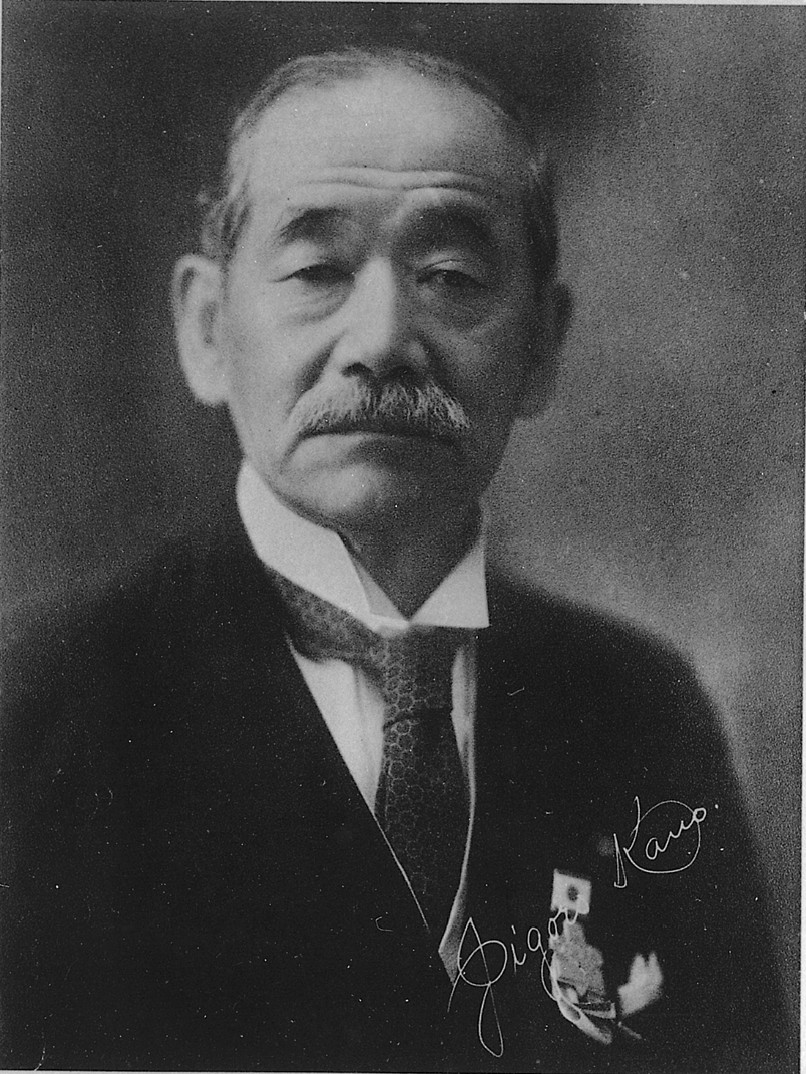

Photographer unknown, published 1941 in Kendo Yokoyama, Kano Sensei Den (Kodokan). Source: Portraits of Modern Japanese Historical Figures, National Diet Library, Japan (https://www.ndl.go.jp/portrait/) · Signed studio portrait photograph of Jigoro Kano, photographer unknown, taken before his death in 1938 and printed as the frontispiece of the biography 'Kano Sensei Den' (Kano Sensei-den) by Kendo Yokoyama (Kodokan, Tokyo, 1941), as reproduced in the National Diet Library's digital exhibition 'Portraits of Modern Japanese Historical Figures' (entry for KANO Jigoro; source item NDL Digital Collections pid 1043572, page 3). The sitter's English signature 'Jigoro Kano' is written on the print and the Library's entry names the sitter. The file is the library's published image (875 x 1146 pixels) with its white page border trimmed (806 x 1074), with no upscaling; it is a halftone book reproduction, so the grain is that of the print. · Public domain (declared by the National Diet Library for all images in 'Portraits of Modern Japanese Historical Figures'; the source book's NDL Digital Collections record shows access restriction 'PDM'; the photograph was published in Japan in 1941, before 1957)
교사 · 19세기
가노 지고로
1860–1938
주요 업적 분야
아직 성격 매칭에 포함되지 않았습니다 — 기록된 근거가 성격 모델 전체를 다루기에는 충분하지 않습니다. 이 페이지의 다른 모든 내용은 자유롭게 확인하실 수 있습니다.
핵심 특성
주요 업적
교육자로서 유도를 창시했다. 1882년 고도칸을 열어 덴진신요류와 기토류 유술에서 유도를 끌어내고, 힘의 최대 효율적 사용과 자타공영의 원칙 위에 세웠으며, 이후 띠와 단위 제도를 도입했다. 유도는 1964년 올림픽 종목이 되었다.
도쿄 사범학교(도쿄고등사범학교, 현 쓰쿠바대학의 전신)의 교장을 20년 넘게 지내며 스포츠를 장려하고 1915년 체육과를 설치했으며, 중국인 유학생을 위한 학교도 세웠다.
국제올림픽위원회(IOC)의 첫 아시아인 위원(1909~1938)이었고, 1912년 스톡홀름 올림픽 무렵 설립된 대일본체육협회를 이끌어 일본 최초의 올림픽 선수단을 보냈으며, 1940년 올림픽의 도쿄 유치를 도왔다.
삶의 장면들
1971년의 한 전기 에세이에 따르면, 가노는 훨씬 몸집이 큰 상대에게 진 뒤 스모 책을 연구해 새 기술인 가타구루마를 만들었고 이를 써서 이겼다.
이는 패배에 외부 자료를 연구해 기술을 개선하는 것으로 응한 사람의 면모와 일치한다. 숙련 지향
마라톤 선수 가나쿠리 시조가 1912년 스톡홀름 올림픽 여비를 마련하지 못하자, 가노는 학교에 후원회를 만들어 그가 갈 수 있을 만큼의 돈을 모았다.
이는 참가 사업을 성사시키려 실질적 후원을 조직한 사람의 면모와 일치한다. 주도 성향
전환점
1882년, 약 22세에 그는 몇 안 되는 제자와 함께 자신의 도장인 고도칸을 열어 유술 수련생에서 새 유파의 창시자이자 스승으로 옮겨 갔다.
이는 여러 유파를 공부한 오랜 수련을 자신의 기관으로 바꾼 사람의 면모와 일치한다. 창의적 독창성
비슷한 인물
전체적인 프로필이 이 사람과 닮은 사람들이에요.
출처
- Kano Jigoro (Q190141), verified live via the Wikidata API (2026-11-05): English label 'Kanō Jigorō', description 'Japanese educator and judoka (1860-1938)', Korean label 가노 지고로, born 10 December 1860, died 4 May 1938, citizenship Japan. Orientation only; not used as support for any row.
- International Judo Federation, Hall of Fame entry 'Jigoro Kano' (read in full). CANONICAL SIGNIFICANCE SOURCE: an educator who founded judo; 1882 Kodokan, Kano Juku and an English school and teaching at Gakushuin; principal of the Secondary Teacher's School in Tokyo from 1893; school for Chinese students; 1909 first Asian IOC member; 1911 first president of the Japan Amateur Athletic Association; Japan's first Olympics at Stockholm in 1912; attended the 1928, 1932 and 1936 Games; judo on the Olympic programme in 1964; died at sea in 1938; his judo definition 'the way of the highest or most efficient use of both physical and mental energy' and a three-part view of education (knowledge, morality, physical training). Governing body's hall of fame; admiring in tone and internally inconsistent on his age at death and the length of the principalship.
- University of Tsukuba, 'Dr. Kano Jigoro' history page (read in full): 23 years as principal of the Higher Normal School and Tokyo Higher Normal School (forerunners of the university); replaced military-style discipline with a more open campus and extracurricular activities; lengthened teacher training; 1915 Department of Physical Education; judo developed from jujutsu with the principles seiryoku-zenyo and jita-kyoei; invited overseas students; first Asian IOC member; took two runners to Stockholm in 1912; founded the Japan Sports Association in 1911. University history of its own predecessor, celebratory, with few dates and unsourced 'first' claims that are not repeated here (the student totals and the notable-alumni list are not used).
- Olympedia, biography of Jigoro Kano (read in full): founded the Kodokan in June 1882, later introduced the belt and dan ranking system; taught at Komaba Agricultural College, principal of Gakushuin in 1885, Ministry of Education from 1891 and director of primary education in 1898; founded the Japan Amateur Athletic Association; IOC member 1909-1938 and Japanese Olympic Committee president 1911-1921; helped organise the 1917 Far Eastern Games; instrumental in having the 1940 Games awarded to Tokyo; died at sea in 1938. Olympic-history database; factual and brief, no behavioural narrative, and its birth date (18 October 1860) differs from other sources.
- Japanese Olympic Committee, history page on Kano Jigoro (read in full): promoted swimming, long-distance running, tennis, football and judo at Tokyo Higher Normal School; welcomed Chinese students from 1896; became the first Japanese IOC member in 1909 after hearing of the Olympic ideal from the French ambassador; on 7 October 1911 issued the letter of intent for the Japan Amateur Sports Association and a Stockholm qualifying event; chose Mishima and Kanaguri for Stockholm and, because Kanaguri could not afford the trip, set up a support association at the school that raised enough; rarely missed an IOC meeting or Games. Committee's own history; institutional and admiring.
- Nippon Foundation, 'Stories from Past Olympics and Paralympics 4: How Jigoro Kano's thinking changed the world' (9 February 2021; read in full): 1909 IOC member recommended by Coubertin; principal of Tokyo Higher Normal School from 1893 introducing swimming and long-distance running for all students; Kobun Gakuin for Chinese students; judo from Tenjin Shin'yo-ryu and Kito-ryu; principles seiryoku-zenyo and jita-kyoei; episodes about Lafcadio Hearn and a Russian sailor (anecdotal, not used) and the 1964 final. Foundation feature, promotional, partly unsourced; the page itself does not discuss any criticism.
- Andy Adams, biographical essay on Jigoro Kano excerpted from '20th Century Warriors' (Ohara Publications, 1971) and published by Judo BC (read in full): early jujutsu training under Fukuda, Iso and Iikubo; training alone when no one else came; a loss to a heavier rival and the technique he developed in response; opening the Kodokan in February 1882 with nine students at Eisho-ji, where early practice was 'more jujutsu than judo'; his aim to reform jujutsu on scientific principles; described as a perfectionist, disciplinarian and traditionalist as well as an innovator and internationalist. Popular 1971 biography, admiring; the passages on his family routines are not used.
- Mike Callan, 'Development of Judo Research: The History of the Scientific Method', The Arts and Sciences of Judo 1(1), 2021 (University of Hertfordshire repository record; abstract and metadata read, the PDF itself not opened): says Kano studied styles of jujutsu and collected jujutsu literature, engaging in discussion, exchange of texts and oral teachings followed by reflection and analysis, and that Kodokan journals and, from 1922, regional research divisions followed. Peer-reviewed historian's overview; abstract only.
- Kosuke Nagaki, 'Jigoro Kano's pursuit of Judo as a martial art' (Japan Journal of Sport Anthropology, 2009; J-STAGE abstract read, full text not opened): argues, as a hypothesis, that in the Meiji era judo was taught as jujutsu for mass education, and that from the late Taisho era Kano set up a research institute of martial arts, resumed study of practical jujutsu, answered questions on 'judo as a martial art' and kept the link to jujutsu to distinguish judo from Western sports. Scholarly counterweight to the promotional accounts; abstract only and explicitly hypothetical.
- National Diet Library, 'Portraits of Modern Japanese Historical Figures', entry for KANO Jigoro (page opened; the biographical note is by Library staff): graduated from the University of Tokyo in 1881; professor at Gakushuin, principal of the First Higher Middle School and of the Tokyo Higher Normal School; established judo by integrating and improving schools of jujutsu; founded the Kodokan in 1882 and served as its head; promoted physical education and sport, member of the IOC, founded the Japan Amateur Sports Association and campaigned for the Olympics in Japan. Library's own biographical note.