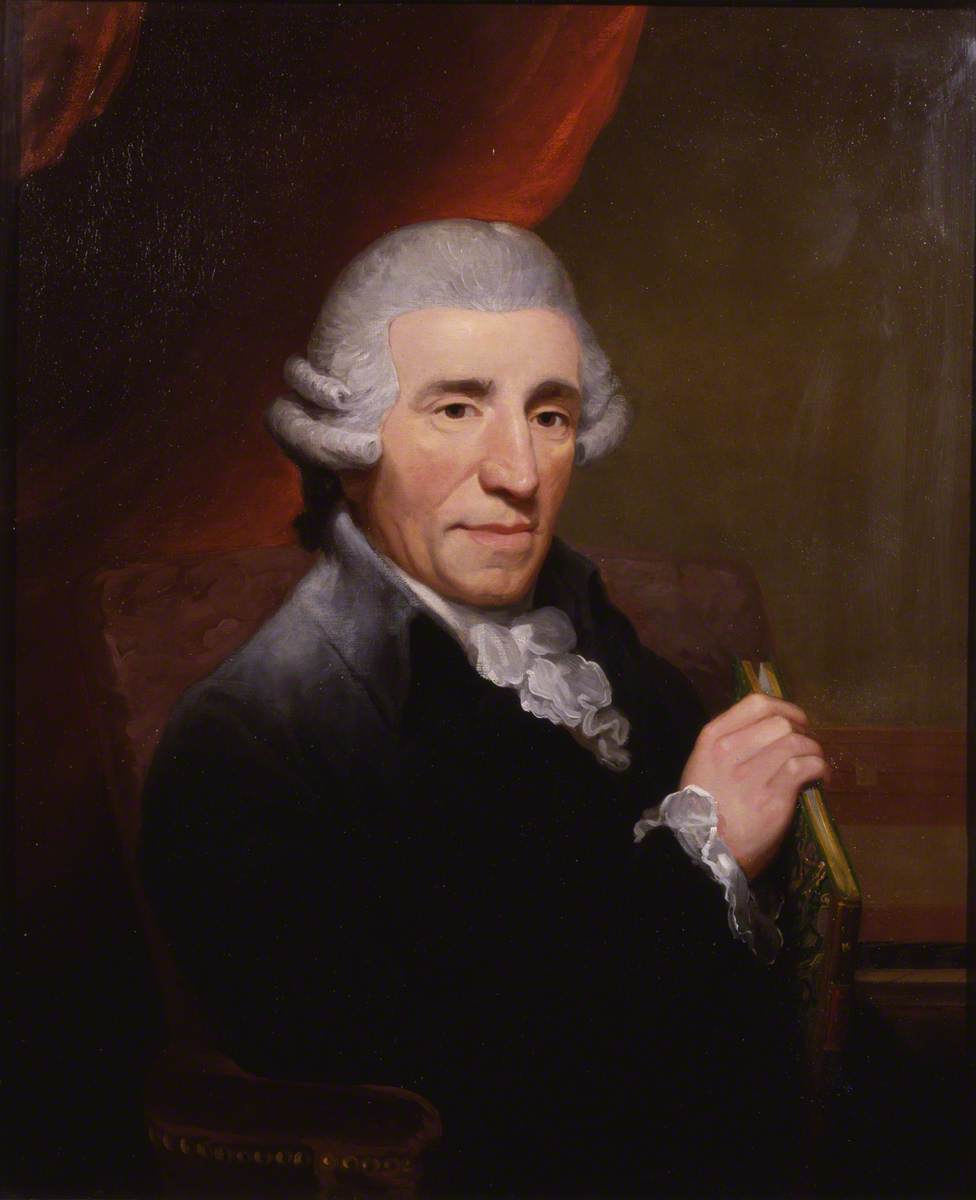

Thomas Hardy, 1791, Royal College of Music, London, public domain · Wikimedia Commons, 'Thomas Hardy (1757-1804) - Joseph Haydn (1732-1809) - PPHC000001 - Royal College of Music.jpg' -- Thomas Hardy, oil on canvas, 1791, Royal College of Music, London (PPHC000001, gift of Arthur F. Hill 1933); a contemporaneous portrait made in London during Haydn's first visit (Art UK and Google Arts & Culture, both naming the Royal College of Music; probably commissioned by the publisher John Bland). Neither source states explicitly that Haydn sat for it, so 'painted from life' is an inference from the date, place and commission, and the kind 'likeness' rests on this being a contemporary portrait by a working London portraitist. Commons file uploaded 6 May 2025 by BotMultichillT from the Royal College of Music's own image server (WMRII_RCMU_PPHC000001-001.jpg), 976 x 1200 pixels, 84,494 bytes (SHA-1 of the download 72fb5810ff478a87b9eb38215f724805d12af751); stored unchanged, never resized or upscaled. Rights basis: the painting dates from 1791 and Hardy died in 1804, so it is out of copyright everywhere relevant; the file is a faithful photographic reproduction of a flat work (Commons PD-Art, PD-old-auto-expired, deathyear 1804, which matches Art UK's 1757-1804). Caveats recorded honestly: (1) Art UK's page carries its generic 'how you can use this image' notice (non-commercial research or private study under UK exceptions, other uses to be cleared with the rights holders) and credits the image to the Royal College of Music; this is boilerplate guidance and does not claim copyright in the painting, but it is a conflicting institutional statement about the photograph that the lead should weigh; (2) two other Commons files of the same painting carry PD-Art tags with wrong death years (1928, 1805) and were not used; (3) the Commons page for the chosen file has an empty Artwork template (no description or source lines). If the lead judges the Art UK notice disqualifying, the next step is to ask the Royal College of Music Museum for a written reproduction statement. LEAD REVIEW RECONCILIATION: Art UK carries a generic non-commercial-use notice for its photograph of this painting and credits the Royal College of Music, but makes no claim of copyright in the 1791 painting itself, which is public domain worldwide by age; a faithful photographic reproduction of a public-domain two-dimensional work does not create a new copyright in the US, and the Commons file was uploaded from the RCM's own image server. Because no source read states that Haydn sat for Hardy, the portrait is classed as a historical depiction rather than a likeness. · Public domain (painting of 1791; Commons PD-Art, PD-old-auto-expired)
작곡가 · 근세
요제프 하이든
1732–1809
주요 업적 분야
아직 성격 매칭에 포함되지 않았습니다 — 기록된 근거가 성격 모델 전체를 다루기에는 충분하지 않습니다. 이 페이지의 다른 모든 내용은 자유롭게 확인하실 수 있습니다.
핵심 특성
주요 업적
고전주의 양식의 발전에서 가장 중요한 인물 중 한 사람으로, 현악 사중주와 교향곡의 형식을 확립하는 데 기여했다. 한 참고 자료는 그의 교향곡을 104곡, 현악 사중주를 83곡으로 센다.
1761년부터 약 30년간 에스테르하지 가문의 궁정 음악을 이끌었다. 모차르트와 가까운 친구가 되어 모차르트가 그에게 현악 사중주 여섯 곡을 헌정했고, 1792~94년 빈에서 젊은 베토벤을 가르쳤다.
두 차례의 런던 방문(1791~92, 1794~95) 동안 잘로몬의 연주회를 위해 교향곡들을 썼고, 이후 오라토리오 '천지창조'(1798)와 '사계'(1801)를 남겼다.
삶의 장면들
17세에 변성기로 성 슈테판 성가대 학교에서 쫓겨난 뒤, 이론 교육을 거의 받지 못한 채 C. P. E. 바흐의 음악과 이론서로 독학했다.
이는 의도적인 독학으로 기량을 쌓은 음악가의 면모와 부합한다. 숙련 지향
'천지창조'를 위해 판 스비텐 남작이 대본을 각색하며 푸가와 음화 기법에 대한 제안을 적어 넣었고, 하이든은 일부는 받아들이고 일부는 물리쳤다.
이는 협력자와 긴밀히 작업하면서도 최종 음악적 판단은 스스로 내린 모습과 부합한다. 협업 성향
전환점
1790년 에스테르하지 궁정이 지출을 줄이자 그는 잘로몬의 초청을 받아들여 58세에 영어를 못한 채 런던으로 건너갔고, 도착하자마자 영어 공부를 시작했다.
이는 긴 경력의 후반에 활동 무대를 바꾸는 것을 마다하지 않은 면모와 부합한다. 적응력
비슷한 인물
전체적인 프로필이 이 사람과 닮은 사람들이에요.
출처
- Joseph Haydn (Q7349) -- verified live via the Wikidata API (2026-10-24): English label 'Joseph Haydn', description 'Austrian composer (1732-1809)', Korean label '요제프 하이든', born 31 March 1732 (1 April also recorded), died 31 May 1809, citizenship Archduchy of Austria and Austria. Orientation only; not used as support for any row.
- 'Joseph Haydn', Encyclopaedia Britannica (articles by Karl Geiringer, H. C. Robbins Landon and Raymond L. Knapp), read through an Internet Archive copy (direct fetch returned 403) that stops in the 1780s before the London years: calls him one of the most important figures in the development of the Classical style, who helped establish the forms of the string quartet and the symphony; humble origins; chorister at St Stephen's, Vienna, expelled when his voice broke, then self-taught from C. P. E. Bach and theory manuals; engaged by Count Morzin in 1758 and by the Esterhazy family from 1761 (director from 1766); almost daily rehearsals, composing most of the music, more than 150 pieces for the prince's baryton; tact and good nature in dealing with people; close friendship with Mozart, who dedicated six quartets to him; 'flexible and receptive to new ideas'; the 1784 revision of Il ritorno di Tobia; the Opus 33 quartets and the Paris symphonies. CANONICAL SIGNIFICANCE SOURCE (with the Austria-Forum biography). Specialist authors; its remarks on his marriage and affairs were not used.
- 'Haydn, Joseph', Austria-Forum biography (Austria-Forum, Graz University of Technology; chronology credited to Guido P. Saner; text drawing on AEIOU and 'Grosse Oesterreicher'), summarised through a page-extraction tool: vice-Kapellmeister 1761 and Kapellmeister 1766 under the Esterhazys at Eisenstadt and Eszterhaza, the chapel growing from 10-15 to 20-25 musicians; output of 104 symphonies, 83 string quartets, 52 piano sonatas, about 30 operas, 14 masses and 4 oratorios; chapel dissolved in 1790 with salary and title kept, re-established 1795 with an annual mass owed; two London trips (1791/92 and 1794/95) at Salomon's urging and the Oxford honorary doctorate; Beethoven his pupil between the trips; Creation and Seasons after studying Handel; says the nickname 'Papa Haydn' misrepresents him and that contemporaries found him sharp-tongued, critical and sometimes sarcastic. CANONICAL SIGNIFICANCE SOURCE (with Britannica). Compact reference text; summary-tool reading, so figures are quoted as the tool reported them.
- Richard Cavendish, 'Joseph Haydn arrives in England', History Today, vol. 66 issue 1 (January 2016), read in full through an Internet Archive copy: a new Prince Esterhazy cut spending including Haydn's salary in 1790; the impresario Johann Peter Salomon proposed concerts in England; at 58 he reached London on 1 January 1791 speaking no English and promptly took English lessons; Charles Burney's report of the first concert; second series of concerts 1794-95; he declined George III's offer of lodging at Windsor to stay; twelve symphonies written in England. Short magazine anniversary piece, admiring; its remarks on an affair and on the theft of his skull were not used. (The page says the Esterhazy cut reduced his salary, whereas the Austria-Forum text says he kept it; the conflict is noted, and the row relies on neither detail.)
- Beethoven-Haus Bonn digital archive, item description for the autograph sketch leaf Hess 246 (Sammlung H. C. Bodmer, HCB Mh 61), read through a page-extraction tool: Beethoven went to Vienna in 1792 to take lessons from Haydn, found his methods 'too dry' for his taste, and was 'not very sorry' when Haydn left for England in January 1794 and the lessons broke off; he then studied counterpoint with Albrechtsberger. Institutional archive text; the page gives no progress report from Haydn and does not say that Haydn recommended Albrechtsberger. Used only as the independent, mildly critical view of Haydn as a teacher.
- 'The Creation: how Haydn came to compose the greatest triumph of his career', BBC Music Magazine (published on classical-music.com, 18 September 2024), summarised through a page-extraction tool: the 1791 Handel festival at Westminster Abbey (more than 1,000 performers) and his wish to write a large biblical work; an English libretto given to him by Salomon in 1795; Baron van Swieten's translation and adaptation, his suggestions for fugues and tone painting, some adopted and some rejected by Haydn; first private performance in April 1798 and public premiere 19 March 1799; the Catholic Church's objection to its 'secularity' and Romantic critics such as Berlioz mocking its tone painting; the composer reported by the early biographers Griesinger and Carpani as devout and as having begun his studies anew after hearing Handel (reported anecdote, not independently documented). Music-magazine feature; the devotion and Carpani remarks are treated as tradition and carry little weight.
- Christopher Wiley, 'Mythological Motifs in the Biographical Accounts of Haydn's Later Life', in R. Chesser and D. Wyn (eds), The Land of Opportunity: Joseph Haydn and Britain (British Library, 2013), pp. 195-211, accepted manuscript on City St George's, University of London open access repository, read in text form: a historiographic critique showing how stories of Haydn's late years (the 1808 Creation homage, the Rohrau monument visit, Beethoven's presence) were shaped by biographical conventions and that Beethoven is not placed at the 1808 concert by Griesinger, Dies or Carpani. Used as a counter-voice: anecdotes of late-life reverence are not used as behavioural evidence.
- Wikimedia Commons file page 'Thomas Hardy - Joseph Haydn - PPHC000001 - Royal College of Music.jpg' (with its API upload record), Art UK's page for the painting (read through an Internet Archive copy), Google Arts & Culture's page for the painting (Royal College of Music as provider) and two other Commons files of the same painting -- checked for the portrait: oil on canvas, 1791, 76.5 x 63.5 cm, by Thomas Hardy (1757-1804), Royal College of Music, London (accession PPHC000001, gift of Arthur F. Hill 1933), painted during Haydn's first London visit and probably commissioned by the publisher John Bland; Hardy later engraved it and Bland published the engraving.