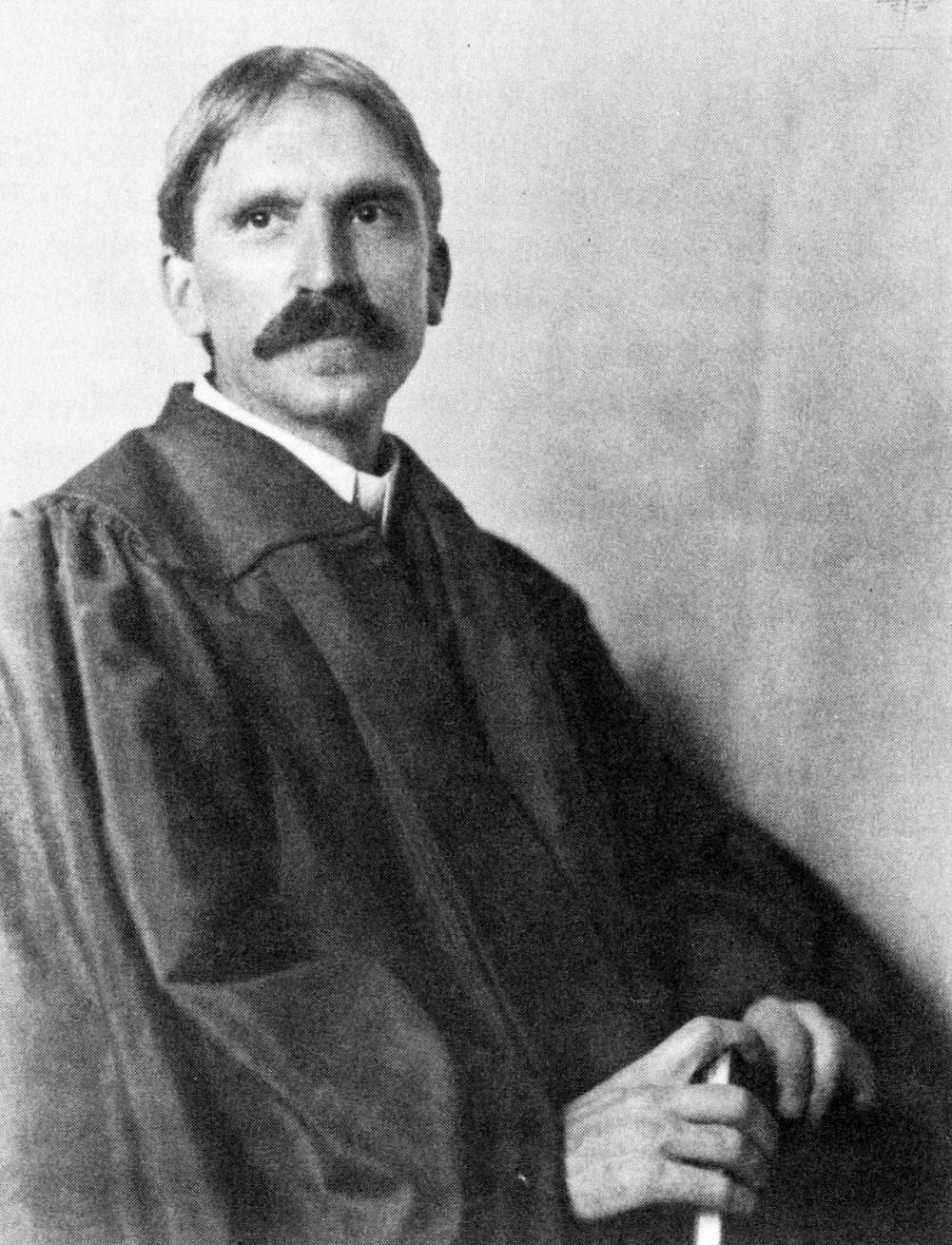
Photo: Eva Watson-Schutze, 1902, public domain · Wikimedia Commons 'John Dewey in 1902.jpg': photograph of John Dewey at the University of Chicago, 1902, by Eva Watson-Schutze (American photographer and painter, 1867-1935, Wikidata Q433566), scanned by the uploader from Louis Menand's The Metaphysical Club (2001), p. 317, original photograph in the John Dewey Photograph Collection, Special Collections Research Center, Morris Library, Southern Illinois University Carbondale; Commons tag PD-old. A lifetime photograph by a photographer who died in 1935, so public domain by age; the book scan is a flat reproduction. Original file 1001 x 1309, used unchanged (no resizing, no upscaling). · Public Domain
철학자 · 20세기
존 듀이
1859–1952
주요 업적 분야
아직 성격 매칭에 포함되지 않았습니다 — 기록된 근거가 성격 모델 전체를 다루기에는 충분하지 않습니다. 이 페이지의 다른 모든 내용은 자유롭게 확인하실 수 있습니다.
핵심 특성
주요 업적
브리태니커 등은 그를 퍼스, 제임스와 함께 미국 실용주의 철학을 연 인물이자 기능주의 심리학의 선구자로 설명한다. 그는 불변하는 존재라는 관념을 거부하고 '경험과 자연'(1925)을 썼다.
시카고 대학에서 자신의 교육 이론을 시험하기 위해 실험학교를 세웠고, '학교와 사회'(1899)와 '민주주의와 교육'(1916)에서 교육철학을 펼쳤다.
컬럼비아 대학과 교육대학에서 그의 사상은 제자들을 통해 퍼져 진보주의 교육과 동일시되었다. 1938년 '경험과 교육'에서는 그 운동의 지나친 면을 비판했으며, 그의 평판은 1950년대 이후 약해졌다.
삶의 장면들
1938년 듀이는 '경험과 교육'에서 진보주의 교육 운동의 지나친 면을 인정하고 비판했다. 전통적 내용을 버리면서 그 자리를 채울 가치 있는 것을 내놓지 못했다고 진보주의자들을 꾸짖었다.
이는 자신이 영감을 준 운동이라도 잘못 가고 있다고 판단하면 비판하는 태도와 부합한다. 갈등 감내
시카고에 온 지 2년 뒤 그는 심리학과 교육 이론을 시험하는 곳으로 실험학교를 세웠고, 그 경험을 '학교와 사회'의 소재로 삼았다.
이는 이론을 지면에서 논증하는 데 그치지 않고 실제 학교에서 시험한 태도와 부합한다. 실험 성향
전환점
미시간 대학에서 듀이의 관심은 헤겔 철학에서 홀과 제임스의 새로운 실험심리학으로 점차 옮겨 갔고, 이는 아동 심리 연구와 교육철학으로 이어졌다.
이는 새로운 경험적 연구를 만나 자신의 지적 출발점을 고쳐 나간 모습과 부합한다. 입장 수정 성향
비슷한 인물
전체적인 프로필이 이 사람과 닮은 사람들이에요.


레오나르도 다빈치

벤저민 프랭클린

세쿼야

에이다 러브레이스

표도르 도스토옙스키
출처
- John Dewey (Q131805) -- verified live via the Wikidata API (2026-10-24): English label 'John Dewey', description 'American philosopher, psychologist, and educational reformer (1859-1952)', Korean label '존 듀이', born 1859-10-20, died 1952-06-01, P18 'John Dewey in 1902.jpg'. Orientation only; not used as support for any row.
- Encyclopaedia Britannica, 'John Dewey' (britannica.com; the live site returns 403, so the article was read through an Internet Archive copy, introduction, career and philosophy sections; the AI summary boxes were ignored): American philosopher and educator, cofounder of pragmatism, pioneer of functional psychology, innovative theorist of democracy and leader of the progressive movement in education; shift at Michigan from Hegel toward the new experimental psychology of Hall and James; 1894 move to Chicago where he developed his pedagogy in the Laboratory Schools; 1904 move to Columbia where most of his career and Experience and Nature (1925) fall; later writing on aesthetics, politics and religion; the common theme of a democratic society of informed and engaged inquirers; his critique of the Western tradition of changeless being and his account of nature, experience and 'the construction of good'. CANONICAL SIGNIFICANCE SOURCE. The political-activism material is not used for scoring.
- Stanford Encyclopedia of Philosophy, 'John Dewey' (David L. Hildebrand, plato.stanford.edu), life, chronology, philosophy-of-education and reception passages read; logic, ethics and aesthetics sections skimmed: Hegelian beginnings and the move to experimental psychology; 1894 invitation to lead philosophy, psychology and pedagogy at Chicago and the 'Chicago School' of functionalism with Mead and Angell; the Laboratory School 'to test psychological and educational theories' with Alice Dewey as principal 1896-1904; 1904 resignation after conflicts over the Laboratory School and move to Columbia and Teachers College; Democracy and Education (1916) as the fullest statement of his philosophy; his reconstruction of philosophy as 'the general theory of education'; critics' charges that his account of experience could not yield a metaphysics (Bernstein) and Rorty's later attack on the term 'experience'. Entry passages on marriages, bereavements, religion and political activism were not used.
- Internet Encyclopedia of Philosophy, 'John Dewey' (iep.utm.edu), biography and theory-of-knowledge sections read, remainder skimmed: founded and directed a laboratory school at Chicago that gave material for The School and Society (1899); 'disagreements with the administration over the status of the Laboratory School' led to his 1904 resignation; Studies in Logical Theory (1903) with Chicago colleagues and students; How We Think (1910) and Democracy and Education (1916); the pragmatic theory of truth met strong opposition, notably from Bertrand Russell, and Dewey later preferred 'warranted assertibility'; Logic: The Theory of Inquiry (1938), Art as Experience (1934), Knowing and the Known (1949, with Arthur Bentley). Passages on the Trotsky commission and public life were not used for scoring.
- Richard J. Bernstein, 'Dewey, John', in Encyclopedia of Philosophy (1967 edition, via encyclopedia.com), read in part (the experience, nature, art, inquiry and critique sections): Dewey's project of a new empiricism combining Greek naturalism with experimental method, 'The Reflex Arc Concept in Psychology' (1896), critics who questioned the status of experience within nature and charged anthropomorphism, Dewey's attempt to answer them in Experience and Nature (1925), Art as Experience (1934) as a surprise to readers who thought his philosophy left no place for art, his 'instrumentalism' described as at least an overstatement, and the charge that his analyses of moral judgment were not wholly consistent. A scholarly, sympathetic but critical contemporary-to-1960s assessment by a Dewey specialist.
- Arthur Zilversmit, 'Dewey, John (1859-1952)', in Encyclopedia of Children and Childhood in History and Society (Gale, via encyclopedia.com), read in full: Dewey as a founder and leading philosopher of Progressive education; founding the Chicago Laboratory School 'to test scientifically his ideas'; The School and Society (1899) and the four natural interests of children; his insistence that teachers guide rather than merely free children and that the curriculum be built from both interests and subject matter; his followers, notably Kilpatrick, emphasised the child's interests at the expense of subject matter, which Dewey himself warned against in quoted passages; the postwar reaction against Progressive education, the 1950s blame for academic shortcomings and the waning of his reputation. The author is a historian of progressive education (Changing Schools, 1993), so this is an independent, critical-historical perspective.
- Jonas F. Soltis, 'Dewey, John (1859-1952)', in Encyclopedia of Education (Gale, via encyclopedia.com), read in full: Johns Hopkins doctorate and Michigan; 1894 Chicago chairmanship of philosophy, psychology and pedagogy; the Laboratory School 'where he scientifically tested, modified, and developed' his ideas; The School and Society and The Child and the Curriculum as lectures given to raise money and support for the school; President Harper merging the laboratory school with the university training school without consulting Dewey, so that he resigned in 1904; Columbia and Teachers College for twenty-six years and the dispersion of his ideas by disciples; Experience and Education (1938), in which he 'recognized and rebuked the many excesses' of the Progressive movement; Knowing and the Known (1949). Educational philosopher's entry, sympathetic and detailed on the school episodes.
- Kirkus Reviews, review of Robert B. Westbrook, 'John Dewey and American Democracy' (Cornell University Press, 1991) (kirkusreviews.com), read in full (one paragraph): a comprehensive intellectual biography tracing Dewey's roughly seventy-year career with emphasis on philosophy and politics, mentioning life circumstances only as they influenced his writings. Used only to show that a modern full biography exists and what it emphasises; the biography itself was not opened, so no row relies on it.
- Wikimedia Commons file page 'John Dewey in 1902.jpg' (wikitext and API record) and creator record 'Creator:Eva Watson-Schutze' with Wikidata Q433566 (American photographer and painter, 1867-1935, checked live): photograph by Eva Watson-Schutze, 1902, scanned from Louis Menand, The Metaphysical Club (2001), p. 317, original photograph in the John Dewey Photograph Collection, Special Collections Research Center, Morris Library, Southern Illinois University Carbondale; tagged PD-old; 1001 x 1309. The SIU Center for Dewey Studies page was opened and gives no photograph rights statement. Checked for the portrait's rights; not used for scoring.