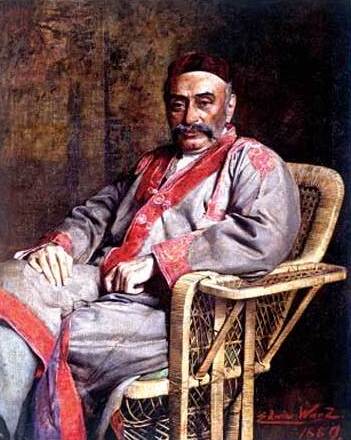

Edwin Arthur Ward, portrait of Jamsetji Tata, 1889, oil on canvas, Tata collection, Chhatrapati Shivaji Maharaj Vastu Sangrahalaya, Mumbai (public domain) · Wikimedia Commons file 'JAMSETJI N. TATA.jpg': oil-on-canvas portrait of Jamsetji Tata by the British painter Edwin Arthur Ward (1859-1933), signed and dated 1889, in the Tata collection at the Chhatrapati Shivaji Maharaj Vastu Sangrahalaya (formerly Prince of Wales Museum), Mumbai, accession 33.72; original 351 x 440 pixels, not resized or cropped · Public domain (artist died 1933)
사업가 · 19세기
잠셋지 타타
1839–1904
주요 업적 분야
아직 성격 매칭에 포함되지 않았습니다 — 기록된 근거가 성격 모델 전체를 다루기에는 충분하지 않습니다. 이 페이지의 다른 모든 내용은 자유롭게 확인하실 수 있습니다.
핵심 특성
주요 업적
타타 가문의 사업을 일으킨 인물로, 1877년 1월 1일 나그푸르에 엠프레스 면직 공장을 열었고, 이후 봄베이 인근의 공장을 사들여 스와데시 공장으로 이름을 바꿨으며, 타지마할 호텔과 봄베이 공장들을 위한 수력발전 구상도 추진했다.
1901년부터 인도에서 대규모 제철 사업을 추진했고, 1904년 완공 전에 세상을 떠났으며 1907년 아들들이 타타 제철 회사를 등록했다.
1898년 연구 중심 대학을 세우기 위해 약 300만 루피 상당의 재산을 내놓았고, 그의 사후인 1909년 설립되어 1911년 방갈로르의 인도 과학원으로 문을 열었다.
삶의 장면들
나그푸르 공장의 첫 기계가 불량이어서 주가가 액면가의 절반으로 떨어지자, 그는 1878년 유럽으로 가서 더 비싼 새 설비를 사들이고 값싼 기계는 폐기했다.
이는 첫 계획이 실패했을 때 다른 방법을 찾는 모습과 일치한다. 자원 활용 성향
1898년 그는 봄베이의 건물 14채와 토지 4곳, 재산의 약 절반을 연구 대학 설립에 내놓았고, 1904년에는 유언장 추가 조항으로 정부에 대한 제안을 유효하게 남겼다.
이는 오랜 지연 속에서도 자신의 재산을 공적 목적에 쏟으려는 모습과 일치한다. 영향 창출 동기
전환점
1858년부터 아버지의 무역 회사에서 일하던 그는 1874년 면방직 회사를 설립하기 시작해 봄베이가 아닌 나그푸르에 입지를 잡았고, 이로써 무역에서 제조업으로 옮겨 갔다.
이는 남들이 의심하던 입지에 과감히 투자하는 태도와 일치한다. 기회 감지
비슷한 인물
전체적인 프로필이 이 사람과 닮은 사람들이에요.
출처
- Jamsetji Tata (Q320109), verified live via the Wikidata API (2026-11-01): label 'Jamsetji Tata', description 'Indian industrialist, founder of the Tata Group (born 1839)', born 1839-03-03, died 1904-05-19, Korean label present. Orientation only; not used as support for any row.
- 'Tata, Jamsetji Nusserwanji', Encyclopedia of World Biography (Gale, unsigned entry hosted on Encyclopedia.com), read in full: dates, his father's export firm and the 1859 Hong Kong branch, the Empress cotton mill opened at Nagpur on 1 January 1877, the later Swadeshi Mill, the freight fight with shipping combines that ended in 1896, the iron and steel project begun in 1901 and registered by his sons as the Tata Iron and Steel Company in 1907, the hydroelectric proposal (dam foundations laid 1911), the Taj Mahal Hotel, the 1898 research-institute offer, and scholarships from 1894; quotes the Dictionary of National Biography calling his mills 'the best managed of Indian-owned factories'. CANONICAL SIGNIFICANCE SOURCE: standard reference biography. Admiring in tone and offers no criticism of him.
- D. E. Wacha, 'The Life and Life Work of J. N. Tata' (Madras: Ganesh & Co., second edition, c. 1915), read via the Internet Archive full text (University of California copy): a contemporary biography by an associate; covers his early career and travel, the Empress Mill, the Swadeshi Mill (1886), the labour-supply problem and his 1888 letters to the United Provinces government and the Bombay millowners, the freight monopoly he broke with Japanese lines, the research-institute scheme, the steel and hydroelectric projects, and appended memorial speeches. Written by a friend and admirer after his death, so favourable; used for the documented episodes, not for assessments of character.
- Tata Group heritage article 'Jamsetji and the Empress Mills, Nagpur' on tata.com, read in full: why he chose Nagpur over Bombay, the 1874 promotion of the Central India Spinning, Weaving and Manufacturing Company (Rs 15 lakh), the 1 January 1877 opening, the poor early machinery and the 1878 Europe trip to replace it, the 16 per cent dividend of 1881, and the later creche and dispensary. Company-published heritage page, so partly self-affiliated and undated on the welfare measures.
- Tata Group heritage article 'Jamsetji Tata, perseverance and the Indian Institute of Science' on tata.com, read in full: how the 1889 Reay address led to his 1896 letter and the 1898 offer of 14 Bombay buildings and four landed properties (about Rs 30 lakh), his silence at the 1898 deputation to Curzon, the 1899 dispute over linking a family settlement, his 1900 meeting with Prof William Ramsay at his own cost, the 1903 abeyance and the 1904 codicil. Company-published; the Curzon dealings are told from the Tata side.
- Indian Institute of Science, 'History' page, read in full: states that in the 1890s he decided to build a world-class university in India from his own wealth, that Mysore gave 371 acres and capital and annual funds, that the colonial government supplied the rest, and that the Institute was established on 27 May 1909 after 'several hurdles, including those resulting from Tata's untimely death' and opened in 1911 with Morris Travers as director. Independent institutional confirmation of the endowment and the delays; says little about his conduct.
- Illa Vij, 'Fact File', The Tribune (Chandigarh), Saturday Plus, 19 June 1999, read in full: newspaper profile covering the 1882 report on the Lohara iron deposits, his reading and travel to gather technical knowledge, a reward offered for a way to smelt the ore, the hiring of the American engineer C. M. Weld, the official restrictions that stalled the steel plans until 1899, and his death in 1904 before the plant was built. The only non-Tata, non-encyclopedia source; popular and uneven (it says British rule held back Indian industry, which is the author's framing).
- Tata Central Archives, online exhibition 'Jamsetji Nusserwanji Tata (1839-1904)', read in full: the archive's panel list covering the Tata family, his travels, the textile mills, the iron and steel company, the Institute of Science, the Taj Mahal Palace Hotel, the Tata electric companies, his final journey and the J. N. Tata Endowment scheme; mentions his 1900s letter to Swami Vivekananda and the only Indian Hotels Company meeting he attended. A company archive, so partly self-affiliated; thin text, used for the range of his ventures.