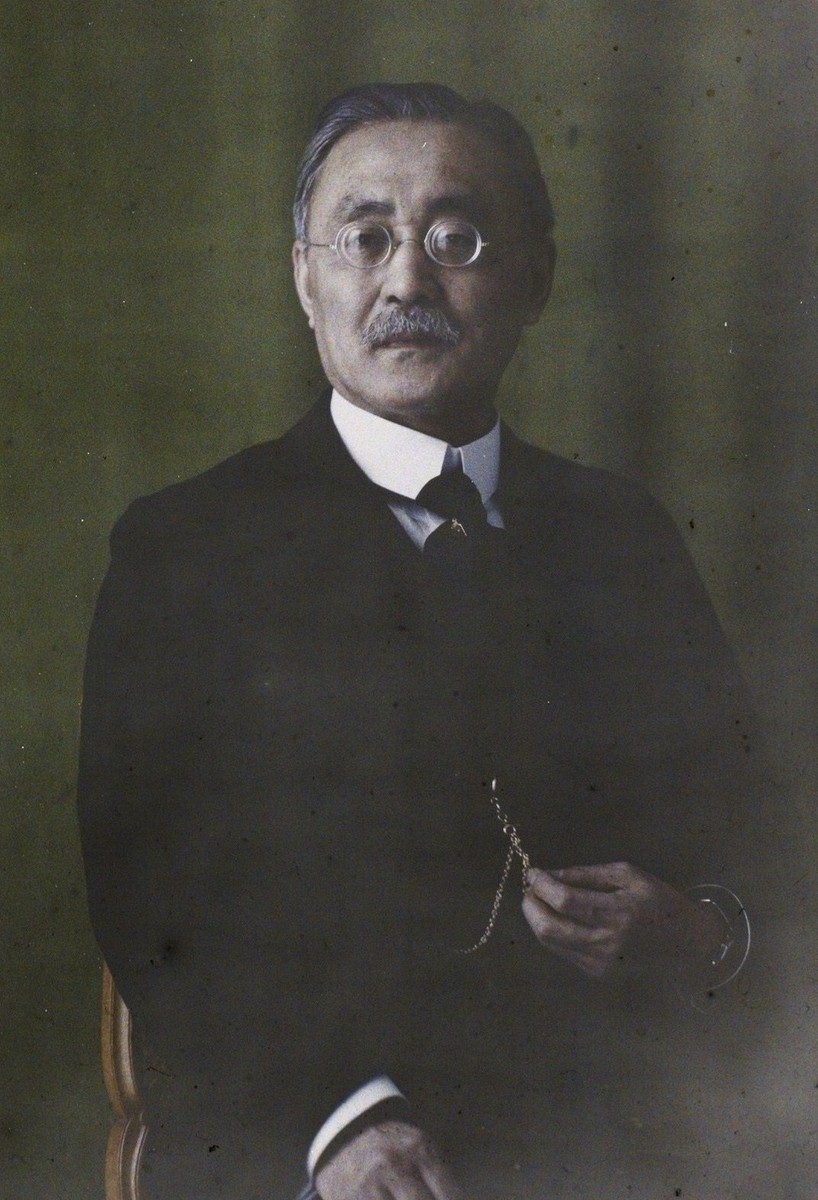
Auguste Leon, Inazo Nitobe, autochrome, 21 December 1922, Musee departemental Albert-Kahn, A35816 · Portrait of Inazo Nitobe, autochrome by Auguste Leon, taken 21 December 1922 at Boulogne, Musee departemental Albert-Kahn, inventory A35816. The museum's collection record for this item states public domain and freely reusable (CC-00); the photographer died in 1942 and Commons tags the file as public domain on the same basis. Commons original 1073 x 1575 pixels, downscaled to 818 x 1200 with no cropping and no upscaling. · Public domain, freely reusable (CC-00) per the museum record
교사 · 19세기
니토베 이나조
1862–1933
주요 업적 분야
아직 성격 매칭에 포함되지 않았습니다 — 기록된 근거가 성격 모델 전체를 다루기에는 충분하지 않습니다. 이 페이지의 다른 모든 내용은 자유롭게 확인하실 수 있습니다.
핵심 특성
주요 업적
영어로 『무사도: 일본의 혼』(1900)을 써서 사무라이에서 비롯된 가치를 외국 독자에게 설명했으며, 1905년 미국판 이후 널리 읽혔고 여러 언어로 번역되었다.
제일고등학교 교장으로서 인격주의에 기반한 교육을 실천했고, 1918년 도쿄여자기독교대학의 초대 학장이 되었다.
농업경제학 박사로 삿포로, 교토, 도쿄에서 가르쳤고, 이후 제네바에서 국제연맹 사무차장을 지냈다(국립국회도서관 기준 1919~1926년).
삶의 장면들
미국인 아내와 벨기에 법학자의 질문에 답하기 위해 영어로 『무사도』를 썼고, 외국 독자가 이해하도록 각 덕목을 유럽의 역사와 문학의 사례와 나란히 설명했다.
이는 외국 독자에 맞춰 메시지를 의도적으로 조정하는 태도와 부합하지만, 책이 사무라이 윤리를 얼마나 정확히 설명했는지는 학자들 사이에서 논쟁이 있다. 설득력
도쿄여자기독교대학 첫 졸업식에서 그는 지식보다 식견을, 학문보다 인격을 중시하고 인재보다 인물을 기르는 것이 학교의 목표라고 밝혔다.
이는 대학 자체의 기록에 따른 교육 중심의 동기와 부합한다. 영향 창출 동기
전환점
1884년 도쿄대학을 졸업 전에 떠나 미국으로 유학했고 그곳에서 퀘이커 교도가 되었으며, 1891년 귀국해 학자의 길을 시작했다.
이는 해외에서의 학업을 위해 진로를 바꾸는 태도와 부합한다. 적응력
비슷한 인물
전체적인 프로필이 이 사람과 닮은 사람들이에요.
출처
- Nitobe Inazo (Q12696), verified live via the Wikidata API (2026-10-26): label 'Nitobe Inazo', description 'Japanese educator, agricultural economist and diplomat (1862-1933)', born 1862-09-01, died 1933-10-15, Korean label present, P18 image 'Monsieur Inazo Nitobe.jpg'. Orientation only; not used as support for any row.
- National Diet Library of Japan, 'NITOBE Inazo' (Portraits of Modern Japanese Historical Figures; short entry read in full). CANONICAL SIGNIFICANCE SOURCE: educator and social-science scholar; Sapporo Agricultural College, Tokyo Imperial University professor, first president of Tokyo Women's Christian University, education based on personalism at the First Higher School (1906-1913), League of Nations Under-Secretary-General (1919-1926), and author of Bushido: The Soul of Japan (1900). Brief national-library biography; the First Higher School end date differs from the Suzuki chapter.
- Tadanobu Suzuki, 'Two Bridges in Nitobe's Bushido and Their Symbolism Today' (University of Victoria repository; about 16,000 characters of text extracted from the PDF and read, so some pages may be missing): his move from agricultural studies to English literature and economics, study at Johns Hopkins and in Germany, his career at Sapporo, Kyoto and Tokyo, headmaster of the First Higher School (1906-1911), founding president of Tokyo Women's Christian University (1918-1923), why and for whom he wrote Bushido in English, its 1900 and 1905 editions, and a Taiwan colonial advisory post. Scholarly commemorative essay, admiring in tone; Nitobe's own statements are quoted from his collected works.
- Christian Etzrodt, 'Nitobe Inazo's Bushido: Science or Fiction?', Electronic Journal of Contemporary Japanese Studies 18(3), 2018 (introduction and abstract read; the full text and appendix were not read): reports that Benesch and other researchers argue Bushido is an invented tradition, tests it against 29 samurai texts, and concludes that Nitobe gave a reasonably accurate description of most of the values. Independent scholarly counter-voice on the reliability of his best-known book.
- Tokyo Woman's Christian University, 'The Aims of the Founders of TWCU' (2018 centennial essay by Prof. Sano Masako, hosted by the United Church of Christ in Japan; read in full): the university's 1918 founding by six mission boards, Nitobe as first president with Yasui Tetsu as dean and A. K. Reischauer as managing director, and his first-graduation-ceremony speech on educational aims. Founder-institution account, admiring.
- UBC Botanical Garden, 'Inazo Nitobe and Bushido' (Nitobe Memorial Garden; read in full): memorial-garden biography stating his wish to be 'a bridge across the Pacific', his education in agriculture and languages in Tokyo, Sapporo, the United States and Germany, and the reception of Bushido in the West. Commemorative and admiring.
- Musee departemental Albert-Kahn collection record 'Inazo Nitobe', inventory A35816, autochrome by Auguste Leon taken 21 December 1922 (checked for the portrait only; not used for any scoring).
- Wikimedia Commons file page 'Monsieur Inazo Nitobe.jpg' (checked for the portrait only; not used for any scoring).