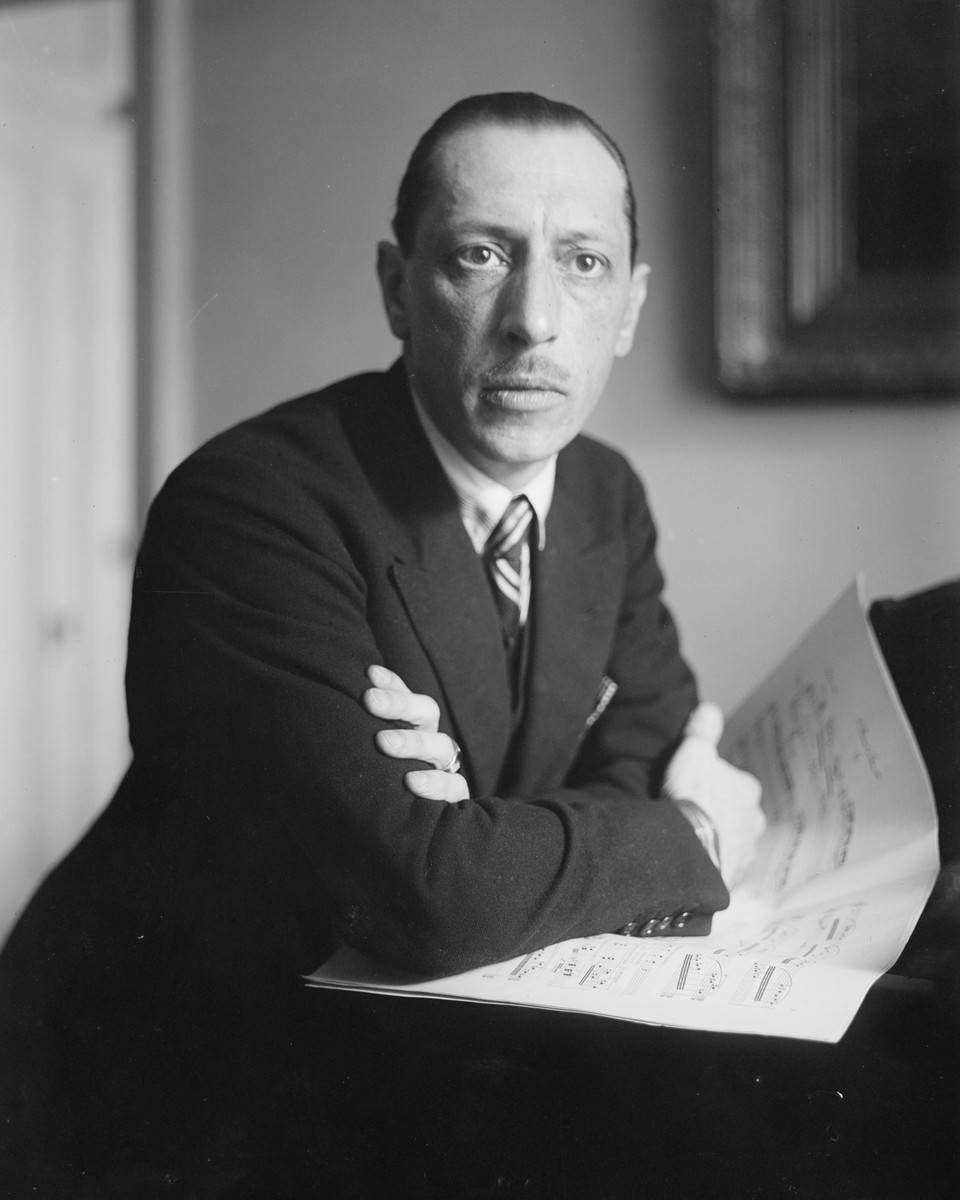
Photo: Bain News Service (publisher), [between ca. 1920 and ca. 1925], Library of Congress, Prints and Photographs Division (LC-DIG-ggbain-32392), cropped and downscaled from the original · Library of Congress, Prints and Photographs Division, George Grantham Bain Collection (item 2014712545, 'Stravinsky', Bain News Service, publisher, glass negative, [between ca. 1920 and ca. 1925]; call number LC-B2- 5464-2 [P&P]; reproduction number LC-DIG-ggbain-32392), via Wikimedia Commons file 'Stravinsky LCCN2014712545.jpg' (original JPEG 5405 x 7487 pixels, grayscale). The Library's rights advisory for the item is 'No known restrictions on publication' and the Bain collection statement reads 'There are no known copyright restrictions on the photographs in the George Grantham Bain Collection. Publicity rights may apply.' The photographer is not named (Bain News Service is recorded as publisher). A 4:5 region (4937 x 6174 pixels) showing the sitter leaning on a piano with a score, excluding the negative's black border and the Bain handwritten caption and number, was cropped from the original and downscaled once to 960 x 1200 (never upscaled). · No known restrictions on publication
작곡가 · 20세기
이고르 스트라빈스키
1882–1971
주요 업적 분야
아직 성격 매칭에 포함되지 않았습니다 — 기록된 근거가 성격 모델 전체를 다루기에는 충분하지 않습니다. 이 페이지의 다른 모든 내용은 자유롭게 확인하실 수 있습니다.
핵심 특성
주요 업적
그는 파리에서 세르게이 댜길레프의 발레 뤼스를 위해 「불새」(1910), 「페트루시카」(1911), 「봄의 제전」(1913)을 작곡했다. 브리태니커는 끊임없이 바뀌는 대담한 리듬과 해결되지 않는 불협화음이 두드러지는 「봄의 제전」을 초기 모더니즘의 이정표로 꼽으며, 1913년 5월 29일의 초연은 큰 소동을 일으켰다.
제1차 세계 대전 이후 그는 신고전주의로 방향을 틀어, 이전 시대의 음악을 자신만의 어법으로 다시 빚어낸 「풀치넬라」(1920), 「오이디푸스 왕」(1927), 「시편 교향곡」(1930), 그리고 그의 유일한 장편 오페라인 「난봉꾼의 인생역정」(1951)을 썼다.
1950년대에 그는 그전까지 외면하던 음렬 기법을 받아들여, 칸타타와 조지 발란신이 안무한 발레 「아곤」(1957), 「트레니」(1958), 「레퀴엠 칸티클스」(1966) 등을 내놓았다. 부지 앤드 호크스는 「아곤」을 현대 음악에서 가장 예상 밖의 양식 전환 가운데 하나로 평한다.
삶의 장면들
조지 발란신과 새 발레를 작업하던 중, 스트라빈스키는 춤 하나가 얼마나 길어야 하느냐고 물었다. 발란신이 '2분 반쯤'이라고 답하자 그는 '대략'이라는 말은 없다며 정확한 시간을 알려 달라고 했다. 가능한 한 그 시간에 맞추겠다는 것이었다. 이 일화는 찰스 조지프가 두 사람의 협업을 다룬 책에 대한 제니퍼 호먼스의 서평에 실려 있으며, 서평은 발란신이 훗날 두 사람의 작업이 이런 시간 협상을 중심으로 돌아갔다고 말했다고 덧붙인다.
대략적인 지정보다 정확한 지정을 선호하는 태도와 일치한다. 디테일 지향
발레 「아곤」을 작곡하기 전, 스트라빈스키는 링컨 커스틴에게서 17세기 무용 이론서인 프랑수아 드 로지의 『무용의 변론(Apologie de la danse)』 현대판을 받았다. 이 판본에는 마랭 메르센의 주석과 발췌문이 붙어 있었다. 찰스 조지프의 연구를 요약한 제니퍼 호먼스에 따르면 스트라빈스키는 이 책에 빼곡히 표시를 해 두고 작곡하는 동안 로지와 메르센을 참고했다. 부지 앤드 호크스는 그가 1952년부터 베베른의 음악을 집중적으로 공부하기 시작했다고 전한다.
작곡하는 동안 옛 이론서와 음악을 폭넓게 참고하는 습관과 함께 놓고 볼 수 있다. 호기심
전환점
부지 앤드 호크스에 따르면 스트라빈스키는 1952년 베베른의 음악을 집중적으로 공부하기 시작하기 전까지 쇤베르크식 음렬 기법을 외면해 왔다. 브리태니커는 칸타타, 칠중주, 「딜런 토머스를 추모하며」 같은 '조심스러운 실험작'이 먼저 나온 뒤 「아곤」(1957년 완성)과 「트레니」(1958)가 나왔고, 1966년 「레퀴엠 칸티클스」로 이어졌다고 설명한다. IRCAM은 그가 로버트 크래프트의 조언에 따라 이 길에 들어섰다고 전한다.
긴 경력의 후반에 쇤베르크 학파와 연결된 기법을 들여와 이미 확립된 양식을 고쳐 쓴 한 사례로 볼 수 있다. 실험 성향
비슷한 인물
전체적인 프로필이 이 사람과 닮은 사람들이에요.


듀크 엘링턴

볼프강 아마데우스 모차르트

제임스 조이스

소르 후아나 이네스 데 라 크루스

마일스 데이비스
출처
- Igor Stravinsky (Q7314) -- verified live via the Wikidata API (2026-10-15): English label 'Igor Stravinsky', description 'Russian, French, and American composer (1882-1971)', Korean label present, instance of human, born 1882 (the entity carries several date values covering the Julian and Gregorian dates), died 6 April 1971 in New York City, citizenship values including the Russian Empire, Russia, France and the United States. Orientation only; not used as support for any row.
- Library of Congress Music Division research guide, 'Igor Stravinsky: A Guide to Primary and Secondary Resources at the Library of Congress' (author Paul Allen Sommerfeld, Music Reference Specialist; Introduction and Music Manuscripts pages, last updated July 2026) -- CANONICAL SIGNIFICANCE SOURCE (with the Boosey & Hawkes biography): the national library's own statement that Stravinsky is 'one of the most influential composers of the 20th century', and its description of its holdings: over 40 music manuscripts in his hand (among them a manuscript of the ballet Apollon musagete commissioned by the Elizabeth Sprague Coolidge Foundation, Agon, Mavra, Oedipus Rex and the Symphony in C) and, in the Igor Stravinsky / Robert Craft collection, publisher's proofs carrying his holograph corrections, including early proofs of Threni with 'corrections and instructions to the engravers and the publisher' and numerous corrected copies of Requiem Canticles, Variations, Movements and Canticum Sacrum. Institutional description of archival objects, neutral in tone. Read in full (the Special Collections, Published Music, Music Literature, Iconography, Lectures and Databases tabs were not opened).
- Boosey & Hawkes, 'Igor Stravinsky' composer page (Snapshot summary and Biography tab, the publisher's own biography reproduced with its permission note) -- CANONICAL SIGNIFICANCE SOURCE (with the Library of Congress guide): his publisher's account of the career arc (study with Rimsky-Korsakov, The Firebird for Diaghilev's Ballets russes in 1910 bringing 'sudden international prominence', Petrushka and The Rite of Spring as 'one of the major landmarks in the history of music' that 'marked the coming of modernism in music' and met 'astonishment and hostility', the smaller-scale theatrical ventures such as The Soldier's Tale with Ramuz prompted by economic conditions, Pulcinella launching the neoclassical phase that ran from the 1920s to the 1940s through Oedipus Rex, Symphony of Psalms and The Rake's Progress, the ballets generally made with George Balanchine, and the 1957 ballet Agon as 'one of the most unexpected stylistic volte-faces in modern music' after he began studying Webern intensely in 1952), with his work as a pianist and then conductor of his own music and the near-complete recorded legacy. Publisher's promotional page, admiring in tone: its sentence that he is 'widely regarded as the most original and influential composer of the 20th century' is the publisher's own claim and is not repeated as fact in any row or card. Read in full except the work list, timeline, news and discography tabs.
- Encyclopaedia Britannica, 'Igor Stravinsky' (article by Eric Walter White, fact-checked by Britannica's editors, last updated 11 September 2026; the page's AI-generated summaries were not used) -- encyclopaedia biography: a Russian-born composer 'whose work had a revolutionary impact on musical thought and sensibility just before and after World War I' and 'whose compositions remained a touchstone of modernism for much of his long working life'; the Diaghilev ballets (The Firebird, 25 June 1910, 'a dazzling success'; Petrushka, 1911; The Rite of Spring, 29 May 1913, 'an early modernist landmark' whose premiere 'provoked one of the more famous first-night riots in the history of musical theatre'); the wartime small-scale works including The Soldier's Tale (1918); the Neoclassical idiom of the 1920s to the 1950s (Octet, Oedipus Rex, Symphony of Psalms, Symphony in C, Symphony in Three Movements, The Rake's Progress, 'his only full-length opera'); the 1950s serial works (Cantata, Septet, Agon, Canticum Sacrum, Threni, Requiem Canticles, 1966); the Royal Philharmonic Society Gold Medal (1954) and Wihuri Sibelius Prize (1963). It also states that his 1936 autobiography and his six later collaborations with Robert Craft are 'factually unreliable'. Encyclopaedic, neutral in tone. Read in full.
- Library of Congress Music Division blog 'In the Muse', 'Acquisition Highlights for the Past Year: A Top Five List' (December 2023), item 2, 'Two Groups of Igor Stravinsky Correspondence' -- curators' note: Stravinsky as 'by any reckoning, one of the most important and influential classical composers of the twentieth century', the Library as 'the major American repository for original scores and correspondence of Stravinsky' (earliest music manuscript the Apollon-Musagete score, performed in 1928 in the Library's Coolidge Auditorium, then about 50 more manuscripts), and two new groups of letters, including 72 items of 1941-47 correspondence with the Associated Music Publishers editor Arthur Mendel that 'center on pre-publication changes to several of Stravinsky's works'. Institutional, admiring but factual. Read the Stravinsky item only.
- Poppy Farr (Music Manuscripts and Archives Cataloguer), 'The life and music of Stravinsky in two newly catalogued collections', British Library blog, 3 June 2026 -- archive cataloguer's account of the Boosey & Hawkes production materials (Stravinsky the best represented composer, over 60 files): his signing with Boosey & Hawkes in the 1940s, his revising of 'many of his compositions' and producing new editions in the decades that followed (citing Helen Wallace's history of the publisher), the 1956 Mavra vocal score with his handwritten revisions of 1966 and several proof copies showing 'the repeated revisions the score underwent' before the 1968 edition, a score of Elegy for J.F.K. with his amendments to dynamics, articulation and phrasing, and the printed score he used to conduct the 1948 premiere of Orpheus. The Dartington Summer School visit (accommodation, catering and other hospitality details) is private and was not used. Archival description, neutral in tone. Read in full.
- Arnold Schönberg Center, Vienna, 'Three satires for mixed chorus op. 28' (composition page with the program note by Agnes Grond) -- the Schoenberg archive's own note on the 1925/26 choral satires: Schoenberg's explanation in a letter that he wrote them 'when I was very much angered by attacks of some of my younger contemporaries', his four targets named in the foreword (those who seek salvation 'in the middle of the road', those who look backwards, 'folklorists' and 'all the ...ists' he sees as 'mannerists'), and the note's statement that in the third satire, 'Der neue Klassizismus', apart from the musicologist Hugo Riemann 'Stravinsky was the main target'. Institutional note from the rival camp's archive, adversarial in tone towards Stravinsky's neoclassicism and concerned with his music, not his conduct. Read in full.
- Jacques Amblard, 'Survey of works by Igor Stravinsky' (translated by Peter Asimov), IRCAM-Centre Pompidou B.R.A.H.M.S. composer database, updated 2015 -- scholarly overview essay: the Rite of Spring as 'a canonical milestone of music history' and its repeated chord and ostinato as 'one of the most influential, even foundational, tools of twentieth-century music'; Schoenberg's 'der kleine Modernsky' in the Three Satires; the wartime reduction of forces (Soldier's Tale, Renard, Les Noces); Pulcinella and the neoclassical works; the later jazz-band pieces; the turn to serialism on the advice of Robert Craft; Adorno's judgement that neoclassicism was 'restoration' and Boulez's rejection of it; and Valerie Dufour's finding that he was 'a strategist' whose press appearances and interviews systematically preceded his concerts. Passages on politics, religion, psychoanalytic and mental-health speculation, and one 1941 anthem-arrangement episode were not used. Scholarly essay by an institutional research body, critical and admiring by turns. Read in full.
- Jennifer Homans, 'Geniuses Together' (review of Charles M. Joseph, Stravinsky and Balanchine: A Journey of Invention, Yale University Press, 2002), The New York Review of Books, 19 December 2002 -- dance historian's review: the anecdote of Stravinsky answering 'Don't say about, there is no such thing as about' when Balanchine gave an approximate length for a dance, his insistence that music be 'transmitted' and not 'interpreted', the two men 'often seen bent over a score', Balanchine's deference to him, Stravinsky's extensive markings in his copy of de Lauze's Apologie de la danse (with Mersenne's notes) while composing Agon and his use of Bach's Concerto for Two Violins in his own Violin Concerto, Balanchine's account of the Apollon musagete score as a revelation; the review's own view that Joseph is good on the music and weak on the dances. Passages on his political and religious outlook were not used. Independent critic's review of a scholarly study (the one scholarly perspective is Joseph's, so this review and the Brooklyn Rail review of the same book are one source of facts, not two). Read in full.
- Paul Grimstad, review of Charles Joseph, Stravinsky & Balanchine: A Journey of Invention (Yale University Press, 2002), The Brooklyn Rail, October 2002 -- composer-critic's review of the same scholarly study: Stravinsky's 'occasionally tyrannical exactitude in matters of metronomic execution' at the first Chant du rossignol rehearsals (a pianola cranked by an 'autocratic' composer), Stravinsky's falling out with Diaghilev 'for business reasons', his own description of Apollo as his 'ballet blanc', the all-string Apollo score that resulted from a 'tangle of correspondence' with the Library of Congress about its auditorium, the origins of Agon in Webern's miniatures, Isaac's Choralis Constantinus, 17th-century French dance manuals and T. S. Eliot's verse, his switch to serialism as 'one of the last major compositional strongholds against the growing orthodoxy of serial technique' giving way, and the reviewer's criticisms of Joseph's method. Independent critic's review that counts, with the Homans review of the same book, as one scholarly perspective (Joseph's). Read in full.
- Robert Craft, 'Stravinsky & Balanchine', The New York Review of Books, 8 October 1998 -- first-person account by Stravinsky's long-time associate, who says he was the only witness to the making of Agon and The Flood: how the two men's collaboration changed from the imperious handling of Balanchine over Jeu de cartes in 1937 to the joint plotting of Orpheus and the 'equal partner from conception to execution' of Agon, Balanchine persuading Stravinsky to expand the Orpheus pas de deux and to repeat the prelude of The Flood, and the order and titles of the Agon dances written down by Stravinsky as they talked. Insider account by one person with a stake in the story (Britannica calls his collaborative books factually unreliable), so used only as one perspective alongside the scholarly and critical sources, never alone. Passages on Balanchine's state of mind and religious feeling were not used. Read in full.
- Ryan Wenzel, 'Modern Antiquity' (review of New York City Ballet's Stravinsky-Balanchine repertory season), The Brooklyn Rail, October 2012 -- dance critic's review: Balanchine choreographed 'at least 45 ballets' to Stravinsky's music; the Apollo-Orpheus-Agon 'Greek trilogy' as showing how 'both artists were always in the business of self-reinvention' (Stravinsky moving from the 17th-and-18th-century French style of Apollo to serial music in Agon); Balanchine's remark that the Apollo score 'in its discipline and restraint, in its sustained oneness of tone and feeling' was 'a revelation'; the success of Orpheus in 1948 that led to the New York City Ballet. Passages on the 2012 dancers were not used. Independent critic's review, admiring. Read in full.
- Tom Vitale (NPR, Weekend Edition Saturday), 'Then The Curtain Opened: The Bracing Impact Of Stravinsky's Rite', 25 May 2013 (read as published by KUNC) -- public-radio feature for the centenary with the critic Alex Ross (the two adjacent chords 'slammed together', accents landing in unexpected places, 'The Rite felt completely different') and the dance historian Lynn Garafola (Nijinsky's choreography as 'a new kind of ballet'), reporting that within a year of the premiere the score was hailed as a masterpiece and that Nijinsky's choreography was abandoned after the first run; it also quotes Stravinsky's 1965 recollection of the premiere (self). Independent journalism with two expert voices, admiring. Read in full.
- James S. Murphy, 'Spring Fever', The Paris Review (On Music), 11 July 2013 -- essay by a musicologically trained writer on how the Rite premiere is remembered: scholars 'have called into question the size, the ferocity, and the immediate effects' of what was 'definitely a disturbance', Stravinsky leaving his seat 'only to watch backstage' and taking four or five curtain calls, Nijinsky counting time to the dancers all week, the London premiere and later Paris performances passing without major incident, and Diaghilev as a 'master marketer' who with Stravinsky made remarks to the press and invited critics to a preview so that the audience was 'primed'. Independent essay, skeptical of the riot legend and relaying Taruskin's argument at second hand. Read in full.
- Katie Buzard, 'Did "The Rite of Spring" Really Incite a Riot?', Clef Notes, Illinois Public Media (WILL), 18 March 2025 -- public-media explainer drawing on contemporary reviews and on Taruskin and Gillian Moore: no evidence of physical altercations or of police being called, the earliest reports not using the word riot, the premiere preceded by press stories and open rehearsals, a score that took 17 orchestra rehearsals and over 130 dance calls, conductor Pierre Monteux's recollection of first hearing the piano reduction ('I was convinced he was raving mad'), Nijinsky's choreography described by Taruskin as 'ugly earthbound lurching and stomping', and the premiere's role in making the work an icon of modernism. Popular but well-referenced; used for the premiere context and counter-evidence on the riot, not for any trait row on its own. Read in full.
- Library of Congress, Prints and Photographs Division, item record 2014712545, 'Stravinsky' (Bain News Service, publisher; glass negative, [between ca. 1920 and ca. 1925]; call number LC-B2- 5464-2 [P&P]; reproduction number LC-DIG-ggbain-32392) -- checked for the portrait's rights: the record gives the Rights Advisory 'No known restrictions on publication' and the Bain collection's own statement reads 'There are no known copyright restrictions on the photographs in the George Grantham Bain Collection. Publicity rights may apply.' (credit line: Library of Congress, Prints & Photographs Division, with the reproduction number); the title is taken from the Bain negative and the summary identifies the sitter as the composer, pianist and conductor Igor Fyodorovich Stravinsky, the same photograph the Library's Stravinsky research guide uses as its illustration. The record was read through the Library's JSON interface and the rights statement through the Library's published rights data because the HTML pages returned HTTP 403 to direct download. Not used for any scoring.
- Wikimedia Commons file page 'Stravinsky LCCN2014712545.jpg' -- checked for the portrait's file and licence: Bain News Service, publisher, from the Library of Congress (digital ID ggbain.32392), tagged with the Commons Bain and public-domain licence tags and the Library's 'No known restrictions on publication' statement; original JPEG 5405 x 7487 pixels (Commons' own date field reads 1900, which conflicts with the Library's [between ca. 1920 and ca. 1925] and was not used). Not used for any scoring.