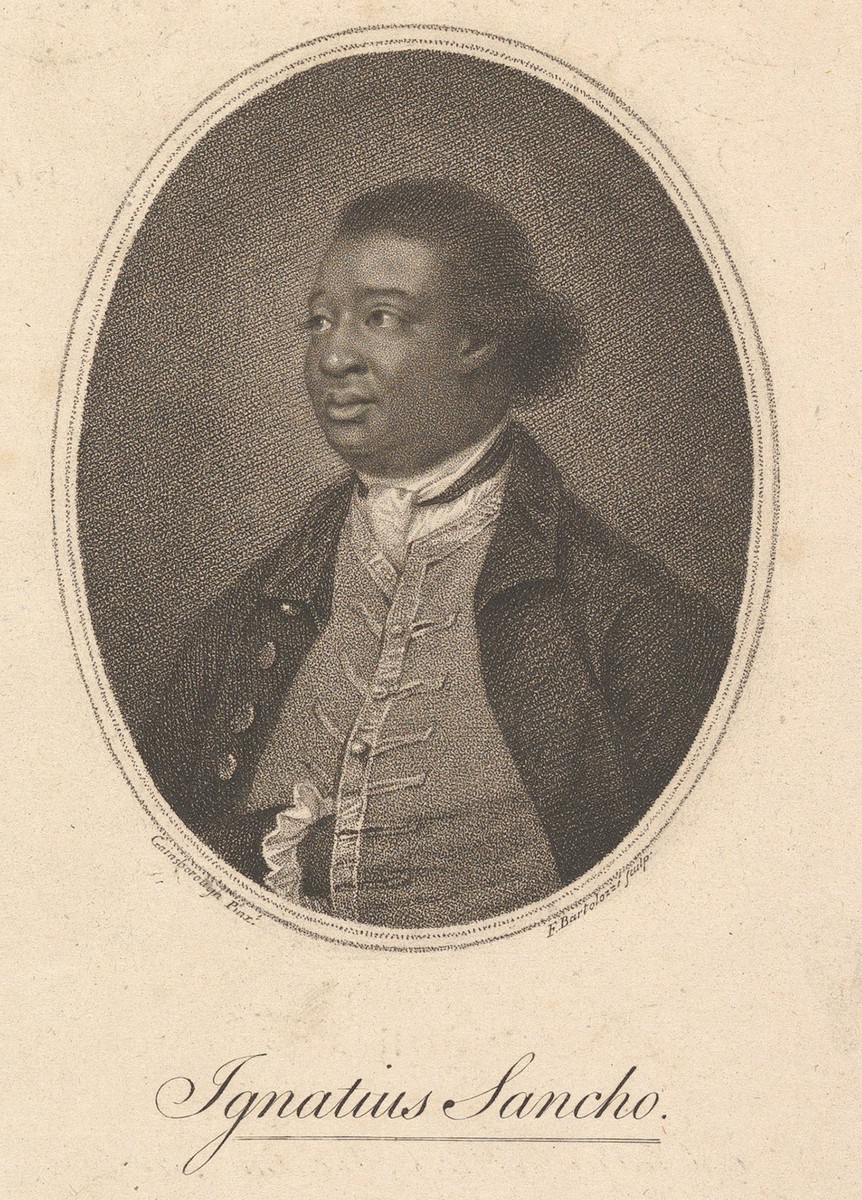
Francesco Bartolozzi after Thomas Gainsborough, 1802, The Metropolitan Museum of Art, Harris Brisbane Dick Fund, 1917, Open Access · Stipple engraving 'Ignatius Sancho' by Francesco Bartolozzi after Thomas Gainsborough's oil portrait, lettered 'Gainsborough Pinxt.' and 'F. Bartolozzi sculp.' and published in London on 20 December 1802 by William Sancho, Charles Street, Westminster; The Metropolitan Museum of Art, Harris Brisbane Dick Fund, 1917 (17.3.756-2151, object 376537). The museum's image (2158 x 3482) was cropped to the oval plate with its title line and downscaled to 862 x 1200 with no upscaling. · Public domain: The Metropolitan Museum of Art Open Access (isPublicDomain true); a 1802 print after a painter who died in 1788 and an engraver who died in 1815
작곡가 · 근세
이그나티우스 산초
1729–1780
주요 업적 분야
아직 성격 매칭에 포함되지 않았습니다 — 기록된 근거가 성격 모델 전체를 다루기에는 충분하지 않습니다. 이 페이지의 다른 모든 내용은 자유롭게 확인하실 수 있습니다.
핵심 특성
주요 업적
그의 서한집은 1782년 사후 2년 만에 출간되어 1803년까지 다섯 판을 찍었고, 그는 18세기 노예무역 반대자들에게 아프리카인의 인간성을 보여 주는 상징이 되었다.
그는 '아프리카인이 작곡한' 미뉴에트, 코티용, 컨트리 댄스 모음집(1767년경)을 런던에서 직접 찍어 냈다.
노예선에서 태어나 하인으로 자란 그는 1774년 의사당 근처에서 식료품점을 열었고, 가장으로서 투표권을 행사했으며, 1768년 토머스 게인즈버러가 그의 초상을 그렸다.
삶의 장면들
그는 유명 작가 로런스 스턴에게 보낸 편지에서 자신을 그의 책을 사랑하는 아프리카인이라고 소개하며, 서인도 제도의 노예제에 잠시만 관심을 기울여 달라고 청했다.
이는 자신이 중요하게 여기는 문제로 저명한 인물에게 먼저 다가가는 주도적인 모습과 일치한다. 선제적 행동력
그는 웨스트민스터의 가게를 운영하면서도 무용 음악을 출판하고, 편지와 수필, 희곡을 쓰며, 개릭과 스턴을 비롯한 예술가·작가들과 교유를 이어 갔다.
이는 생업을 이어 가면서 여러 창작 활동을 병행하는 모습과 일치한다. 분야 횡단성
전환점
자매들이 글을 가르치기를 거부하자 그는 독학으로 글을 깨쳤고, 블랙히스에서 그를 만난 몬터규 공작은 책을 빌려주며 교육을 권해 몬터규 가문에서 일하는 길이 열렸다.
이는 배우려는 강한 욕구가 그의 삶의 경로를 만든 모습과 일치한다. 호기심
비슷한 인물
전체적인 프로필이 이 사람과 닮은 사람들이에요.
출처
- Ignatius Sancho (Q1657368), verified live via the Wikidata API (2026-11-05): description 'British composer, writer and grocer', born 1729, died 14 December 1780, no Korean label (the Korean name below is a recorded transliteration). Orientation only; not used as support for any row.
- Brycchan Carey, 'Ignatius Sancho: African Composer and Man of Letters' (brycchancarey.com; a scholar's study page, read). CANONICAL SIGNIFICANCE SOURCE (with the London Museum story below): said to be born into slavery on a ship crossing to the West Indies; as a child in Greenwich forced to work for three sisters; employed by the Montagu family as butler; ran a grocery at 19 Charles Street, Westminster; composed music, appeared on stage and entertained London's literary and artistic circles; painted by Gainsborough in Bath in 1768; his letters published in 1782 and reissued in five editions to 1803; to eighteenth-century opponents of the slave trade he symbolised the humanity of Africans. The page links to the scholarly debate on the reliability of Joseph Jekyll's memoir but does not describe it. Single-author scholar's website; short.
- London Museum, 'Ignatius Sancho: Writer and early Black voter' (London Stories page, read). Records that he taught himself to read after the sisters refused to teach him, that the Duke of Montagu lent him books, that he became butler to the Duchess Mary and later valet to the next Duke, married Ann Osbourne in 1758, opened a grocery near Parliament in 1774 with the Duke's help and voted as a householder; that he wrote letters and essays (some printed under the name Africanus) and plays, composed music, was friends with Garrick and Sterne and was painted by Gainsborough in 1768; that his 1766 letter urged Sterne to support abolition; that his Letters (1782) sold out and were reprinted; and that he was less hopeful than his publisher about English attitudes and still faced discrimination. Museum text: balanced, institutional.
- Royal Museums Greenwich, collection record for the stipple-engraving frontispiece 'Ignatius Sancho, 1729-80' (read). Says the print is after an oil portrait by Thomas Gainsborough now in the National Gallery of Canada; that after Montagu's death in 1749 Sancho persuaded the widow to remove him from the sisters' household and she hired him as butler; that with Montagu family support he opened a Westminster grocery that sold slave-produced goods; that his property gave him the vote and the record calls him the second-earliest known Black person to vote in a British election, after John London in 1749; and that he was the first African in Britain to receive an obituary. Museum record; its 'second-earliest' voter claim differs from the 'first' claim in some other pages.
- Caroline Copeland, 'Ignatius Sancho and the Minuet', The Life and World of Ignatius Sancho (Rutgers-New Brunswick interdisciplinary research group; read). Says he published minuets for friends, family and patrons to dance, shows the title page 'Minuets, Cotillons & Country Dances... Composed by an African', dated [1767], printed for the author in London and dedicated to Henry, Duke of Buccleuch, with six minuets and eighteen cotillions and country dances (the page's own counts of minuets differ). It does not assess his musical training, reception or quality; the only evaluative comment concerns his letters.
- Letters of the Late Ignatius Sancho, an African, to which are prefixed Memoirs of his Life (third edition, London: J. Nichols, 1784; Project Gutenberg text of an Internet Archive scan; the Memoirs by Joseph Jekyll, the letter to Mr. Sterne and the letters of May-June 1780 on the state of the country and the Gordon Riots read, the rest searched only). SELF-REPORT and a prejudiced contemporary memoir: the Letters are his own words (the letter to Sterne is printed here with a date of 1776, whereas the London Museum dates it 1766 and Sterne died in 1768); Jekyll's Memoirs carry demeaning racial assumptions and anecdotes that scholars treat as unreliable, so only facts also given by another source are used and its anecdotes about his private life are excluded.
- The Metropolitan Museum of Art, Open Access record for 'Ignatius Sancho' (object 376537, Francesco Bartolozzi, stipple engraving and etching, 1802, Harris Brisbane Dick Fund 1917; read via the Met Open Access API). Portrait source record for the image used.