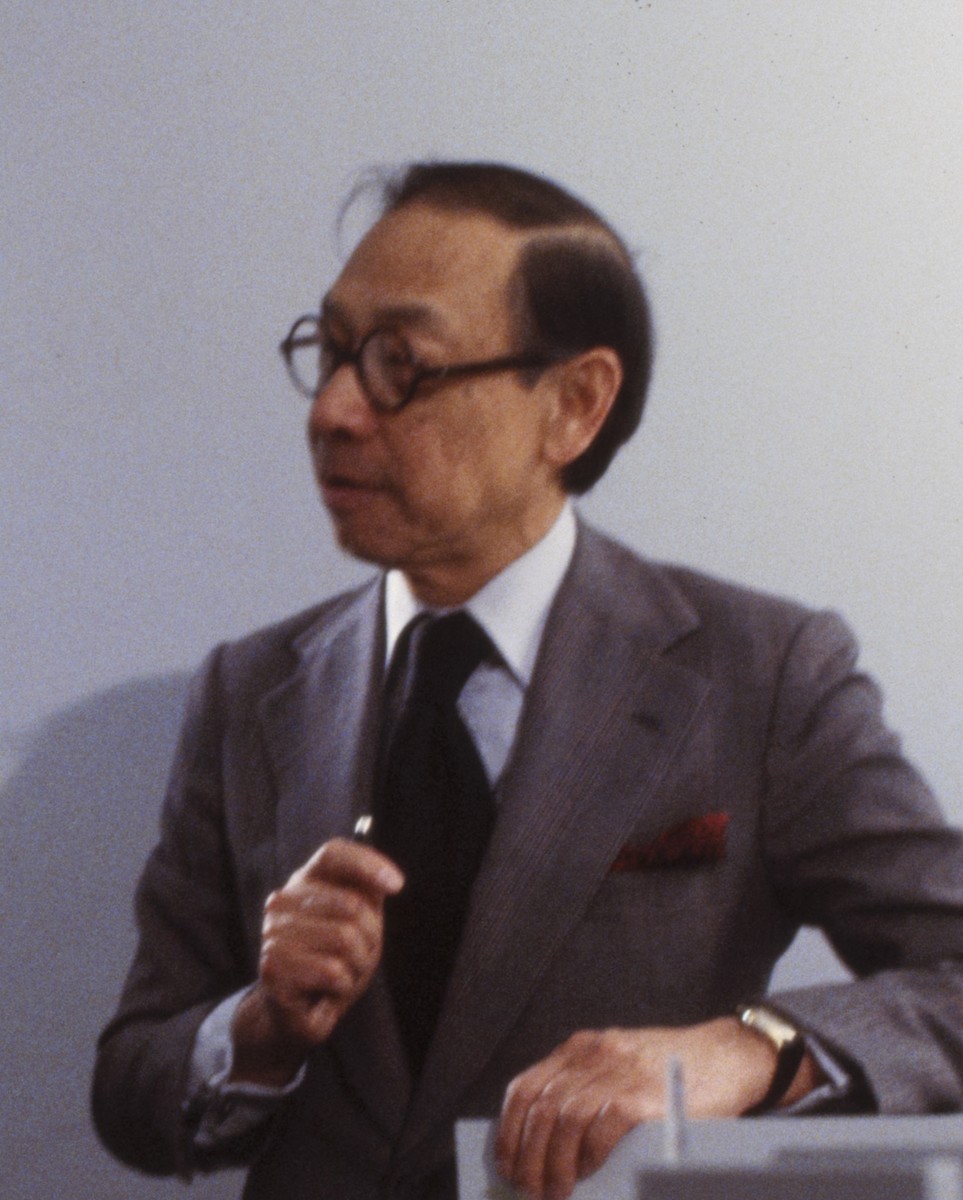

Photo: Bernard Gotfryd, 1980, Library of Congress, Prints and Photographs Division (LC-DIG-gtfy-03125), cropped and downscaled from the original · Library of Congress, Prints and Photographs Division, Bernard Gotfryd photograph collection (item 2020732666, reproduction number LC-DIG-gtfy-03125; slide caption 'Itzhak Perlman with I.M. Pei, architect, looking at model of NYC Convention Center', photographer Bernard Gotfryd, [1980]), via Wikimedia Commons file '(03125v).jpg' (original JPEG 4910 x 3340 pixels). The Library's rights advisory for the item is 'No known restrictions on publication'; the item notes read 'Photo agency: Newsweek' and 'Gift; Bernard Gotfryd; 2004', and the collection statement adds that the photographs were restricted during Gotfryd's lifetime (he died in 2016) and that privacy and publicity rights may apply. A 4:5 region (1553 x 1935 pixels) around Pei was cropped from the right of the frame, excluding the violinist Itzhak Perlman at the left, and downscaled once to 963 x 1200 (never upscaled). · No known restrictions on publication
건축가 · 20세기
I. M. 페이
1917–2019
주요 업적 분야
아직 성격 매칭에 포함되지 않았습니다 — 기록된 근거가 성격 모델 전체를 다루기에는 충분하지 않습니다. 이 페이지의 다른 모든 내용은 자유롭게 확인하실 수 있습니다.
핵심 특성
주요 업적
그는 그랑 루브르 사업에서 유리 피라미드와 그 아래 지하 로비를 설계해, 루브르 박물관의 세 개 동을 곧장 잇는 중앙 출입구를 만들었다. 거센 비판 속에서 1989년 3월 29일 문을 연 이 피라미드는 지금은 박물관의 상징이 되었다.
그는 워싱턴 국립미술관 동관(1978년 개관)을 설계했다. 불규칙한 부지를 두 개의 삼각형으로 나누어 푼 건물이다. 폴 골드버거에 따르면 『뉴욕 타임스』 건축 비평가 에이다 루이스 헉스터블은 이 건물을 그 시대에 가장 중요한 건물이라고 평했고, 페이 자신도 이를 가장 중요한 작품 중 하나로 꼽았다.
그는 1955년 I. M. 페이 앤드 어소시에이츠(훗날 페이 콥 프리드 앤드 파트너스)를 세워 케네디 도서관(1979), 홍콩 중국은행 타워(1989), 도하 이슬람 미술관(2008) 등 50개가 넘는 프로젝트를 설계했다. 브리태니커는 그의 양식을 대담한 기하학적 구성과 대비가 풍부한 재료가 특징인 국제주의 양식의 확장으로 설명하며, 그는 1983년 프리츠커 건축상을 받았다.
삶의 장면들
루브르 피라미드를 설계하면서 페이는 처음에는 반사율이 약간 있는 유리를 검토했으나, 옛 건물들의 색이 달라 보이지 않도록 유리를 최대한 투명하게 만들기로 했다. 건축가 마이클 플린에 따르면 그는 금속 프레임도 주변 지붕의 색에 맞추기를 원했고, 그래서 주변 건물에 쓰인 11가지 회색 가운데 어느 것을 고를지를 두고 팀이 여러 차례 논의했다. 루브르 박물관은 이 초투명 유리를 개발하는 데 2년의 연구가 필요했다고 설명한다.
재료의 투명도와 색 같은 세밀한 시각적 요소에 세심하게 주의를 기울인 태도와 일치한다. 디테일 지향
클리블랜드의 로큰롤 명예의 전당 설계를 의뢰받았을 때 록 팬이 아니었던 페이는 처음에는 일을 거절했다. 마음을 바꾼 뒤에는 『롤링 스톤』 발행인과 함께 록 콘서트를 찾아다니며 준비했다고 『뉴욕 타임스』는 전한다. AP는 그가 이제 막 비틀스를 따라잡는 중이라고 털어놓았고 로큰롤의 뿌리를 조사했다고 보도한다.
낯선 주제를 설계하기 전에 먼저 배워 두는 습관과 일치한다. 호기심
전환점
1964년 재클린 케네디는 그의 사무실을 찾았다가 감명을 받아, 루이스 칸 등이 후보에 오른 가운데 페이에게 케네디 도서관을 맡겼다. 골드버거는 이 일이 그를 미국 건축가들의 선두로 끌어올렸다고 쓴다. 이후 케임브리지 부지를 둘러싼 정치적 반대로 사업은 수년간 지연되었고, 1976년 컬럼비아 포인트로 부지를 옮긴 뒤 페이와 동료는 설계를 '처음부터 다시' 시작했다. 도서관은 1979년 10월 20일 헌정되었다.
부지 변경과 재설계를 거치면서도 오래 걸리고 얽힌 사업을 끝까지 이끌어 간 태도와 일치한다. 끈기
비슷한 인물
전체적인 프로필이 이 사람과 닮은 사람들이에요.
출처
- I. M. Pei (Q46868) -- verified live via the Wikidata API (2026-10-15): English label 'I. M. Pei', description 'Chinese-American architect (1917-2019)', born 26 April 1917, died 16 May 2019, citizenship United States, Korean label present. Orientation only; not used as support for any row.
- The Pritzker Architecture Prize, 1983 laureate page for I. M. Pei (biography, announcement and jury citation) -- CANONICAL SIGNIFICANCE SOURCE: the laureate biography (Webb & Knapp director of architecture from 1948, I. M. Pei & Associates from 1955, Pei Cobb Freed & Partners from 1989; the East Building of the National Gallery of Art and the Louvre extension named as two of his most prominent commissions; over fifty projects) and the unanimous jury's citation (some of the century's most beautiful interior spaces and exterior forms, concern for the surroundings of his buildings, a refusal to limit himself to a narrow range of problems, including moderate and low-income housing, and 'diplomacy and patience' that drew disparate people and disciplines together). Award-body citation, honouring in tone. Read in full.
- Elizabeth Evitts Dickinson, 'Louvre Pyramid: The Folly that Became a Triumph', ARCHITECT magazine (American Institute of Architects), on the 2017 AIA Twenty-Five Year Award for the Grand Louvre -- trade-press account of how Pei secretly studied the Louvre for four months before accepting President Mitterrand's personal request, the 'Battle of the Pyramid' (a 1985 New York Times round-up of criticism and Pei's PBS recollection that most of the public was against it), and interviews with two Pei Cobb Freed architects (Ian Bader, Michael D. Flynn) on his working style, the glass and frame decisions, the full-scale wire mock-ups for Mitterrand and Chirac, and building the pyramid ahead of its supporting structure. Firm colleagues' recollections, admiring but specific; Pei's own PBS words are self. Read in full.
- Encyclopaedia Britannica, 'I.M. Pei' (article by Britannica's editors, last updated 5 October 2026; the page's AI-generated summaries were not used) -- encyclopaedia biography: a Chinese-born American architect noted for large, elegantly designed urban buildings and complexes, who headed Webb & Knapp's architectural division from 1948 (Mile High Center, Hyde Park Redevelopment, Place Ville-Marie), formed I. M. Pei & Associates in 1955, designed the National Gallery of Art East Building (1978, 'hailed as one of his finest achievements'), was chosen by Mitterrand after the East Building for the Grand Louvre, whose glass pyramid 'was initially controversial but over time came to be celebrated', and completed the Bank of China Tower (1989), the Miho and Suzhou museums and the Museum of Islamic Art in Doha (2008); his style as an extension of the International Style with geometric arrangements and richly contrasted materials; honours. CANONICAL SIGNIFICANCE SOURCE alongside the Pritzker laureate page (encyclopaedic orientation to his primary contribution; neutral in tone, used for the achievement cards and orientation and never alone for a behavioural row). Read in full except the early-life and family passages, which were not used.
- Musee du Louvre, 'A pyramid for a symbol: Cour Napoleon and Pyramid' (museum web page) -- the client museum's own account of the Grand Louvre project commissioned by President Mitterrand in 1981: Pei's July 1983 appointment, his idea of a central underground lobby giving direct access to the three wings, the pyramid and the new exhibition spaces, storerooms and visitor facilities, the controversy, his statement that his approach was that of a landscape designer with Le Notre as inspiration, the metal frame built with firms specialised in ships' rigging, the inauguration on 29 March 1989, two years of research for the extra-clear glass made by Saint-Gobain, and his solution for the alignment of the courtyard with the Tuileries axis. Client-institution account, admiring in tone; Pei's own quoted statement is self. Read in full.
- Agence France-Presse, 'Angry glances in the street: How Paris met Pei's Louvre pyramid', Paris, 17 May 2019 (read as published by Malay Mail) -- wire-service account of the pyramid controversy: up to 90 per cent of Parisians said to be against it at one point, Pei's recollection of 'angry glances', the January 1984 meeting of the historic-monuments commission that ended in uproar before he could present, the Louvre's then director Andre Chabaud's resignation in 1983 in protest at the 'architectural risks', former culture minister Jack Lang's recollection, later praise by Le Figaro and Prince Charles, and the present director's judgement; says Pei needed 'all his tact and dry sense of humour'. Wire copy; AFP's 28 March 2019 anniversary piece was also read and repeats the same episodes, so the two are one perspective, not two. Passages on the president's health and on one commentator's characterisation of the opposition were not used. Read in full.
- Agence France-Presse, 'From outrage to icon: Paris marks 30 years of Louvre's pyramid', Paris, 28 March 2019 (read as published by Malay Mail) -- anniversary wire piece by the same agency as the obituary above and covering the same episodes (the early outrage, Pei's recollection of 'angry glances', the monuments-commission meeting, the former director's resignation, Le Figaro's later supplement, the current director's view that the Louvre's entrance is a work of art), so it is counted as the same single wire perspective. Read in full; passages on the president's health and on satirical coverage were not used.
- National Gallery of Art, Washington, Margaret Huang (archivist, National Gallery Archives), 'Who Is I. M. Pei? 10 Things to Know', 12 May 2023 -- client institution's archival article: his first constructed design (a 1949 Gulf Oil office in Atlanta whose marble curtain wall Architectural Forum praised), the 1955 firm, Jacqueline Kennedy's 1964 choice of Pei for the Kennedy Library over Kahn and Mies, the trustees' 1968 selection for the East Building, his division of the irregular site into two triangles (first sketched on an envelope), the approach of manipulating mass, volume, light and materials with an eye to how people experience architecture and its debt to cubism, the visits by Mitterrand and Emile Biasini to the East Building before the Louvre commission, the use of his 1983 Pritzker money for a scholarship fund for Chinese architecture students, and the Gallery's archive of the firm's East Building records. Client-institution account, admiring in tone; Pei's quoted statements are self. Read in full.
- John F. Kennedy Presidential Library and Museum, 'I.M. Pei, Architect' (library history page) -- the client institution's account of the commission: Jacqueline Kennedy's selection in 1964 of a relatively young and unknown architect who told her he had not worked on monumental projects, the December 1964 commission for a Cambridge site and the initial design with a truncated glass pyramid, the 1976 decision to build instead at Columbia Point after delays and local concerns, Pei and his associate Ted Musho starting 'all over again' for the new site, the 1977 groundbreaking and 1979 dedication, the 1991 addition by Pei, and a career summary noting that he showed little concern with theory and did not think architecture should be isolated from commercial forces. Client-institution account; Pei's own dedication-programme words are self. Read in full.
- Paul Goldberger, 'I.M. Pei, World-Renowned Architect, Is Dead at 102', The New York Times, 16 May 2019 (read as a full-text repost on the Ohio State University MCLC Resource Center, because the Times page returned HTTP 403 to direct download) -- critic's obituary: Pei's rise from Webb & Knapp to I. M. Pei & Associates (1955, with Henry Cobb and Eason Leonard) and independence in 1960, an appeal to developers, corporate chiefs and museum boards at once, the Kennedy Library's 15-year path and compromises, the Hancock Tower failure (designed by his partner Henry Cobb; experts blamed the glass; the firm nearly closed), the East Building and Ada Louise Huxtable's 1978 verdict, the Rock and Roll Hall of Fame commission he first turned down and the Qatar museum for which he began by reading and travelling, the Fragrant Hill hotel he later called a disappointment, and the Louvre pyramid as, like the Kennedy Library, Hancock Tower and Javits Center, a measure of his 'patience and perseverance'. Independent critic's assessment, admiring but recording failures; family and private-life passages were not used. Read in full.
- James S. Russell (Bloomberg), 'Celebrated Architect I.M. Pei Is Dead at 102', Fortune, 16 May 2019 -- architecture critic's obituary: 'reserved and supremely diplomatic', with charm and quick wit towards clients; Goldberger's 1989 judgement of Pei as the most pragmatic and most visionary of architects; the firm's perfectionism with materials (razor-sharp marble corners, stretched glass, honed concrete) and the price paid when they stretched materials to the limit (the Hancock Tower's glass failures, litigation that 'might well have destroyed the firm', an opening four years late at almost double the estimate, and the roof of the Javits Center), yet setbacks 'could never persuade Pei to turn away from technological possibility'; critics' limits (forms derived from Le Corbusier and Kahn, limited influence on the course of architecture, the stiff grandeur of the Rock and Roll Hall of Fame, the much-reviled MIT media building). Independent critic's balanced assessment. Family passages were not used. Read in full.
- Associated Press, 'I.M. Pei, architect who designed JFK Library, dies at 102', 16 May 2019 (read as published by Boston.com) -- wire obituary: Pei 'painstakingly researched each project', his reputation as a skilled diplomat who persuaded clients to spend money on grand-scale projects, Jacqueline Kennedy's remark that he 'loves things to be beautiful', the Louvre pyramid and his comment that the time had to be right, the Hancock Tower lawsuits (settled in 1981), his research into the roots of rock and roll for the Cleveland museum, and the Qatar museum. Wire copy; wartime and family passages were not used. Read in full.
- Architectural Record, 'Architects Pay Tribute to I. M. Pei', 22 May 2019 -- trade-press collection of recollections by former colleagues and friends (Rob Rogers, Lo-Yi Chan, Ted Trussell Porter, Abby Suckle, Alexander Gorlin, Lorcan O'Herlihy, Michael Speaks, Robert Heintges, Kathy Ogawa): Pei's calm intensity across urban scale and fine detail, watching him with clients 'listening, teaching, selling', a lesson about placing every dot on a site plan exactly, his advice to pick clients carefully, a firm of up to 300 people in which any member's better design idea was pursued, the habit of reinventing products when none suited, his encouragement and referrals for departing staff, and his persuasive manner with a difficult client. Admiring tribute pieces by former employees, specific in anecdote; an anecdote about a third party's alleged misconduct was not used. Read in full.
- Library of Congress, Prints and Photographs Division, item record 2020732666, 'Itzhak Perlman with I.M. Pei, architect, looking at model of NYC Convention Center' (Bernard Gotfryd photograph collection; 35 mm colour transparency, [1980]; reproduction number LC-DIG-gtfy-03125) -- checked for the portrait's rights: the record gives Rights Advisory 'No known restrictions on publication', names Bernard Gotfryd as photographer and carries the notes 'Photo agency: Newsweek' and 'Gift; Bernard Gotfryd; 2004'; the Library's statement for the collection says there are no known copyright restrictions on Gotfryd's photographs, that they were restricted during his lifetime (he died in 2016) and that privacy and publicity rights may apply. The record was read through the Library's JSON interface because its HTML page returned HTTP 403 to direct download. Not used for any scoring.
- Wikimedia Commons file page 'Itzhak Perlman with I.M. Pei, architect, looking at model of NYC Convention Center (03125v).jpg' -- checked for the portrait's file and licence: Bernard Gotfryd, dated 1980-03-01 on Commons (the Library records [1980]), tagged with the Commons licence tag for the Gotfryd collection (Library of Congress, no known copyright restrictions; the tag's note repeats that the photographs were restricted during his lifetime and that privacy and publicity rights may apply); original JPEG 4910 x 3340 pixels with the Library's item link as its source. Not used for any scoring.