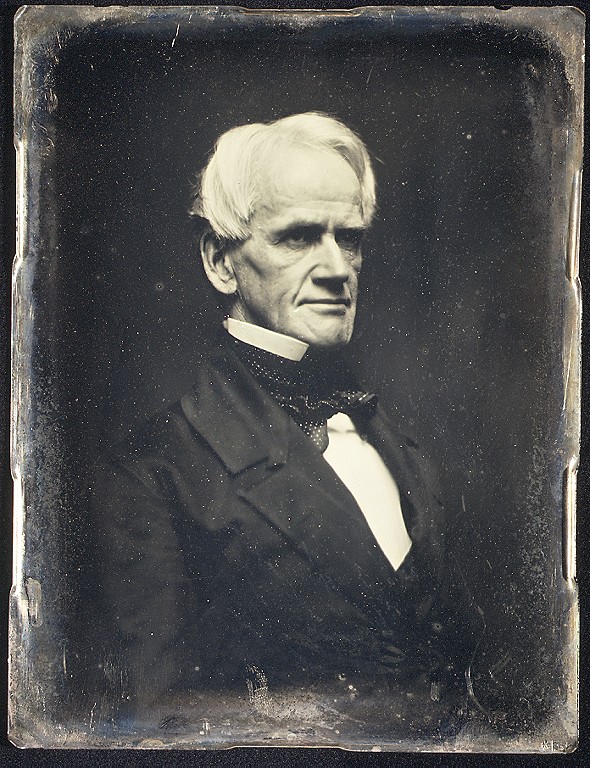

Southworth and Hawes, Horace Mann, ca. 1850, daguerreotype, The Metropolitan Museum of Art, Gift of I. N. Phelps Stokes, Edward S. Hawes, Alice Mary Hawes, and Marion Augusta Hawes, 1937 (37.14.25), public domain · Daguerreotype portrait 'Horace Mann' by the Boston studio of Southworth and Hawes (Albert Sands Southworth and Josiah Johnson Hawes), about 1850, The Metropolitan Museum of Art, New York (object 37.14.25, gift of I. N. Phelps Stokes, Edward S. Hawes, Alice Mary Hawes and Marion Augusta Hawes, 1937). The Met's live object page labels the work Public Domain with an image download and states that Open Access public domain images are free for commercial and noncommercial use; the Met's collection API reports the object as public domain with no reproduction restriction. The file is the Met's original image (590 x 768 pixels), unaltered and not upscaled. A daguerreotype is a mirror image, so left and right are reversed. · Public domain (The Met Open Access; photographers died 1894 and 1901)
교사 · 19세기
호러스 맨
1796–1859
주요 업적 분야
아직 성격 매칭에 포함되지 않았습니다 — 기록된 근거가 성격 모델 전체를 다루기에는 충분하지 않습니다. 이 페이지의 다른 모든 내용은 자유롭게 확인하실 수 있습니다.
핵심 특성
주요 업적
새로 생긴 매사추세츠 교육위원회의 초대 사무총장(1837-48)으로서 열두 편의 연례 보고서와 끊임없는 강연으로, 무상의 보편적이고 특정 종파에 치우치지 않으며 훈련받은 교사가 가르치는 공립학교를 주장했다. 그는 흔히 '공립학교의 아버지'로 불린다.
1838년 『공립학교 저널』을 창간해 편집했고, 주 곳곳의 학교를 다니며 교사 양성을 위한 사범학교, 더 긴 학사 일정, 더 나은 학교 설비와 읽기 교재를 요구했다.
1853년 오하이오의 신설 안티오크 대학의 초대 총장이 되었다. 남녀공학이고 특정 종파에 속하지 않으며 흑인에게도 문을 연 이 대학을 재정난 속에서도 1859년 숨질 때까지 이끌었다.
삶의 장면들
새 위원회의 일을 이끌기 위해 6년 동안 홀로 말을 타고 주의 공립학교를 돌며 천 곳이 넘는 학교를 살폈고, 해마다 군(郡) 모임을 열어 직접 연설하고 교사와 졸업생의 증언을 듣게 했다.
이는 개혁을 위한 지지를 직접 현장으로 나가 얻으려 한 모습과 일치한다. 선제적 행동력
열두 편의 연례 보고서에서 공교육을 위한 여섯 가지 명제를 폈고, 특정 종파에 치우치지 않는 학교를 못마땅해한 성직자, 그의 교수법에 반대한 교육자, 지역 자치를 옹호한 정치인의 반발에 맞섰다.
이는 공식적 권한 대신 논증과 공개적 설득으로 일한 개혁가의 모습과 일치한다. 설득력
전환점
1837년 유망한 정치 경력을 내던지는 것이라는 친구들의 만류에도 변호사 일과 주 의회 경력을 접고, 직접적인 권한이 거의 없는 새 매사추세츠 교육위원회 사무총장직을 맡았다.
이는 더 유망한 기존의 경력보다 하나의 대의를 택한 모습과 일치한다. 영향 창출 동기
비슷한 인물
전체적인 프로필이 이 사람과 닮은 사람들이에요.
출처
- Horace Mann (Q1151173), verified live via the Wikidata API (2026-10-31): label 'Horace Mann', description 'American politician (1796-1859)', born 4 May 1796, died 2 August 1859, country United States, Korean label present, image a Southworth and Hawes daguerreotype of about 1850. The 'politician' description is Wikidata's; this profile treats and scores only his education-reform work. Orientation only; not used as support for any row.
- Lawrence A. Cremin, 'Horace Mann', Encyclopaedia Britannica, read in full. CANONICAL SIGNIFICANCE SOURCE: American educator, the first great American advocate of public education, who held that education in a democratic society should be free, universal, nonsectarian, democratic in method and reliant on well-trained professional teachers; self-educated at the Franklin town library; left a promising political career, against his friends' advice, to accept the first secretaryship of the new Massachusetts state board of education (1837), a post with little direct power that demanded moral leadership for eleven years; started the Common School Journal (1838), lectured widely, wrote twelve annual reports built on six propositions, met strong resistance from clergymen, educators and politicians but saw his views prevail; later became president of the new Antioch College (1853). Reference entry by an education historian; the praise is retrospective.
- 'Horace Mann', American Social Reform Movements Reference Library (Gale), via Encyclopedia.com, read in full. Student-level biography: as education secretary he visited the state's common schools alone on horseback over six years and inspected more than a thousand, held annual county meetings, worked with the philanthropist Edmund Dwight on a matching gift for teacher-training 'normal' schools, founded and edited the Common School Journal from 1838, urged a minimum school year, standard reading materials, equipment and compulsory attendance, and later presided over the struggling Antioch College; the schools story is told largely in the voice of admiration and some claims (such as 'first of their kind') are not used here.
- Jennings L. Wagoner Jr. and William N. Haarlow, 'Common School Movement', Encyclopedia of Education (Gale), via Encyclopedia.com, read in full. Independent overview of the movement: Mann, 'often referred to as the Father of the Common School', left law and the legislature in 1837 to become secretary of the new board and stumped the state for common schools; other reformers (Carter, Barnard, Stowe, Beecher and others) worked in parallel; opposition came from Catholics who found the 'nonsectarian' schools Protestant, from advocates of local control, and from opponents of taxation; Kaestle's view that acceptance rested on republican values, Protestant culture and capitalism. Used as the independent significance and counter-voice source; it shows his place within a wider movement.
- 'Horace Mann Collection, 1669-1926', Guide to the Microfilm Edition, Massachusetts Historical Society, read: biographical timeline (Brown University 1819, bar 1823, legislature from 1827, elected secretary of the Massachusetts Board of Education 29 June 1837, normal school sites chosen January 1840, Antioch presidency inaugurated 5 October 1853, college sold at auction 20 April 1859, death 2 August 1859) and a description of the papers (correspondence, journals, speeches on education, politics, slavery, temperance and religion). Archival finding aid; the timeline is neutral and gives dates only.
- 'Mann, Horace', Dictionary of Unitarian and Universalist Biography, read in full. Denominational biography: his education policy rested on a belief in human perfectibility and moral law; during his tenure school funding rose, teacher preparation improved and compassionate discipline was urged; his advocacy of nonsectarian religious teaching was his most controversial work and he was criticised then and now from both sides, as anti-Christian by some and as reflecting Unitarianism and phrenology by others; at Antioch conservative faculty suspected him of making the students Unitarians until a rescue of the college's finances was arranged. Used as a counter-voice; its Unitarian perspective colours the account.
- 'Horace Mann', daguerreotype by Southworth and Hawes, about 1850, The Metropolitan Museum of Art (object 37.14.25), live object page and Open Access record, read for the portrait review only. Not used for any row.