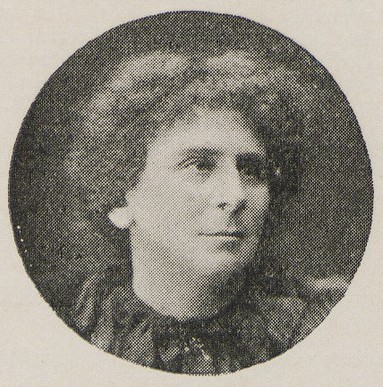

Photographer unknown, Mrs Ayrton, printed in the Who's Who of the International Congress of Women, London, 1899, Schlesinger Library, Harvard, public domain, via Wikimedia Commons · Studio photograph of Hertha Ayrton, reproduced as a small printed halftone in the 'Who's Who' album of the International Congress of Women, London, June 1899 (caption 'Mrs Ayrton'); photographer not named. The scan is from the Charlotte Perkins Gilman Papers, Schlesinger Library, Radcliffe Institute, Harvard University (Collection 177, folder 6), page about 2682 x 1828 pixels, and the Wikimedia Commons copy is a circular-portrait crop of that page, 383 x 387 pixels. The same pose, hair and brooch appear in a Library of Congress Bain News Service photograph of Hertha Ayrton, which is how the identification was checked. A printed publication of 1899 is in the public domain in the United States by age (published before 1931) and, with no named photographer, in the United Kingdom. The file is used at its original 383 x 387 size, with no resizing or upscaling. · Public domain (published in 1899)
핵심 특성
주요 업적
그녀는 전기 아크등이 쉿 소리를 내며 깜박이는 이유를 밝혀 그 원인이 양극 탄소에 닿는 산소임을 찾아냈고, 1899년의 논문과 1902년의 저서 《전기 아크》에서 전류, 아크 길이, 전압의 관계를 정리했다.
모래 물결무늬와 물의 소용돌이를 연구한 끝에 그녀는 제1차 세계대전 참호에서 독가스를 몰아내는 손부채를 설계했고, 육군부는 처음에는 이를 일축했으나 결국 약 10만 4천 개를 보급했다.
그녀는 1899년 전기기술자협회의 첫 여성 회원이 되었고 1906년 왕립학회의 휴즈 메달을 받았으나, 왕립학회는 기혼 여성이라는 이유로 그녀를 회원으로 선출하지 않았다.
삶의 장면들
샤프는 그녀가 아크의 분화구에 산소를 불어 넣으면 쉿 소리가 나고 질소를 불어 넣으면 나지 않는다는 것을 강연 실험으로 보인 일을 기록했다.
이는 기체를 하나씩 바꿔 가며 원인을 가려낸 실험가의 모습과 일치한다. 실험 성향
허시에 따르면 육군부는 그녀의 부채를 일축했고 신문 지상의 격한 공방이 이어진 뒤에야 10만 4천 개를 보급했으며, 샤프는 부채가 전선에서 쓰이기까지 1년이 지체되었다고 기록했다.
이는 공식적인 거부 속에서도 거절당한 발명을 계속 밀고 나간 발명가의 모습과 일치한다. 끈기
전환점
1893년 남편이 시카고에 가 있는 동안 그녀는 전기 아크 실험을 넘겨받았고, 선 분할기 등 앞선 발명에 이어 이 연구가 그녀의 명성을 세웠다.
이는 기구 발명에서 지속적인 실험 연구로 옮겨 간 경로와 일치한다. 분야 횡단성
비슷한 인물
전체적인 프로필이 이 사람과 닮은 사람들이에요.
출처
- Hertha Ayrton (Q17522), verified live via the Wikidata API (2026-10-31): label 'Hertha Ayrton', description 'English electrical engineer (1854-1923)', born 28 April 1854, died 23 August 1923 (other sources give 26 August), citizenship United Kingdom, Korean label present. Orientation only; not used as support for any row.
- Marjorie Malley, 'Ayrton, Hertha', Complete Dictionary of Scientific Biography (Scribner, 2008), via Encyclopedia.com, read in full. CANONICAL SIGNIFICANCE SOURCE: engineer; education at Girton and Finsbury; her patented line divider; taking over the electric-arc research and relating power, potential, current and arc length; her analysis of the hissing arc as oxidation of the positive carbon; the 1899 reading of her paper at the Institution of Electrical Engineers and her election as its first woman member; The Electric Arc (1902); the sand-ripple vortex work and its application in the anti-gas fan, whose wide use was hindered; the 1906 Hughes Medal and the Royal Society's refusal to elect a married woman. Reference article by a historian of science.
- Pam Hirsch, 'Hertha Ayrton', Jewish Women: A Comprehensive Historical Encyclopedia (Jewish Women's Archive, 2009), read in full: family and schooling, Cambridge, the line divider and its patents, work on the arc, the first paper read by a woman at the Institution of Electrical Engineers, her 26 patents (five on dividers, 13 on arc lamps and electrodes, the rest on propelling air), the anti-gas fan that the War Office first dismissed before issuing 104,000, and the Royal Society's refusal of her fellowship in 1902. Scholarly encyclopedia entry by a Cambridge historian; it also describes suffrage campaigns, which are not scored.
- Evelyn Sharp, 'Hertha Ayrton, 1854-1923: A Memoir' (Edward Arnold, 1926), read through the Internet Archive text (about 625,000 characters searched, chapters on the arc, the 1902 Royal Society episode, the Hughes Medal and the Ayrton fan read closely): the gas experiments showing that oxygen reaching the crater causes the hissing, the Royal Society's 1902 letter on a married woman's certificate, the fan's rejection by the War Office advisers, the favourable Chatham report and the year of delay before use at the front. Biography by a friend and fellow campaigner, so admiring and partisan; letters quoted in it are the nearest thing to her own voice here.
- 'Hertha Ayrton', Grace's Guide to British Industrial History, read in full, including the two 1923 obituaries reproduced from the engineering press: timeline from 1884 to 1923, her demonstrated linear relation among arc length, pressure and potential difference, the 12 papers in The Electrician in 1895-6, the 1899 Institution of Electrical Engineers paper, the 1906 medal, and the over 100,000 anti-gas fans used on the western front. Volunteer-run industrial-history site reproducing contemporary obituaries; the obituaries are professional-press tributes.
- 'Hertha Ayrton', Wikipedia, read for orientation only (it cites the Oxford Dictionary of National Biography entry by Joan Mason, which was not opened); never counted as a research source.