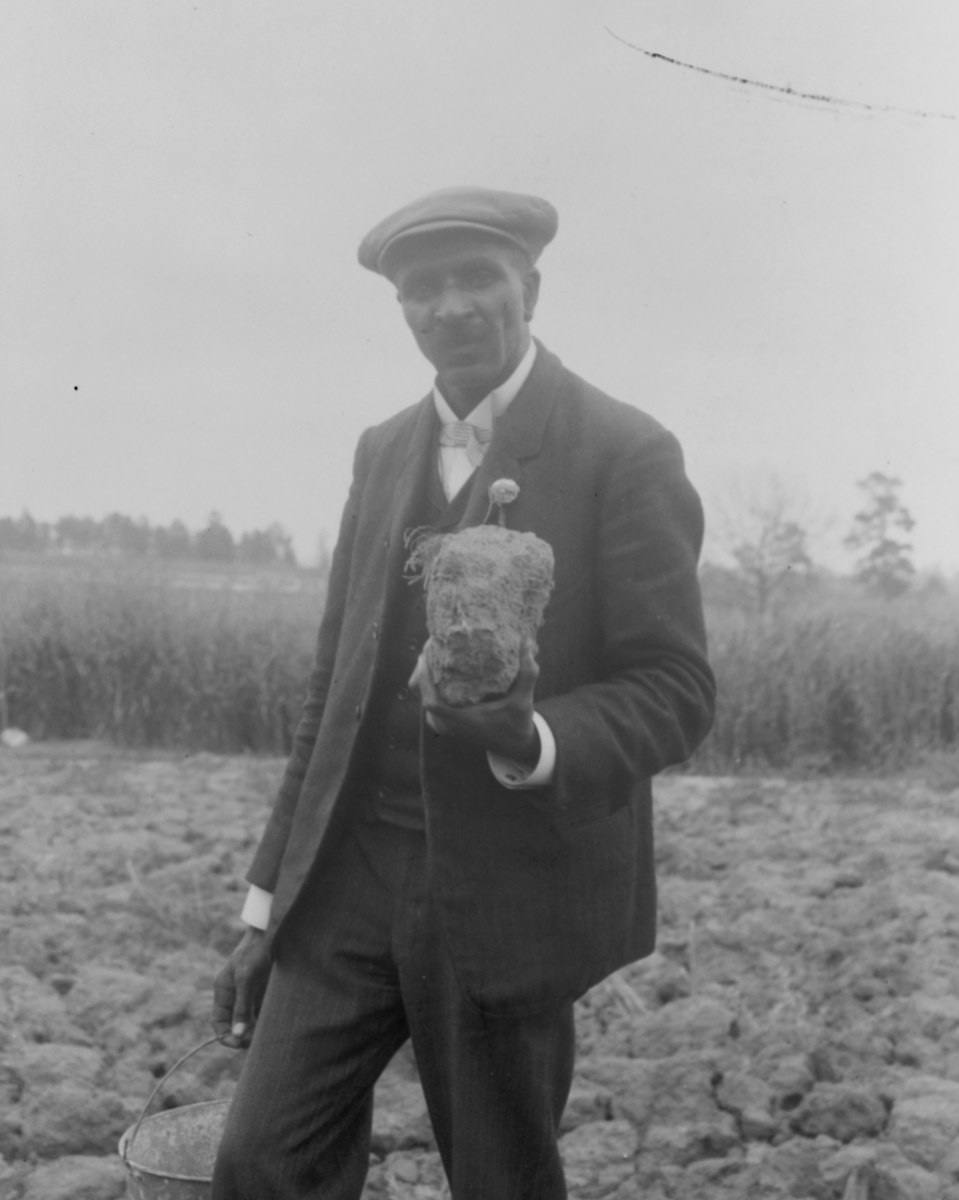

Frances Benjamin Johnston, 1906, Library of Congress Prints and Photographs Division (LC-J694-520) · Library of Congress, Prints and Photographs Division, LCCN 95507555 (LC-J694-520; cph.3c14302; Booker T. Washington Collection): 'George Washington Carver, full-length portrait, standing in field, probably at Tuskegee, holding piece of soil', photograph by Frances Benjamin Johnston (1864-1952), 1906. The image is the Library's own scan as mirrored on Wikimedia Commons (3282 x 4096 pixels, 839,321 bytes, SHA-1 33ff2bd0d46beca115967024d243377facca83d8, checked against the Library's 821 x 1024 pixel download at cdn.loc.gov: mean grey-level difference about 2 of 255, the same photograph); the Commons record carries the Library's rights line 'No known restrictions on publication' and the Library credit. It is the unrestored Library scan, not a third-party restoration. Saved as a crop of the figure's upper body (about 1999 x 2499 pixels of the original) downscaled once to 959 x 1200 (never upscaled). · Public Domain (published 1906; photographer died 1952; Library of Congress: no known restrictions on publication)
농학자 · 20세기
조지 워싱턴 카버
1864–1943
주요 업적 분야
아직 성격 매칭에 포함되지 않았습니다 — 기록된 근거가 성격 모델 전체를 다루기에는 충분하지 않습니다. 이 페이지의 다른 모든 내용은 자유롭게 확인하실 수 있습니다.
핵심 특성
주요 업적
1896년 조지 워싱턴 카버는 앨라배마의 터스키기 학원에 새로 생긴 농학부와 농업시험장의 책임자로 부임했고, 이후 평생 목화로 땅심이 다한 남부 가난한 농민들을 돕는 일에 매달렸다. 미국화학회에 따르면 그는 목화밭을 콩과 작물 등 땅을 기름지게 하는 작물과 돌려짓기해 상업 비료 없이도 수확량을 높였고, 반 에이커 규모의 고구마 밭 수확을 몇 해 만에 40부셸에서 266부셸로 늘렸다. 그는 터스키기에서 47년 동안 가르쳤다.
카버는 지식을 농민에게 직접 가져갔다. 미국화학회에 따르면 은행가 모리스 K. 제섭과 슬레이터 기금의 후원으로 1906년 5월 24일 문을 연 이동 학교인 제섭 마차는 카버가 계획했으며, 그가 직접 몰지는 않았지만 곧 미국 농무부 보급 사업의 일부가 되었다. 그는 농업시험장 책임자로서 소작농과 교사, 주부를 위한 소책자도 썼다. 미국화학회는 1898년부터 1943년까지 44권을 헤아리고, 미국 국립농학도서관은 이를 '말 한 마리 농기구만 가진 가난한 소작농'을 위한 평이한 안내서로 설명한다.
카버는 농민들이 땅을 되살리는 작물을 팔 시장을 얻도록 땅콩, 고구마, 토종 점토의 쓰임새를 개발했다. 미국화학회는 땅콩 하나에서만 300가지가 넘는 제품을 헤아린다. 1921년 땅콩 관세를 두고 하원 위원회에서 한 증언은 그를 대중에게 '땅콩 박사'로 각인시켰다. 다만 통념은 그를 과장한다. 바이오그래피닷컴은 그가 땅콩버터를 발명하지 않았다고 짚고, 앨라배마 백과사전은 그의 명성 상당 부분이 신화에 바탕을 두었지만 실제 기여는 컸다고 평가한다.
삶의 장면들
1921년 카버는 땅콩 업계의 전문가 증인으로 하원 세입위원회에 출석했다. 미국화학회에 따르면 그는 허름한 차림으로 견본을 더듬거리며 서툴게 시작했지만, 제품을 하나씩 보여 주고 설명하자 발언 시간이 거듭 연장되었고 위원들은 기립 박수를 보냈다. 바이오그래피닷컴은 위원들이 처음에는 그가 흑인이라는 이유로 그를 의심했다고 덧붙인다.
다듬어진 말솜씨보다 구체적인 시연으로 회의적인 청중을 설득하는 방식과 일치한다. 설득력
카버는 터스키기에서 자신의 방식대로 연구할 여건을 거듭 요구했다. 미국화학회에 따르면 그는 자기 혼자 쓰는 실험실과 수업 면제를 고집했고, 부커 T. 워싱턴의 제안을 자주 거절했다. 워싱턴은 그 제안이 '명령을 정중하게 말하는 방식'이라고 인정한 바 있다. 카버는 기숙사 방도 둘을 받아 하나를 식물 표본용으로 썼다. 워싱턴은 그가 가르치는 일을 완전히 그만두게 하지 않았고, 후임 로버트 모턴이 나중에 여름학기를 빼고 모든 수업을 면제해 주었다.
자기 일의 조건을 스스로 정하려는 강한 욕구와 일치하며, 그 때문에 학교 지도부와의 관계에서 대가를 치렀을 가능성이 있다. 자율성 욕구
전환점
1896년 4월 아이오와 주립대에서 석사 학위를 받은 카버는 앨코른 대학 교수직과 아이오와 주립대 교수 자리 대신, 부커 T. 워싱턴이 제안한 터스키기의 새 농업 학교를 택했다. 미국화학회는 그의 수락 편지를 인용한다. '내 사람들'에게 가능한 한 가장 큰 선을 베푸는 것이 평생의 가장 큰 이상이었다고 썼다. 앨라배마 백과사전에 따르면 그는 몇 해만 머문 뒤 박사 과정을 밟을 생각으로 왔지만 1943년 세상을 떠날 때까지 터스키기에 남았다.
더 명망 있거나 안정적인 자리보다 자신이 도울 수 있는 사람들을 기준으로 일자리를 고르는 태도와 일치한다. 영향 창출 동기
비슷한 인물
전체적인 프로필이 이 사람과 닮은 사람들이에요.


말랄라 유사프자이

제인 구달

엘리자베스 케이디 스탠턴

넬슨 만델라

공자
출처
- George Washington Carver (Q296898) -- verified live via the Wikidata API (2026-10-22): English label 'George Washington Carver', description 'African American botanist and inventor (1864-1943)', born 1864 (year only), died 1943-01-05, citizenship United States, Korean label present. Orientation only; not used as support for any row.
- American Chemical Society, National Historic Chemical Landmarks, 'George Washington Carver: Chemist, Teacher, Symbol' (landmark designated 27 January 2005 at Tuskegee University; web version of the 2007 commemorative booklet) -- read in full: his early life and training (Simpson College, Iowa State, master's degree 1896 under the mycologist L. H. Pammel); Booker T. Washington's 1896 call to Tuskegee; the friction over his salary, his two dormitory rooms, his wish for a laboratory of his own and relief from teaching and committee work, and his running feud with a subordinate; the 10-acre experiment station, where legume rotation took a half-acre sweet potato plot from 40 to 266 bushels without commercial fertilizer; the products from sweet potatoes and peanuts (more than 300 from the peanut); the 1906 Jessup wagon; the 44 bulletins of 1898-1943 written, edited and typed by Carver in a one-man, underfunded station; the 1921 House Ways and Means testimony; the 1930s peanut-oil massage claims ('a bit of the charlatan', yet he never took payment); his role as teacher and mentor; and the closing verdict that he was a scientist 'not one who always used the most rigorous methods' whom many groups adopted as a symbol. Balanced institutional account that names both achievements and weaknesses. CANONICAL SIGNIFICANCE SOURCE (his primary historical contribution: agricultural research, soil-restoring rotation and extension teaching for poor Southern farmers, and crop-product development).
- Encyclopedia of Alabama, 'George Washington Carver' (encyclopediaofalabama.org) -- read in full: recruited in 1896 to head Tuskegee's new school of agriculture and experiment station, arriving in October 1896 meaning to stay a few years; early friction over salary and his demand for a room to paint; an experiment station funded far below the nearby all-white Auburn station; research aimed at the 'man fartherest down' with low-cost substitutes needing no commercial fertilizer, and sweet potatoes, cowpeas and peanuts as soil-replenishing, protein-giving alternatives to cotton; 'cookstove chemistry'; two-day conferences at fairs and short courses fitted to sharecroppers' time and literacy; the Movable School run for decades by his former student Thomas Monroe Campbell; the 1921 peanut tariff testimony that made him the 'Peanut Man'; the struggling Carver Products Company of the 1920s; and the verdict that 'Much of his fame was based upon myth, but his real contributions were significant.' Independent state reference work, admiring of the work and openly critical of the myth; it does not use the term crop rotation.
- National Park Service, George Washington Carver National Monument, 'George Washington Carver' article (nps.gov/articles/gwcarver.htm) -- read in full: born into slavery in Missouri; education at Simpson College and Iowa State (Bachelor of Agriculture 1894, Master of Agriculture 1896); Booker T. Washington's 1896 invitation to head Tuskegee's Agriculture Department, where Carver taught for 47 years; his stated aim 'to be the greatest good to the greatest number of my people'; research on alternatives to cotton, more than 100 uses for the sweet potato and more than 300 for the peanut; and the movable school named for its backer Morris K. Jesup. Official park-service biography, admiring and brief; it does not mention patents, bulletins or myths.
- Biography.com, 'George Washington Carver: Beyond Peanuts' -- read in full: he did not invent peanut butter; the 1921 House Ways and Means testimony after the United Peanut Association of America asked him to speak, after which the 'Peanut Man' association stuck; the 1930s peanut-oil massage treatment of polio patients with 'no scientific evidence it helped'; the 1916 bulletin on growing and preparing peanuts; his refusal to keep a fixed list of his products; the correspondence with John Harvey Kellogg (1919-26) and the friendship with Henry Ford; weeds and wild plants promoted as food, with a former student's 1948 complaint that the dishes tasted terrible; and that he filed only three patents ('it would take so much time I would get nothing else done'). Popular-press profile that corrects the peanut-butter myth; it does not discuss rotation, teaching or the Jesup wagon.
- National Inventors Hall of Fame, inductee profile 'George Washington Carver' (invent.org) -- read in full: two U.S. patents listed (Nos. 1,522,176 and 1,541,478, the page does not say what they cover); 325 uses credited for the peanut and flour, vinegar, ink, dyes and paints from the sweet potato; soil studies at Tuskegee; teaching farmers to rotate cotton with legumes and sweet potatoes; the 1921 testimony; the ranking of peanuts among leading U.S. crops by 1940; his life savings left to a research institute at Tuskegee; and the 2005 ACS landmark. A promotional hall-of-fame profile whose claims are not independently sourced; the page and Biography.com disagree on the number of patents (two against three), so no patent count is used here.
- USDA National Agricultural Library, 'George Washington Carver's Tuskegee Institute Experiment Station Bulletins' (exhibit by Emily Marsh) -- read in full: 38 Carver bulletins of 1898-1942 held by the library, in six topic groups (crop development, farm management, homemaking, livestock, rural schools, soil productivity); bulletins written for the 'poor tenant farmer with a one-horse equipment', rural schoolteachers and housewives; Carver as author of all but four of about 25 station bulletins in the 15 years after 1905 (citing Hersey 2006); plain, list-based instruction mixed with moralising; the 1898 'Feeding Acorns' opening that promises work 'of direct benefit to every farmer'; sweet potato yields, soil bulletins building on Liebig, cotton breeding, alfalfa on sandy soil, 1918 and 1922 sweet potato product bulletins and 1942 wartime wild-greens guidance; and the exhibit's own caveats that some claims are unsubstantiated and the information dated. Library exhibit read for the content of the bulletins themselves, descriptive rather than evaluative.
- Tuskegee University Archives, digital repository record 'Jesup Agricultural Wagon' (archive.tuskegee.edu) -- read in full: Carver's hand-drawn illustration of the wagon (circa 1906), described as his means of conducting extension work in rural Alabama, named for the northern banker Morris Jesup who funded it, the first vehicle of Tuskegee's Movable School and, in the archive's words, the model for the U.S. Department of Agriculture's extension service. A short institutional archive description; the claim about the USDA model is the archive's own and is not repeated here as fact, the ACS booklet saying only that the wagon was made part of the Department's outreach.
- University of Georgia Press, publisher's description of Mark D. Hersey, 'My Work Is That of Conservation: An Environmental Biography of George Washington Carver' (2011) -- read in full with the quoted reviewer: the scholarly biography argues that Carver, widely and reductively remembered as the scientist who found many uses for the peanut, developed his most important agricultural and environmental thinking at Tuskegee among the depleted soils, poverty and institutional racism of Alabama's Black Belt, and that Progressive Era agronomy was 'greener' than commonly assumed. Publisher's blurb for an independent historian's monograph (the book itself was not opened); used only for the independent historian's framing of how his legacy has been narrowed.
- Library of Congress Prints and Photographs Division, 'George Washington Carver, full-length portrait, standing in field, probably at Tuskegee, holding piece of soil' (photograph by Frances Benjamin Johnston, 1906; LCCN 95507555, reproduction number LC-J694-520, digital id cph.3c14302, Booker T. Washington Collection), as reproduced on its Wikimedia Commons file page -- checked for the portrait's rights only; the Library's own web page returned HTTP 403 (bot challenge) to every fetch, so the record was read through Commons, which reproduces the Library's rights line 'No known restrictions on publication'. Not used for any scoring.