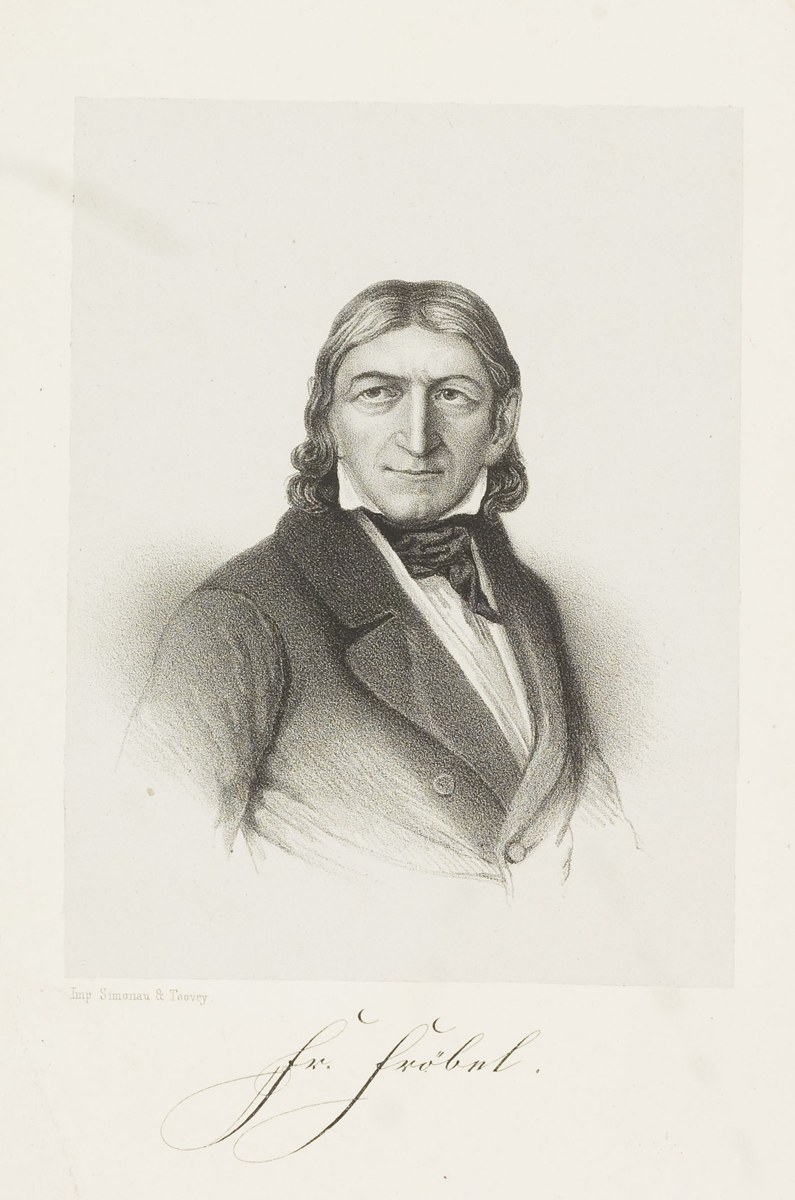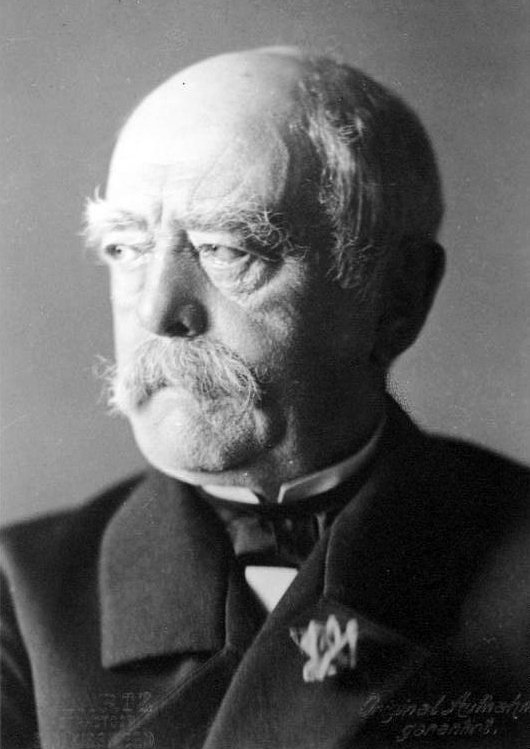

Lithograph printed by Simonau & Toovey, Brussels, in the 1861 edition of L'education de l'homme (Leuven University Libraries, public domain) · Lithograph portrait 'Fr. Frobel' printed by the Belgian firm Simonau & Toovey (lithographers and phototype printers, active about 1847-1899), with a facsimile signature, from the Brussels 1861 edition of Froebel's L'education de l'homme (translated by Baroness de Crombrugghe; F. Claassen, 1861); Leuven University Libraries print record PA02638 (KU Leuven), opened via Wikimedia Commons 'Fr. Frobel, PA02638.jpg'. The print itself is undated and not signed by a named artist; it was published nine years after Froebel's death, so it is treated as a later printed likeness rather than a lifetime portrait. Public domain by age: a printed work published in 1861 by a commercial printing firm. Original file 1404 x 2118; saved downscaled only to 795 x 1200, not cropped. · Public Domain
교사 · 19세기
프리드리히 프뢰벨
1782–1852
주요 업적 분야
아직 성격 매칭에 포함되지 않았습니다 — 기록된 근거가 성격 모델 전체를 다루기에는 충분하지 않습니다. 이 페이지의 다른 모든 내용은 자유롭게 확인하실 수 있습니다.
핵심 특성
주요 업적
1837년 블랑켄부르크에 유아 학교를 열고 이를 훗날 '아이들의 정원'을 뜻하는 킨더가르텐(유치원)이라 불렀으며, 1842년부터 이곳에서 여성 유치원 교사 양성 과정이 열렸다.
공, 블록, 도형 같은 놀이 교구와 노래·놀이로 이루어진 '은물'과 '작업'을 고안해, 자발적 활동과 놀이를 통해 어린아이를 가르치는 방법을 만들었다.
튀링겐의 카일하우에 학교를 세우고 『인간의 교육』(1826)에 자신의 원리를 정리했으며, 이 책을 통해 그의 사상은 훗날 영국과 미국 등지로 퍼졌다.
삶의 장면들
그는 여성도 어린아이의 교사로 양성되어야 한다고 주장했고, 1847년 남성만 모인 회의에서 조롱을 받았음에도 이 생각을 밀고 나갔다. 블랑켄부르크에서는 이미 1842년부터 여성 양성 과정이 시작되어 있었다.
이는 지배적 견해에 맞서 관례에서 벗어난 입장을 고수한 모습과 부합한다. 독립적 사고
1816년 그는 스톡홀름의 광물학 교수직 제안을 거절하고, 아이들을 가르치는 자신의 구상을 시험해 볼 학교를 직접 세웠다고 전해진다.
이는 안정적인 학계의 길을 버리고 불확실한 교육 사업에 나선 모습과 부합한다. 위험 감수
전환점
카일하우와 스위스에서 나이가 더 많은 학생을 위한 학교를 운영한 뒤, 1830년대 중반 독일로 돌아와 취학 전 아동에게 전념하며 교육용 놀이 교구를 설계하고 1837년 블랑켄부르크 유아 학교를 열었다.
이는 유아기를 교육의 핵심 단계로 판단하자 노력을 그쪽으로 돌린 모습과 부합한다. 영향 창출 동기
비슷한 인물
전체적인 프로필이 이 사람과 닮은 사람들이에요.
출처
- Friedrich Froebel (Q76679), verified live via the Wikidata API (2026-10-24): English label 'Friedrich Fröbel', description 'German educator', Korean label 프리드리히 프뢰벨, born 1782-04-21, died 1852-06-21. Orientation only; not used as support for any row.
- Encyclopaedia Britannica, 'Friedrich Froebel' by Stanley James Curtis and the editors (britannica.com; read through an Internet Archive copy, full article): German educator, founder of the kindergarten and one of the most influential educational reformers of the nineteenth century; early life, apprenticeship to a forester, Jena, the Frankfurt model school run on Pestalozzi's lines, Yverdon, Gottingen and the 1813 campaign, schools at Griesheim and Keilhau, The Education of Man (1826), Swiss teacher training and the Burgdorf orphanage, the infant school at Blankenburg later renamed the Kindergarten, the publishing firm for play materials and the Mother-Play and Nursery Songs, the 1851 Prussian ban 'because of a confusion with the socialist views of Froebel's nephew', disciples such as Marenholtz-Bulow, Dewey's use of his principles, 'self-activity' and play, the 'gifts' or 'occupations'. CANONICAL SIGNIFICANCE SOURCE.
- John P. Manning, 'Rediscovering Froebel: A Call to Re-examine his Life & Gifts', Early Childhood Education Journal 32 (2005), 371-376 (Springer Nature Link; the open article text read, about 22,000 characters): an overview of his life and first ten gifts by an early-childhood scholar; his philosophy as unity of creation, respect for children as individuals and the importance of play; the gifts were 'not new in themselves' but their use in a structured curriculum was; his argument for training women as teachers despite ridicule at a 1847 conference; kindergartens open to all classes and religions between 1848 and 1852; the later commercialisation and the followers' dogma that he would probably have been 'appalled' by; John Dewey's criticism of the Froebelians' metaphysics and his praise of Froebel himself; the present-day criticism of his religious focus. Sympathetic but with explicit criticism of the movement. Contains contested psychological speculation about his childhood that is not used.
- University of Edinburgh, 'Froebel: an introduction', Froebelian Futures project (froebel.ed.ac.uk), read in full: Froebel as founder of the kindergarten; his school at Keilhau; the 1837 infant school at Blankenburg opened 'with male and female colleagues'; the 1851 Prussian ban 'conflating progressives like Froebel with revolutionary socialists like his nephew'; the survival of his work outside Prussia; the principles of unity and connectedness, autonomous learners and 'freedom with guidance'; the remark that his principles 'are not always deeply understood'. An institutional project page by a university research group that promotes Froebelian ideas.
- German Historical Institute Washington, 'Friedrich Froebel (c. 1840)', German History in Documents and Images (germanhistorydocs.org), abstract read: study at Jena, Gottingen and Berlin, the Frankfurt model school, service with the Lutzow Free Corps in 1813-14, the institute founded in 1816 and moved to Keilhau, The Education of Man (1826), return to Germany in 1836 to devote himself to pre-school children and the design of educational toys, women's teacher-training courses from 1842 in Blankenburg, the August 1851 ban by the Prussian Ministry of Culture ('atheistic and demagogic'), the 1860 reintroduction, the first Froebel Society in 1863 and emigrant students in the United States. A scholarly institute's neutral caption.
- Miriam LeBlanc, 'Friedrich Froebel: His life and influence on education', Community Playthings Learning Library (communityplaythings.co.uk, June 2012), read in full: a trade article from a company whose founders' community was linked to the Keilhau school; Froebel's apprenticeship to a forester, change from architecture to teaching, the Yverdon years, the Berlin mineralogical museum and his reading of crystals, the 1816 decision to decline a professorship of mineralogy in Stockholm and found a school, Keilhau, the 1840 kindergarten at Blankenburg, the gifts and occupations, the 1851 ban and Barop's role in keeping Keilhau going. A popular and partisan source; its date for the kindergarten differs from Britannica's 1837.
- friedrichfroebel.com, 'Prussian Government closes Kindergartens, August 1851' (friedrichfroebel.com/ban.html), read in full: a short web page reproducing Froebel's letter to the King of Prussia and the Prussian government's text citing his nephew Karl Froebel's pamphlet, with the source given as Joachim Liebschner, A Child's Work (1992), p. 30. Used only for the factual context of the 1851 ban (a political decree, unscored); the letter is his own writing and supports no row. Liebschner's book itself was not opened.
- Wikimedia Commons file page 'Fr. Fröbel, PA02638.jpg' (wikitext and API record) citing the KU Leuven Libraries catalogue record for the lithograph in the 1861 Brussels edition of L'education de l'homme; also the pages for the Bardeen lithograph (c. 1897, Library of Congress) and other Froebel images, checked for the portrait's rights. Not used for scoring.