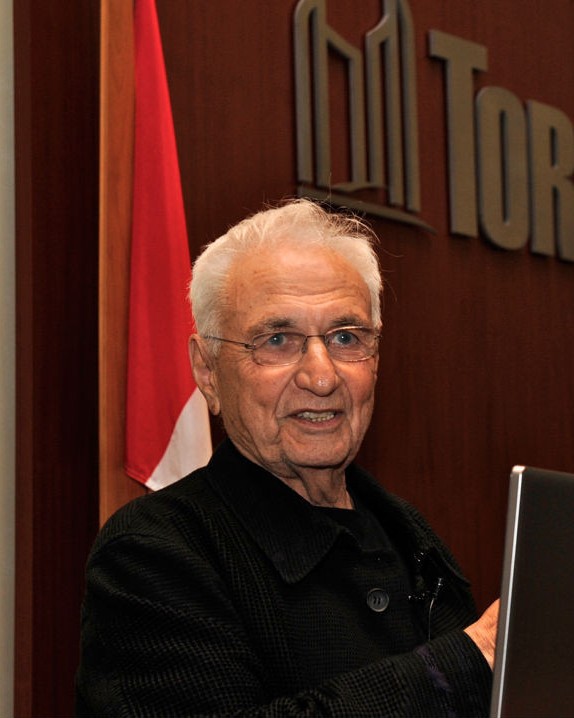

Photo: Jose San Juan / City of Toronto, 13 September 2010, City of Toronto Archives, Fonds 219, Series 2311, File 2969, Item 89 (cropped from the original) · City of Toronto Archives, Fonds 219 > Series 2311 > File 2969 > Item 89, 'Frank Gehry, Viljo Revell Centenary reception: Council Chamber, City Hall' (1 colour JPG; photographer Jose San Juan, City of Toronto Protocol Services Photo/Video Section; 13 September 2010), original 1080 x 718 pixels as served by Wikimedia Commons ('Frank Gehry, Viljo Revell Centenary reception, 2010 (S2311 fl2969 it0089).jpg', uploaded 6 December 2025, the image Wikidata uses for him). Rights: the Archives' record gives Access Conditions 'OPEN - No restrictions on these government records' and Copyright 'held by the City of Toronto', and its Copyright page (code G-CC) reads 'Copyright is held by the City of Toronto. You do not need permission to use the work for any purpose.' No conflicting notice was found on the Archives' page. The frame was cropped to a 574 x 718 portrait region around his face at original pixel scale (offset 10 px from the left edge); no resampling, never upscaled. It shows him speaking at a lectern in a dark jacket, with a Toronto flag and sign behind him. · City of Toronto Archives: copyright held by the City of Toronto; no permission needed to use the work for any purpose
건축가 · 현대
프랭크 게리
1929–2025
주요 업적 분야
아직 성격 매칭에 포함되지 않았습니다 — 기록된 근거가 성격 모델 전체를 다루기에는 충분하지 않습니다. 이 페이지의 다른 모든 내용은 자유롭게 확인하실 수 있습니다.
핵심 특성
주요 업적
게리는 체인링크 울타리와 골함석 같은 파격적인 재료로 지은 건물들, 특히 산타모니카에 있는 자신의 집으로 먼저 널리 주목받았고, 1989년에는 프리츠커상을 받았다. 심사위원단은 그의 건축을 '신선할 만큼 독창적'이라고 평했다. 다른 건축가 두 명과 겨룬 설계 경쟁에서 따낸 빌바오 구겐하임 미술관(1997)은 그를 세계적인 인물로 만들었고, 비평가 로언 무어는 이 건물을 현대에 가장 큰 영향을 미친 건물이라고 부른다.
로스앤젤레스 필하모닉의 본거지인 월트 디즈니 콘서트 홀은 1987년 릴리언 디즈니의 기부로 시작되었다. 게리는 1988년 설계 경쟁에서 당선되었고, 스테인리스 스틸로 마감한 이 홀은 16년에 걸친 과정 끝에 2003년에 완공되었다. 그는 일본인 음향 설계자 도요타 야스히사와 함께 포도밭형 객석 구조의 연주홀을 설계했다. LA 필하모닉의 사무총장은 이 건물을 상징적인 명소라고 평했지만, 로스앤젤레스의 도시계획 평론가 샘 홀 캐플런은 도시를 향해 열려 있지 않다고 비판했다.
게리의 사무소는 곡면 형태를 실제로 지어내는 기반으로 디지털 모델링을 도입했다. 1991년부터 동업자 제임스 글림프의 제안으로 항공우주 소프트웨어 CATIA를 들여와 물리적 스터디 모델을 디지털 곡면으로 옮겼고, 한 학술 논문은 빌바오를 이 소프트웨어로 설계한 최초의 주요 건물이라고 평한다. 이후 사무소는 CATIA를 기반으로 한 '디지털 프로젝트' 플랫폼을 내놓은 게리 테크놀로지스를 세웠고, 이 플랫폼은 그의 설계 작품 밖의 프로젝트에도 쓰였다. 건설 전문지 엔지니어링 뉴스-레코드의 부고는 그의 건물이 시공사와 제작업체를 모델 기반의 시공 방식으로 이끌었다고 전한다.
삶의 장면들
월트 디즈니 콘서트 홀 설계 경쟁에서 당선된 뒤 건축가들은 다양한 음악가들에게 조언을 구했고, 게리의 팀은 기존 공연장과 대안 평면을 본뜬 축척 모델을 약 40개 만들었다. 이는 사무소가 기술적 쟁점을 더 잘 이해하게 하고 음향 설계자 나가타 미노루와 신뢰를 쌓는 데 도움이 되었다. 나가타는 당선안이 닮은 베를린 필하모니보다 콘세르트헤바우나 무지크페라인 같은 오래된 직사각형(슈박스) 홀이 더 나은 모델이라고 주장했고, 결국 음향 설계자들과 건축가들은 홀의 폭을 두고 절충했다.
여러 개의 실물 모델을 만들어 비교하며 작업하는 설계자의 모습과 일치하지만, 이 기록은 한 비평가가 사무소의 작업 과정을 전한 것이며 모델은 그의 팀이 만들었다. 실험 성향
2003년 6월 월트 디즈니 콘서트 홀에서 첫 전체 오케스트라 리허설이 열리기 몇 달 전, 게리는 어느 저녁 지휘자 에사페카 살로넨에게 집으로 전화를 걸어 아직 완공되지 않은 홀에서 당장 만나자고 청했다. 살로넨은 악장에게 바이올린을 가져오라고 했고, 악장은 두 사람 앞에서 바흐를 조금 연주했다. 6월 리허설에서 살로넨은 모차르트 '주피터' 교향곡의 첫 소절을 지휘하다 멈추고 그에게 '프랭크, 이대로 갑시다'라고 말했다.
완성되기 전의 홀에서 그곳에서 연주할 음악가들과 함께 소리를 확인한 설계자의 모습과 일치하지만, 이 일화는 살로넨의 증언을 뉴스위크 인물 기사가 전한 것이며 음향 설계는 음향 설계자 도요타 야스히사와 함께 진행되었다. 협업 성향
전환점
릭 스미스에 따르면 게리의 실물 모델과 2차원 도면을 본 시공업자들은 이 설계는 지을 수 없다고 말하는 경우가 많았다. 1991년 그의 사무소는 동업자 제임스 글림프가 IBM 컨설턴트 릭 스미스를 통해 들여온 CATIA를 쓰기 시작했는데, 제도사와 모델 제작자들의 반발이 컸다('저항이 아주 많았다'). 스미스는 디지털 모델에서 뽑은 단면 출력물을 모델 제작자들에게 건네 이를 바탕으로 모형을 만들게 하는 방식으로 이를 우회했고, 게리는 결과물을 직접 검토해 손으로 수정했다. 이 소프트웨어로 설계된 빌바오는 건축에서 CATIA를 대규모로 성공시킨 첫 사례였다고 메트로폴리스는 전한다.
직접 다루지 않는 도구를 중심으로 사무소의 작업 방식을 다시 짠 대표자의 모습과 일치하지만, 자료들은 소프트웨어를 들여온 공을 글림프와 스미스에게 돌린다. 적응력
비슷한 인물
전체적인 프로필이 이 사람과 닮은 사람들이에요.


파블로 피카소

레오나르도 다빈치

엘리자베스 케이디 스탠턴

프리다 칼로

윌버 라이트
출처
- Frank Gehry (Q180374) -- verified live via the Wikidata API (2026-10-16): English label 'Frank Gehry', description 'Canadian and American architect (1929-2025)', Korean label present, instance of human, born 28 February 1929 (Toronto), died 5 December 2025, citizenship United States and Canada. Orientation only; not used as support for any row.
- The Pritzker Architecture Prize, 'Frank Gehry' (1989 laureate page: announcement, formal jury citation, biography and selected works) -- CANONICAL SIGNIFICANCE SOURCE: the Hyatt Foundation's announcement of the twelfth laureate and the jury's citation read by Bill Lacy, which honours a 'refreshingly original' architecture of 'a highly refined, sophisticated and adventurous aesthetic that emphasizes the art of architecture', likens it to jazz 'replete with improvisation', says it resists being bound by critical acceptance or his successes and calls his buildings 'juxtaposed collages of spaces and materials'; the page also records his path (a Los Angeles firm of his own from 1962, the Danziger Studio/Residence of 1964, work in chain-link, corrugated metal and cardboard, the Walt Disney Concert Hall commission) and shows Bilbao (1997) among its selected works. Award-body prose written in 1989, before Bilbao and Disney Hall were built, by a jury of critics, architects and patrons; admiring by genre. Read in full.
- Bryan Gottlieb, Debra K. Rubin and Jeff Yoders, 'Frank Gehry, 96, Was Architect Who Pushed Construction Into the Digital Era', Engineering News-Record (ENR), 9 December 2025 (obituary) -- a construction-trade obituary built on ENR's decades of coverage: his adoption of CATIA and his insistence that the digital model, not 2D drawings, be the authoritative record; Experience Music Project (2000) and Walt Disney Concert Hall (2003) as proving grounds for contractors, with the contractor Mortenson's account (including the off-site ceiling panels Gehry agreed to); Gehry Technologies and its Digital Project platform (Trimble acquired it in 2014); his 2011 alliance of architects and builders; and an ENR editor's remark that his projects were acclaimed but often struggled to keep costs in line. Trade-press obituary with contractors' quotations, admiring in tone but candid on costs; its passages on his death and honours and on clients who replaced his firm on two later projects were not used for scoring. Read in full.
- Penelope Dean (University of Illinois at Chicago), 'Practice Nouveau', Proceedings of the ACSA (Association of Collegiate Schools of Architecture) 97th Annual Meeting, 'The Value of Design', pp. 307-317 (the PDF shows no date and cites sources to 2006) -- a scholarly paper on how CATIA entered Gehry's practice in 1991 at the instigation of partner James Glymph (partner from January 1990 to December 2005), first on the Barcelona fish sculpture and then on the Guggenheim Bilbao (called the first major building designed with it) and Walt Disney Concert Hall; the 'master model' as a shared platform for architect, engineer and contractor; the hybrid of hand-made physical models and digitised ones; and remarks by Gehry and Glymph, quoted from other publications, on regaining the architect's authority, budgeting jobs early and the 'master builder'. Independent scholarly interpretation, with Gehry's own words as self evidence (never sole support); a quoted Gehry remark about how builders treated architects, which the author herself calls gendered, was not used. Read in full.
- Laurie Manfra, 'Rick Smith Joins Frank Gehry -- 1991', Metropolis, 1 April 2006 -- a magazine profile of the IBM consultant who brought CATIA into Gehry's office: Glymph's partnership with Gehry from 1989 and his search for a way to build Walt Disney Concert Hall, his call to Smith, the practice's drafters and model-makers reluctant to adopt the software ('There was a lot of reluctance'), Smith's method of digitising physical massing models with a mechanical probe and handing printed sections to the model-builders, Gehry reviewing and adjusting by hand, Gehry's boast that he did not know how to turn a computer on, and Bilbao as the first successful large-scale use of CATIA in architecture. A colleague's recollections (Smith's) through a design-magazine writer. Read in full.
- Rowan Moore, 'The Bilbao effect: how Frank Gehry's Guggenheim started a global craze', The Guardian, 1 October 2017 -- the Observer architecture critic's article for the museum's 20th anniversary, with interviews of Gehry and the museum's director Juan Ignacio Vidarte: the competition Gehry won against two other architects, the Basque authorities' and the Guggenheim's aims, Gehry's office pioneering CATIA and building Bilbao within its $100 million budget (as Gehry himself points out), the most sustained critique (Hal Foster, in Sydney Pollack's film, that the building trumps the art), Gehry's pushback, his distance from the 'Bilbao effect' and its imitators, and Moore's own verdict that the museum cannot be copied. An independent critic's mixed verdict; Gehry's remarks are self evidence. Read in full.
- Sarah Milroy, 'The Bilbao effect', The Globe and Mail, 24 January 2004 -- a Canadian critic's essay written as Gehry's plans for the Art Gallery of Ontario were about to be unveiled, weighing the 'Bilbao effect': his sensual way with materials and shapes and the investment in ambitious architecture he set off, against critics who see him as an enemy to art (the architecture upstaging the museum's content), Witold Rybczynski's 'show-dog architecture', modernists who see a box dressed in cladding, and Milroy's own reply that this blames Gehry for the shortcomings of the Guggenheim's director. The counter-voice read, with a critic's own mixed verdict; its speculation about the Toronto design was not used. Read in full.
- Michael Webb, 'A hall for Los Angeles' (online as 'When the Walt Disney Concert Hall redefined the landscape of downtown Los Angeles'), Domus no. 863, October 2003 (republished online 28 February 2023) -- an architecture writer's history of the hall: Lillian Disney's 1987 gift, the 1987-88 competition among four finalists, Gehry's winning scheme, the acoustician's selection and the compromise over the hall's plan, about 40 scale models and consultation with musicians, the 1993 'final design' shelved for four years, the project shut down in November 1994 and revived, the attempt to sideline Gehry in 1997, the switch from stone to stainless-steel cladding, and the estimated cost rising from $100 million to $265 million (final $274 million). The fullest independent account of one project, by a critic admiring of the result; its characterisations of other people's motives (for example 'vindictive') were not used. Read in full.
- Cathleen McGuigan, 'A Mighty Monument to Music', Newsweek, 18 August 2003 -- a magazine profile written before the opening of Walt Disney Concert Hall, built around Esa-Pekka Salonen's account of the first full-orchestra rehearsal and a late-night visit to the unfinished hall, with Gehry on the acoustician Yasuhisa Toyota, the 16-year history (cost estimate of $100 million against $274 million in the end, the five-year construction stop, his near-resignation in 1997), his reliance on cardboard or wooden models and the Gehry Technologies program, and the writer's own characterisation of his 'fierce discipline and perfectionism'. A journalist's profile with a conductor's quoted recollection; the paragraphs on his diet, daily routine, marriage and a friend's death were not used. Read in full.
- Jeffrey Kaye, 'Birth of an Icon', PBS NewsHour, 17 October 2003 (broadcast report with transcript) -- a report shortly before the opening of Walt Disney Concert Hall: the Los Angeles Philharmonic's executive director Deborah Borda on the building as a civic landmark, Gehry on his 'language of motion with inert materials' and on aerospace software letting the hall be built without breaking the budget, the vineyard-style auditorium he designed with the acoustician Yasuhisa Toyota, musicians' reactions, the 1987 gift and the 1990s delays, the $274 million final cost, and the local planning critic Sam Hall Kaplan's dissent that it does not reach out to the city. Broadcast reporting with a client's praise and one local critic's counter-voice; Gehry's remark on the politics of the time was not used. Read in full.
- City of Toronto Archives, finding-aid record 'Frank Gehry, Viljo Revell Centenary reception: Council Chamber, City Hall' (Fonds 219 > Series 2311 > File 2969 > Item 89; 1 colour JPG photograph; statement of responsibility Jose San Juan; date of creation 13 September 2010) and the Archives' Copyright page -- checked for the portrait's rights: the record gives Access Conditions 'OPEN - No restrictions on these government records' and Copyright 'held by the City of Toronto'; the Archives' Copyright page code G-CC ('Government Records - City owns copyright') reads 'Copyright is held by the City of Toronto. You do not need permission to use the work for any purpose.' The series is the City's Protocol Services photographs taken by its own staff photographers, Jose San Juan among them. Not used for any scoring.
- Wikimedia Commons file page 'Frank Gehry, Viljo Revell Centenary reception, 2010 (S2311 fl2969 it0089).jpg' -- checked through the Commons API for the file's metadata: author 'City of Toronto / Jose San Juan', date 2010-09-13, 1080 x 718 pixels, uploaded 6 December 2025, source and permission text copied from the City of Toronto Archives ('OPEN - No restrictions ... You do not need permission to use the work for any purpose'), tagged with an attribution-only template that says it does not itself indicate copyright status; the page cites the archival citation as 'Fonds 200' where the Archives' own record reads 'Fonds 219'. It is the image Wikidata uses for him. Not used for any scoring.