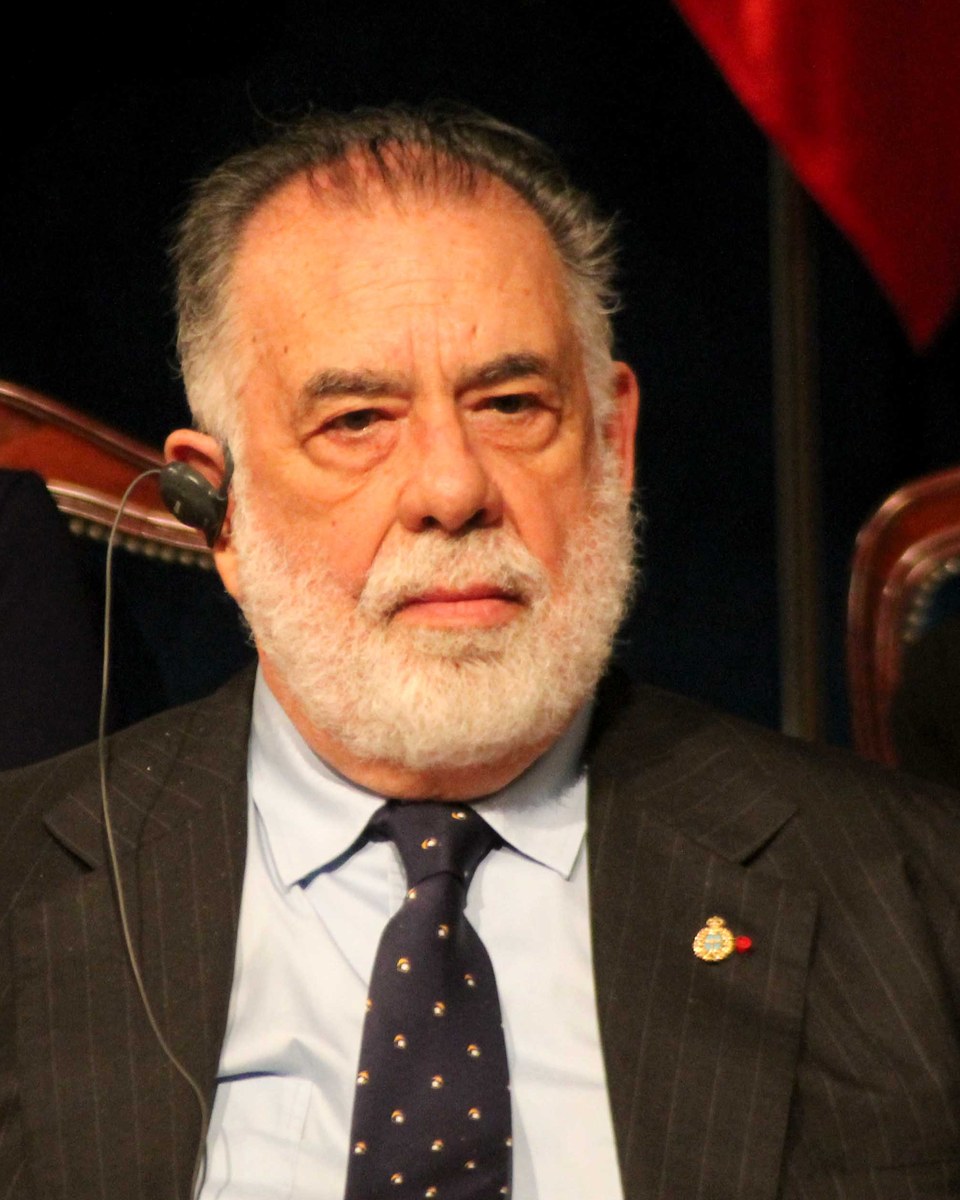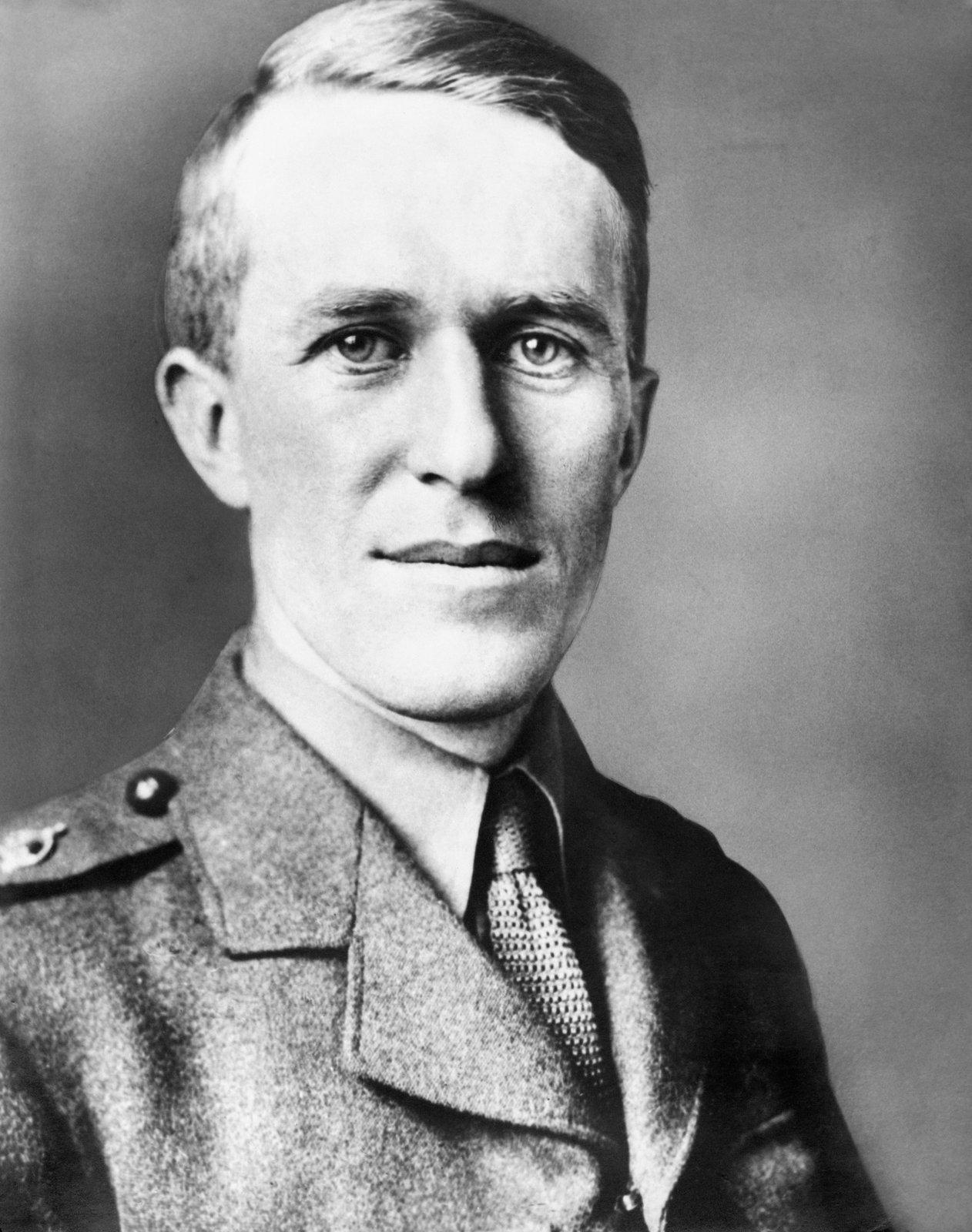

Photo: Rubén Ortega, 23 October 2015, CC BY-SA 4.0, cropped and downscaled from the original · Wikimedia Commons, 'Premios Princesa de Asturias 2015 5.JPG' -- photograph credited 'Own work' to Ruben Ortega (EXIF author 'Ruben Ortega Vega', EXIF copyright 'Ruben Ortega'; Canon EOS 1100D), taken 23 October 2015 at the Princess of Asturias Awards ceremony in Oviedo, where Coppola was the 2015 laureate for the Arts (Commons structured data depicts Francis Ford Coppola; the award is confirmed by the Foundation's own page); the copyright holder publishes it under CC BY-SA 4.0 and asks for the credit 'Rubén Ortega; CC-BY-SA' near the image; no restriction template. Original 4272 x 2848 pixels; a 4:5 region (2000 x 2500 pixels) around his head and shoulders was cropped from it, excluding the neighbouring sitters, and downscaled once to 960 x 1200 (never upscaled). · CC BY-SA 4.0
영화감독 · 현대
프랜시스 포드 코폴라
b. 1939
주요 업적 분야
아직 성격 매칭에 포함되지 않았습니다 — 기록된 근거가 성격 모델 전체를 다루기에는 충분하지 않습니다. 이 페이지의 다른 모든 내용은 자유롭게 확인하실 수 있습니다.
핵심 특성
주요 업적
그는 『대부』(1972)를 연출하고 마리오 푸조와 함께 각색했다. 이 영화는 작품상, 남우주연상, 각색상을 받았으며 각색상은 코폴라와 푸조가 공동 수상했다. 속편 『대부 2』(1974)는 오스카 6개 부문을 받았고, 그중 세 개는 제작자, 감독, 공동 각본가로서 코폴라의 몫이었다. 1970년 『패튼』의 각본상까지 더해 그는 아카데미상을 다섯 번 받았다.
1974년에는 감시 전문가를 다룬 『컨버세이션』으로 칸 영화제 황금종려상을 받았다. 1979년에는 조지프 콘래드의 『어둠의 심연』을 베트남전으로 옮겨 온 『지옥의 묵시록』을 내놓았다. 촬영에 238일이 걸린 이 영화도 황금종려상을 공동 수상했으며, 브리태니커는 이 작품을 대체로 '결함 있는 걸작'으로 평가한다고 쓴다.
1969년 조지 루커스와 함께 아메리칸 조에트로프를 세웠다. 젊고 이름 없는 창작자들이 개인적인 영화를 만들도록 북돋는 회사였다. 브리태니커는 1970년대 그의 활동을 할리우드의 제작·배급 방식에 맞서는 대안을 만들려던 시도로 설명하며, 아카데미는 2010년 아메리칸 조에트로프를 세우고 『블랙 스탤리언』에서 『굿 셰퍼드』에 이르는 영화를 후원한 공로로 그에게 어빙 G. 솔버그 기념상을 수여했다.
삶의 장면들
『지옥의 묵시록』의 제작비가 계획했던 1,200만 달러에서 3,150만 달러 가까이로 불어나자, 코폴라는 자신의 부동산을 담보로 대출을 받아 초과분을 메웠다. AFI 카탈로그가 당시 보도를 정리해 전하는 내용이다. 프레미엄 임페리얼 수상자 소개에는 아무도 도와주려 하지 않아 번 돈과 가진 재산을 모두 들고 은행에 갔다는 그의 말이 실려 있다.
외부 지원이 모자랄 때 자기 재산을 걸고서라도 작품을 밀고 가려는 태도와 일치한다. 위험 감수
월터 머치에 따르면 코폴라는 『대부』의 결혼식 장면이나 『컨버세이션』의 첫 장면 같은 대목을 다큐멘터리처럼 찍었다. 배우들을 장면 속으로 던져 넣고, 때로는 즉흥을 허락하며, 카메라 여러 대로 담았다. 『컨버세이션』을 비롯한 작품들에서는 테이크를 15번, 20번까지 이어 가며, 뻔한 연기를 지나친 배우들에게서 다른 데 없는 무언가가 나오기를 기다렸다.
촬영 범위를 미리 못 박기보다 우연한 발견의 여지를 남겨 두는 작업 방식과 일치한다. 실험 성향
전환점
1981년 코폴라는 할리우드에 있던 자신의 조에트로프 스튜디오 스테이지에서 『원 프롬 더 하트』를 찍었다. 그가 '전자 영화(electronic cinema)'라 부른 방식을 썼고, 해외 투자자들이 빠지자 사비를 투입했다. 1982년 1월 파라마운트가 개봉을 막자 그는 조에트로프가 파라마운트와의 관계를 끝낸다고 밝히고 직접 배급을 추진했다. 약 2,500만 달러가 든 이 영화가 1,000만 달러도 벌지 못하면서 조에트로프는 파산했다.
스튜디오의 재정이 걸려 있는 상황에서도 제작과 배급의 통제권을 쥐려는 성향과 일치한다. 자율성 욕구
비슷한 인물
전체적인 프로필이 이 사람과 닮은 사람들이에요.
출처
- Francis Ford Coppola (Q56094) -- verified live via the Wikidata API (2026-10-15): English label 'Francis Ford Coppola', description 'American filmmaker (born 1939)', born 7 April 1939, no date of death, citizenship United States, Korean label present. Orientation only; not used as support for any row.
- Encyclopaedia Britannica, 'Francis Ford Coppola' (article by Michael Barson, fact-checked by Britannica's editors; page updated August 2026) -- encyclopaedia biography: a director, writer and producer who had his greatest success and influence in the 1970s, 'when he attempted to create an alternative to the Hollywood system of film production and distribution'; covers the Warner Bros. split over his Zoetrope Productions, the Patton screenplay Oscar, The Godfather (a hit that the AFI ranked third on its 1998 list; Coppola nominated as director and sharing the adapted-screenplay Oscar with Mario Puzo), The Conversation, The Godfather Part II (Best Picture, Best Director and a shared screenplay Oscar), and Apocalypse Now (a $12 million budget that exceeded $30 million, a considerable part of the overrun paid by Coppola himself; 'generally regarded as a flawed masterpiece'; eight Oscar nominations). CANONICAL SIGNIFICANCE SOURCE (encyclopaedic assessment of his primary contribution; honouring but balanced in tone, so used for the achievement cards and orientation and never alone for a behavioural row). The page text breaks off after Apocalypse Now behind Britannica's subscription wall, so the 1980s-onward sections were not read, and the early-life passages and the page's AI-generated summaries were not used. Read as far as the page shows.
- Princess of Asturias Foundation, 'Francis Ford Coppola', 2015 Princess of Asturias Award for the Arts, laureate page and jury minutes (Oviedo, 6 May 2015) -- the jury calls him 'an outstanding narrator' with a prominent place in film history, says his career 'has been a continuous struggle to maintain total independence as a creator and entrepreneur' as director, producer and screenwriter, and calls him essential for understanding the transformation and contradictions of the industry and art of filmmaking; the page's summary adds specialists' view of his 'genuine resolve to make auteur films within the confines of the major studios'. Award-body citation, honouring in tone; the foundation's biography tab did not load and was not read. Read the laureate page and the jury minutes in full.
- Japan Art Association, Praemium Imperiale, 'Francis Ford Coppola' (25th laureate, Theatre/Film), profile, biography and chronology, 'a record of the laureate at the time of receiving the award' -- calls him one of the most influential directors, producers and screenwriters of all time; chronology and Oscar summary (the 1970 Patton screenplay Oscar; The Godfather, three Academy Awards; The Godfather Part II, six, including three for Coppola; The Conversation and Apocalypse Now, each a Palme d'Or); says he established American Zoetrope with George Lucas, 'a film company which encouraged young unknown artists to make personal and meaningful films'; and quotes him that for Apocalypse Now 'absolutely no one came forth to help me' and he went to the bank with all he had earned and the property he owned (self). Award-body profile, honouring in tone; its biography text is cut off behind a 'read more' control, so it was read as far as the page shows, and passages on his early life and his winery were not used.
- Steve Pond, 'Honorary Oscars for Coppola, Wallach, Brownlow, Godard', TheWrap, 25 August 2010 -- trade-press report of the Academy of Motion Picture Arts and Sciences' announcement of its 2010 Governors Awards: the Irving G. Thalberg Memorial Award to Coppola, described as a 14-time nominee and five-time winner with Oscars for writing and directing the Best Picture winners The Godfather and The Godfather Part II and for writing Patton, honoured also for establishing American Zoetrope and backing films from The Black Stallion to The Good Shepherd; quotes the award's criterion (a producer 'whose body of work reflects a consistently high quality of motion picture production'). Press report of an institutional announcement; passages on the other honorees were not used. Read in full.
- American Film Institute, AFI Catalog of Feature Films, 'The Godfather' (1972) -- catalogue entry whose History section is compiled from contemporary trade papers, newspapers and magazine features (Variety, Hollywood Reporter, New York Times, Los Angeles Times, Time) and from Coppola's DVD commentary: Paramount's option on Puzo's novel, the directors approached before Coppola, the casting history, Paramount's initial refusal to film in New York (Coppola prevailed before shooting began), real-location shooting, reported resistance from cinematographer Gordon Willis, the box-office and Academy Award results, and the continuity of Willis and designer Dean Tavoularis across all three films. Compiled institutional record that includes some of Coppola's own statements (self); passages on cast members and on other controversies were not used. Read the History notes in full.
- American Film Institute, AFI Catalog of Feature Films, 'The Godfather Part II' (1974) -- catalogue entry compiled from contemporary trade press and magazine features: the decision to make the sequel as 'a true continuation', the continuity of Willis, Tavoularis, Puzo and the composers, Coppola taking over the producing duties, the film's final cut still unfinished weeks before release, his re-cutting of the last portion at his San Francisco Zoetrope facilities after a sneak preview and before the 12 December 1974 New York premiere, his insistence that the 200-minute film not be interrupted by an intermission, and its Academy Award results (six Oscars including Best Picture, Best Director and a shared Adapted Screenplay for Coppola). Compiled institutional record including Coppola's own quoted statements (self); passages on fees and cast negotiations were skimmed and not used. Read the History notes.
- American Film Institute, AFI Catalog of Feature Films, 'The Conversation' (1974) -- catalogue entry compiled from trade press and the New Yorker: Coppola began the screenplay in 1966 and finished it in 1970, produced the film for The Directors Company that he formed with Peter Bogdanovich and William Friedkin, shot it in San Francisco including in his newly formed American Zoetrope studio (which the Catalog says made him one of the first major American filmmakers of his generation to open a studio outside Los Angeles), replaced cinematographer Haskell Wexler with Bill Butler after friction, left the footage with Walter Murch (whom a modern source quotes him calling 'an author' of the film), and the film's Palme d'Or and Academy Award nominations. Compiled institutional record; its closing news items were not used. Read the History notes in full.
- American Film Institute, AFI Catalog of Feature Films, 'Apocalypse Now' (1979) -- catalogue entry compiled from contemporary trade press, the New York Times and magazine features, production notes held in the Academy's library and the 2001 Redux notes: development from John Milius's script bought for American Zoetrope in 1969, Coppola's 1975 decision to self-finance it as a $10 million independent feature, the casting and re-casting (including the replacement of an actor after four days of shooting), 238 days of filming from March 1976 to May 1977 interrupted by a typhoon, at least five release postponements, the 70mm run without screen credits and the Cannes 'work in progress' screening (a shared Palme d'Or), the choice of ending and the pulling of the 35mm prints, costs rising toward $31.5 million with Coppola putting up his estate as collateral, the divided critical reaction, and the 2001 Redux. Compiled institutional record that includes Coppola's own statements (self); passages on cast members' circumstances, on the political context of the location and on a published production diary were not used. Read the History notes in full.
- American Film Institute, AFI Catalog of Feature Films, 'One from the Heart' (1982) -- catalogue entry (summary and notes completed with the AFI Academic Network) compiled from the New York Times, Los Angeles Times, Variety and other press: Coppola's refusal to direct it as a studio employee and his purchase of the rights for Zoetrope Studios, the move from romantic comedy to musical fantasy (about $8 million added), the withdrawal of foreign investors, the 'electronic cinema' press conference, his commitment of personal funds at $1 million a week, Paramount's veto of the release and his announcement ending Zoetrope's relationship with it, attempts to distribute the film himself, and the film's gross of under $10 million against about $25 million followed by Zoetrope's bankruptcy. Compiled institutional record including Coppola's own claims (self) and Paramount's contrary account; passages on a lender and on the later sale of the studio property were not used. Read the History notes in full.
- Ian Freer, 'Walter Murch: A Conversation With The Legendary Sound Designer', Empire, 4 August 2017 -- interview with the editor and sound designer of The Conversation, the Godfather films and Apocalypse Now: Coppola's challenge to himself of combining Hermann Hesse and Hitchcock in The Conversation, his hiring Murch to edit it and leaving to prepare The Godfather Part II (returning about once a month for a screening), 'that's the way Francis works with everybody. He gives heads of department, and the actors, a lot of rope', and that none of Apocalypse Now's opening eight minutes was in the screenplay. First-hand collaborator's account some 40 years later, admiring but specific about process; passages on other films and on Murch's own projects were not used. Read in full.
- Steve Hullfish, 'ART OF THE CUT with Walter Murch, ACE, on 7 of his films', ProVideo Coalition, 15 March 2020 -- editor-to-editor interview in which Murch describes how Coppola shot scenes in a documentary manner with several cameras and some improvisation (the Godfather wedding, The Conversation, the Apocalypse Now helicopter attack), his willingness to shoot 15 or 20 takes and his reasons, the deliberately artificial surveillance look of The Conversation, and the Godfather restaurant scene (Coppola and composer Nino Rota had designed an operatic moment, he held the music back until after the murder, and Murch added the elevated-train sound). First-hand collaborator's account, admiring but specific; passages on Murch's other films and on editing technique were skimmed and not used. Read the passages on the Coppola films in full.
- April MacIntyre, 'Gordon Willis Interview', Below the Line (M&E), 1 July 2004 -- interview with the cinematographer of the first two Godfather films: Paramount 'wanted to make your standard gangster movie', Coppola 'saw it another way' and 'because he persevered, something great was fashioned'; the script, the use of Brando and Pacino, the framework of the film and Nino Rota's score were 'all Francis' while the visual structure was Willis's; Coppola re-hired him for Part II and again years later, and Willis says 'I'm not easy to deal with'. First-hand collaborator's account some 30 years later, with credit and criticism in the same answer; passages on other directors and on technique were not used. Read the passages on Coppola in full.
- Gordon Willis, ASC, 'Interview at AFI' (Parts I and II), American Cinematographer, September and October 1978 (web pages posted February and March 2018) -- 1978 AFI seminar with the cinematographer: on the first Godfather he and Coppola were 'too busy fighting with Paramount to discuss anything'; on Part II their discussions were long and the relationship good; Coppola kept re-cutting up to the last minute, which forced the laboratory to make new matrices for each change; he laid out sequences in detail in advance; the one disagreement was over soft light; and the real changes came in the editing, cutting a six-hour film to three hours. Contemporary first-hand account. NOTE: theasc.com returned HTTP 403 to direct download, so these pages were read through the harness's web-extraction tool, which returns summaries and short excerpts; the claims used rest on short excerpts (the key passages were confirmed by a second extraction), only paraphrases are used, and no row relies on this source alone. Passages on the Lake Tahoe location and on technique were not used.
- Stephen Pizzello, 'Apocalypse Now: A Clash of Cultures', American Cinematographer, February 2001 (web page dated 24 August 2017) -- roundtable interview with cinematographer Vittorio Storaro, joined by Stephen Burum, who supervised second-unit photography: Coppola gave Storaro 'the most freedom', described each day's main idea in metaphorical terms and left the technical means to him, said the responsibility for the film was his, supported the decision to flash the negative, and asked Burum 'What do you want to do?'. Collaborators' accounts of the 1976-77 production recalled in 2001. NOTE: theasc.com returned HTTP 403 to direct download, so this page was read through the harness's web-extraction tool, which returns summaries and short excerpts; only paraphrases are used and only as supporting evidence. Passages on photographic technique were not used.
- Wikimedia Commons file page 'Premios Princesa de Asturias 2015 5.JPG' -- checked for the portrait's licence: photograph 'Own work' by Ruben Ortega taken on 23 October 2015 at the Princess of Asturias Awards ceremony in Oviedo (structured data depicts Francis Ford Coppola), published by the copyright holder under CC BY-SA 4.0 with the requested credit 'Rubén Ortega; CC-BY-SA'; the original's EXIF names the photographer as author and copyright holder; no restriction template. Not used for any scoring.