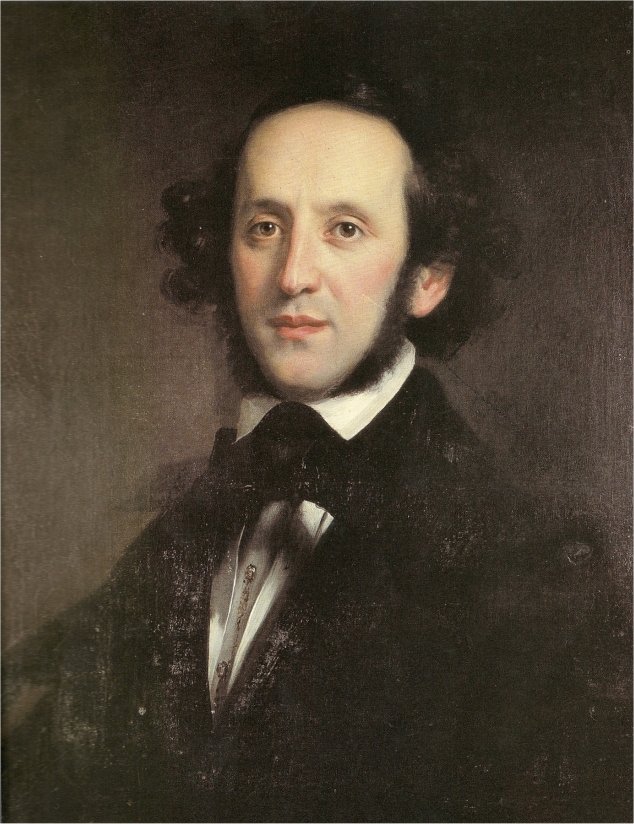

Eduard Magnus, 1846, public domain · Wikimedia Commons file 'Felix Mendelssohn Bartholdy - Edward Magnus 1846.jpg': oil portrait of Mendelssohn by Eduard Magnus (1799-1872), dated 1846 on the file page, scanned from a 1990 book; the work is public domain because the painter died in 1872 (more than 70 years), and the Commons tag states this basis. Saved at the original 634 x 824 pixels without resizing or upscaling. No conflicting institutional notice found; the sibling Commons file of the same painting carries an inconsistent 1833 date and cites a Berlin State Library copy. A sitting for the painting is not documented in the sources read, so it is treated as a historical depiction rather than a documented likeness. · Public domain (artist died 1872)
작곡가 · 19세기
펠릭스 멘델스존
1809–1847
주요 업적 분야
아직 성격 매칭에 포함되지 않았습니다 — 기록된 근거가 성격 모델 전체를 다루기에는 충분하지 않습니다. 이 페이지의 다른 모든 내용은 자유롭게 확인하실 수 있습니다.
핵심 특성
주요 업적
1829년 베를린에서 바흐 사후 처음으로 마태 수난곡을 지휘했으며, 브리태니커는 이 공연이 19세기 바흐 부흥의 출발점이 되었다고 설명한다.
현악 팔중주, 한여름 밤의 꿈 서곡, 헤브리디스 서곡, 이탈리아·스코틀랜드 교향곡, 바이올린 협주곡, 오라토리오 엘리야 등 지금도 연주되는 작품을 남겼다.
1835년부터 라이프치히 게반트하우스 관현악단을 이끌며 연주 수준과 레퍼토리를 넓혔고, 1843년 독일 최초로 평가되는 라이프치히 음악원을 세웠다.
삶의 장면들
드라이버는 에두아르트 데브리엔트가 그의 '인쇄에 대한 지독한 경외심'을 회고했다고 전하며, 멘델스존이 헤브리디스 서곡 등을 수년간 고쳐 쓰고서야 출판했고 스스로를 '고치는 지독한 병'에 걸렸다고 썼다고 전한다.
이는 작품의 완성도를 높였지만 출간을 늦추게 한 완벽주의와 일치한다. 완벽주의
그는 바그너가 훗날 그를 사적·공적으로 비난했음에도 라이프치히에서 바그너의 초기 교향곡과 리엔치 발췌, 탄호이저 서곡을 연주회에 올렸다.
이는 개인적 마찰과 상관없이 동료의 새 작품을 소개하려는 태도와 일치한다. 협업 성향
전환점
뒤셀도르프에서의 힘든 직책을 거친 뒤 1835년 라이프치히 게반트하우스 지휘를 맡았고, 이후 레퍼토리를 넓히며 1843년 음악원을 세웠다.
이는 연주자·작곡가에서 기관을 세우는 사람으로 역할이 넓어진 흐름과 일치한다. 선제적 행동력
비슷한 인물
전체적인 프로필이 이 사람과 닮은 사람들이에요.


레오나르도 다빈치

제임스 조이스

마야 안젤루

볼프강 아마데우스 모차르트

듀크 엘링턴
출처
- Felix Mendelssohn (Q46096) -- verified live via the Wikidata API (2026-10-26): English label 'Felix Mendelssohn', description 'German composer, pianist, organist and conductor of Jewish descent (1809-1847)', born 3 February 1809, died 4 November 1847, Korean label '펠릭스 멘델스존', P18 image 'Felix Mendelssohn Bartholdy by Eduard Magnus (1833).jpg'. Orientation only; not used as support for any row.
- Encyclopaedia Britannica, 'Felix Mendelssohn' (britannica.com), read as served (the free-to-read portion; the late-career and death sections are behind the subscription wall): German composer, pianist, conductor and teacher, one of the most celebrated figures of the early Romantic period; boyhood works including operas and symphonies for string orchestra; the String Octet (1825) and the Overture to A Midsummer Night's Dream as the first works of full stature; on 11 March 1829 at the Berlin Singakademie he conducted the first performance since Bach's death of the St. Matthew Passion, 'thus inaugurating the Bach revival of the 19th century'; ten visits to England and the lasting popularity of Elijah (1846) there, with the note that later generations of English composers revolted against his domination and condemned the sentimentality of his lesser works; as Gewandhaus conductor from 1835 he 'raised the standard of orchestral playing but made Leipzig the musical capital of Germany'; the Berlioz baton exchange. CANONICAL SIGNIFICANCE SOURCE.
- Encyclopedia.com entries 'Felix Mendelssohn' (UXL Encyclopedia of World Biography, Gale; and the Encyclopaedia Judaica entry by Dika Newlin, plus the Oxford dictionary summary), read in full: the 1829 St. Matthew Passion performance as the beginning of the revival of Bach's works; he turned down a Berlin university music professorship; in 1835 he became director of the Gewandhaus concerts in Leipzig, featured contemporary works and Schubert's C major symphony 'newly discovered by Robert Schumann'; in 1843 he founded the Leipzig Conservatory, 'the first of its kind in Germany', where he also taught piano and composition; Encyclopaedia Judaica calls it the most renowned institution of its kind in Germany in the 19th century and records that his father added the name Bartholdy while Felix, in 1829, conducted under the name Felix Mendelssohn. Reference-work narrative; the health and bereavement passages were not used.
- Claudia Roth (German Federal Government Commissioner for Culture), speech at the 25th anniversary of the Mendelssohn House in Leipzig (bundesregierung.de), read in full in German: Mendelssohn's Berlin revival of Bach's St. Matthew Passion, which the speaker says Bach's later standing owes much to; his shaping of the Gewandhaus orchestra from 1835 into a leading orchestra, his promotion of new works and revival of older music, and the idea and 'chutzpah' to wrest from the Saxon king the founding of the first conservatory in Germany; the failed application to succeed Zelter at the Berlin Singakademie, which witnesses attributed to his origins; Wagner's early admiration and later envy, Wagner's letter disparaging Mendelssohn's 1843 Dresden chorus, and Wagner's 1850 essay 'Judaism in Music' attacking Mendelssohn's alleged lack of depth; the 1850 protest by eleven Leipzig Conservatory professors against the editor; the removal of his Leipzig monument by the Nazi regime in 1936 and the long postwar rehabilitation. A government cultural-policy speech, celebratory but with named, checkable episodes; used for institution building and for reception history (reception history is not scored).
- Lewis Lockwood, 'Which Is the Real Mendelssohn?', The New York Review of Books, 4 November 2004 (review of R. Larry Todd's 'Mendelssohn: A Life in Music' and Clive Brown's 'A Portrait of Mendelssohn'), read in full: calls Todd's book likely to be the standard biography; assesses the Octet, the Midsummer Night's Dream overture, the Hebrides and Elijah as lasting works, while acknowledging the widespread view that many later works and salon pieces are routine; the 1829 Passion revival with Eduard Devrient and Mendelssohn's ironic remark about 'an actor and a Jew-boy'; the scholarly dispute (Sposato versus Botstein and Steinberg) over his religious identity; Wagner's 1850 essay as the template for later negative criticism. Independent scholarly review by a Harvard musicologist; the contested interpretation of his religious identity was NOT scored.
- Paul Driver, 'The Faster the Better', London Review of Books, vol. 27 no. 3 (3 February 2005) (review of R. Larry Todd's biography), read in full: Todd's book is critiqued as exhaustive but dense; the review draws on contemporaries' recollections: Eduard Devrient's 'awful reverence for print', Mendelssohn's own letter calling himself subject to 'this dreadful disease of altering', years of revision on the Hebrides and Fair Melusine overtures and the Italian Symphony, a perfectionism his father feared would prevent him finding a libretto; his ear and memory (Charles Hallé's and Julius Benedict's recollections, the Tannhauser theme anecdote); his role in the Bach and Schubert 'Great' C major rescue and in historically informed Handel; improvisation; he is called a pivotal figure in the role of the modern conductor. Critical independent review; the book itself was NOT opened.
- Classic FM, 'The Life Of Mendelssohn: Dusseldorf, Leipzig And Berlin' (classicfm.com), read in full: the Dusseldorf post with its provincial standards and heckling (Mendelssohn once tore up the score of Beethoven's Egmont in mid-rehearsal and left); seven Gewandhaus years that 'set the standard for modern orchestral training and repertoire', expanded repertoire from new works to Bach, Mozart concertos from the keyboard, Schubert's Great C major symphony, Beethoven symphonies; the failed Berlin Singakademie application. Popular-press biography; some claims (e.g. 'world premiere') stated without sources and used cautiously.
- Berliner Philharmoniker Digital Concert Hall, programme introduction to Abbado's final concert (digitalconcerthall.com, concert 3462), read in full: Mendelssohn's and Berlioz's first meeting in Rome in 1832, Mendelssohn's quoted private criticism of Berlioz's Symphonie fantastique and effusive manner, and the 1843 Leipzig meeting where, after initial distance, the two exchanged batons as mementos. Orchestra programme note; used only for the Berlioz relationship.
- Wikimedia Commons file pages 'Felix Mendelssohn Bartholdy - Edward Magnus 1846.jpg' (wikitext and API record) and 'Felix Mendelssohn Bartholdy by Eduard Magnus (1833).jpg', checked for the portrait: oil portrait by Eduard Magnus (1799-1872), dated 1846 on the used file, scan from a 1990 book, tagged public domain for art by an artist dead over 70 years; 634 x 824 pixels. The second file carries an inconsistent 1833 date field alongside a description saying 1846 and cites the Berlin State Library, so the 1846-dated file was used. Not used for scoring.