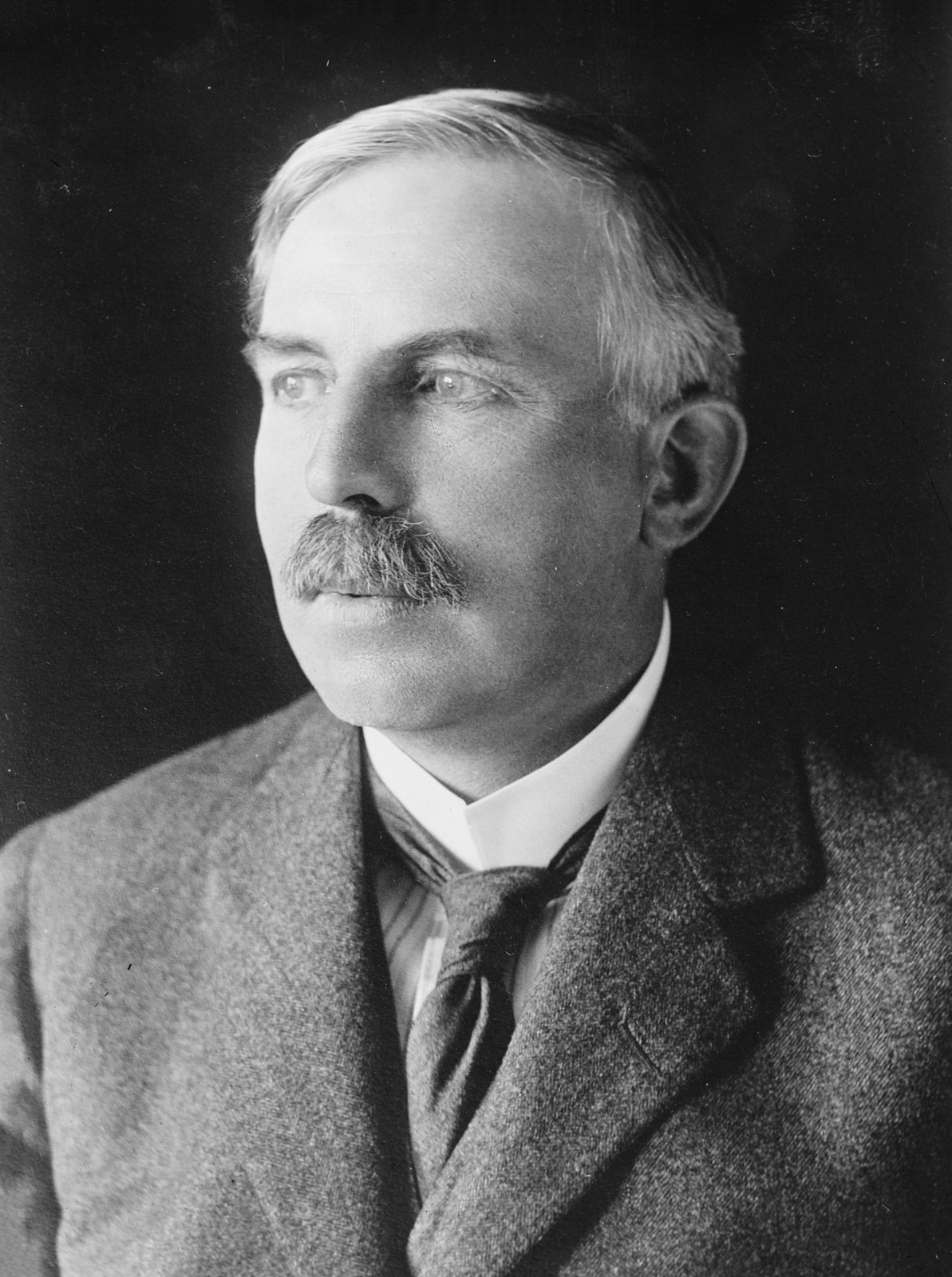

Bain News Service, Library of Congress, George Grantham Bain Collection (ggbain.36570); photographer not credited; date not recorded · Library of Congress, Prints and Photographs Division, George Grantham Bain Collection (digital ID ggbain.36570), via Wikimedia Commons · Public domain (US); LOC: no known restrictions on publication
핵심 특성
주요 업적
몬트리올의 맥길 대학에서 러더퍼드는 화학자 프레더릭 소디와 함께 토륨과 그 방사성 기체(에머네이션)를 연구했고, 두 사람이 1902년과 1903년에 발표한 논문은 방사성 물질이 존재하는 양에 비례하는 속도로 다른 물질로 변한다는 점을 제시했다. 역사학자 헬게 크라흐는 이 붕괴 이론이 오늘날에도 방사성 변화의 기본 법칙으로 여겨진다고 설명한다.
1911년 5월 러더퍼드는 《철학 잡지(Philosophical Magazine)》에 논문을 발표해, 한스 가이거와 어니스트 마스든이 맨체스터에서 관측한 알파 입자의 큰 각도 산란을 설명하려면 원자의 질량과 전하의 대부분이 아주 작은 중심부에 모여 있어야 한다고 주장했다. 1913년에 발표된 가이거와 마스든의 새 측정 결과는 그가 도출한 산란 공식과 잘 들어맞았다.
1919년에 발표한 논문들에서 러더퍼드는 알파 입자가 질소를 통과할 때 사거리가 긴 입자가 생기며 이것이 수소 원자일 가능성이 크다고 보고했고, 충돌 과정에서 질소 원자가 붕괴한 것으로 해석할 수 있다고 제안했다. 이브와 채드윅의 추도문은 그가 윌리엄 케이의 섬광 관측 도움을 받아 실험 작업을 직접 수행했다고 전한다.
삶의 장면들
1908~09년 한스 가이거와 어니스트 마스든이 얇은 금속박에서 알파 입자가 어떻게 산란하는지 측정하던 중, 러더퍼드는 마스든에게 금속 표면에서 곧바로 반사되는 알파 입자가 있는지 찾아보라고 제안했다. 마스든은 훗날 러더퍼드가 그런 결과를 기대했을 것 같지는 않다고 생각했으며 그 제안을 일종의 '직감'이라고 적었고, 러더퍼드는 가이거가 크게 흥분해서 일부 알파 입자가 뒤로 되돌아온다고 알려 왔다고 회고했다.
이 일화는 결과가 나오기 어려워 보이는 실험도 시도해 보려는 태도와 부합하며, 이 프로필의 다른 증언에서도 다른 시기에 비슷한 모습이 나타난다. 실험 성향
1919년 3월 7일, 러더퍼드는 케임브리지의 캐번디시 석좌직에 지원할지 정하기 전에 J. J. 톰슨에게 실험실과 연구 학생들에 관해 분명한 상호 합의가 필요하다고 편지를 썼다. 톰슨은 실험실 운영을 전적으로 러더퍼드에게 맡기겠다고 답했고, 러더퍼드는 교수이자 실험실 소장이 되었다.
이 서신 교환은 실험실의 방향을 책임지려는 관심과 부합하며, 이 프로필에 있는 리더십 관련 다른 증거와 함께 볼 수 있다. 주도 성향
전환점
1907년 1월 러더퍼드는 오토 한에게 맨체스터 대학의 교수직과 실험실 책임자로 임명되어 6월에 맥길을 떠난다고 알리면서, 미국과 캐나다는 학문의 중심에서 벗어난 변두리처럼 느껴져 중심에 더 가까워지는 것이 반갑다고 썼다. 맨체스터에서 그는 가이거, 마스든과 함께 알파 입자의 산란 연구를 이어 갔다.
비슷한 인물
전체적인 프로필이 이 사람과 닮은 사람들이에요.


윌버 라이트

존 D. 록펠러

닐스 보어

루스 베이더 긴즈버그

엘리자베스 1세
출처
- Ernest Rutherford -- English Wikipedia, fetched and read for orientation only (birth/death dates and places, the McGill 1898-1907 / Manchester 1907-1919 / Cambridge 1919-1937 posts, the 1908 Nobel Prize in Chemistry, knighthood 1914, barony 1931); not used as support for any scored row.
- Ernest Rutherford (Q9123) -- identity verified live through the Wikidata API (wbgetentities): en label 'Ernest Rutherford', en description 'New Zealand physicist (1871-1937)', born 1871-08-30, died 1937-10-19, citizenship New Zealand, P18 'Ernest Rutherford LOC.jpg', kowiki sitelink title '어니스트 러더퍼드'.
- A. S. Eve, Rutherford: Being the Life and Letters of the Rt Hon. Lord Rutherford, O.M. (Cambridge University Press, 1939), Internet Archive OCR full text (Digital Library of India scan, item dli.csl.3544), downloaded whole and read by chapter with targeted searches -- by Rutherford's former McGill colleague and authorised biographer, working from the preserved letters. Used for: the 1902 McGill work with Soddy and Soddy's own 1933 recollection of it, Prof. Norman Shaw's 1937 account of the McGill Physical Society meeting, the 1903 Soddy book episode, the 6 Jan 1907 letter to Hahn, C. G. Darwin's 1938 recollection of the 1911 calculation, the 1910 Marconi expert-witness episode, the 7 Mar 1919 letter to J. J. Thomson about the Cavendish chair, the April 1925 Royal Institution lecture, and Rutherford's 1933 remarks to the Royal Society on the word 'isotope'. Rutherford's own letters quoted in it are self-testimony (counted as one perspective with the rest of his writings).
- A. S. Eve and J. Chadwick, 'Lord Rutherford, 1871-1937', Obituary Notices of Fellows of the Royal Society vol. 2 no. 6 (Jan 1938) pp. 395-423 -- reprint digitised by the Wellcome Library via the Internet Archive (item b33631104), OCR full text downloaded and read. Two-author obituary by Rutherford's McGill-era colleague Eve and his Manchester/Cambridge collaborator Chadwick. Used for: the Manchester and Cambridge chapters (Geiger as second, the 1919 nitrogen experiments done by Rutherford with Kay's help and supported by control experiments, the 1920 'short-range atoms' deduction later found wrong, the attempts to detect a neutral particle, the satellite-nucleus model 'without real success', the acceptance of a large student body as a duty). Subject-adjacent (his own colleagues, published by a society he had presided over), so weighted below the independent sources.
- Norman Feather, Lord Rutherford (Blackie & Son, 1940), Internet Archive OCR full text (item LordRutherford), downloaded and read; foreword by W. H. Bragg. Biography by a Cavendish researcher who worked under Rutherford in his later years. Used for: the Manchester chapter (Bohr's 1912 request to drop his experiment for theory and Rutherford's 1929 statement that he was able to 'encourage Professor Bohr's bold application' of the quantum theory; Rutherford's own account of the older-school objection that a nuclear atom must be unstable) and the epilogue (a 1936 letter advising a colleague against pugnacious papers). Independent authorship from Eve, but the preface says Feather used letters Eve had already sifted and that Chadwick criticised the proofs.
- Rudolf Peierls, 'Rutherford and Bohr' (Rutherford Memorial Lecture, National Physical Laboratory, New Delhi, 10 Nov 1987; reproduced in Current Science 73, 1997 and Resonance, May 2010, pp. 476-487), PDF downloaded and read in full -- a physicist's account of the Rutherford-Bohr correspondence 1912-1937, quoting Rutherford's letters (1913 comments on Bohr's first paper, the 1914 readership, a Dec 1917 letter on his disintegration experiments, his 1919 plan for a Manchester chair, 1920-1936 remarks). Independent of Eve/Feather; used only for Rutherford's science-related behaviour, not for the health or bereavement passages it also contains.
- Helge Kragh (historian of science, Aarhus University), 'Rutherford, Radioactivity, and the Atomic Nucleus' (arXiv:1202.0954), PDF downloaded and read in full -- scholarly review of Rutherford's science c.1900-1937: the 1902 letter to his mother about keeping in the race, the 1902-03 disintegration theory with Soddy, the 1908 Rutherford-Royds proof, Dec 1910 letter to Boltwood, the May 1911 scattering paper and its stated assumptions, the reception of Bohr's atom and the beta-ray change of mind, the 1919 nitrogen experiments, the 1920s satellite nucleus model, the 1933-37 search for tritium. Independent scholarly perspective; cites letters through Badash, Pais and Stuewer.
- American Institute of Physics, Center for History of Physics, online exhibit 'Rutherford's Nuclear World', section 'Alpha Particles and the Atom' (2011), fetched and read in full -- Manchester 1907-1919: Geiger, Kay and Royds; the 1908 Bumstead letter; Ernest Marsden's recollection (quoted from Birks, Rutherford at Manchester, 1962, p. 8) of being asked to look for reflected alpha particles; William Kay's 1957 interview (quoted from Hughes 2008); Chadwick's oral-history remarks on Rutherford's first public announcement of the nuclear theory; the winter 1910-11 testable predictions; the 1917-19 experiments. Institutional secondary account; Birks and Hughes were not opened (lending-only), so the Marsden and Kay voices are as transmitted by AIP.
- American Institute of Physics, Center for History of Physics, 'Rutherford's Nuclear World', section on the Cavendish Laboratory years 1919-1937 (page 'Atop the physics wave', 2011), fetched and read in full -- the 1919 succession, the 1919 nitrogen paper's wording, Chadwick's oral-history remark on 'silly experiments', Phillip Dee's oral-history remark on how Rutherford concentrated the laboratory's resources, Mark Oliphant's account of Rutherford in lectures, the 1927 Royal Society address on accelerators, the neutron search 'for more than 10 years'. Institutional secondary account; the oral-history voices are as transmitted by AIP (the AIP oral-history transcripts themselves were blocked and not opened).
- American Institute of Physics, Center for History of Physics, 'Rutherford's Nuclear World', section on McGill 1898-1907 (page 'Exploring Radioactivity', 2011), fetched and read in full -- the team approach with the chemist Soddy, the alpha-particle deflection attempts that first failed, Rutherford's reluctance to state the alpha-helium identity before proof, and his 1907 letter to Hahn about leaving McGill. Institutional secondary account.