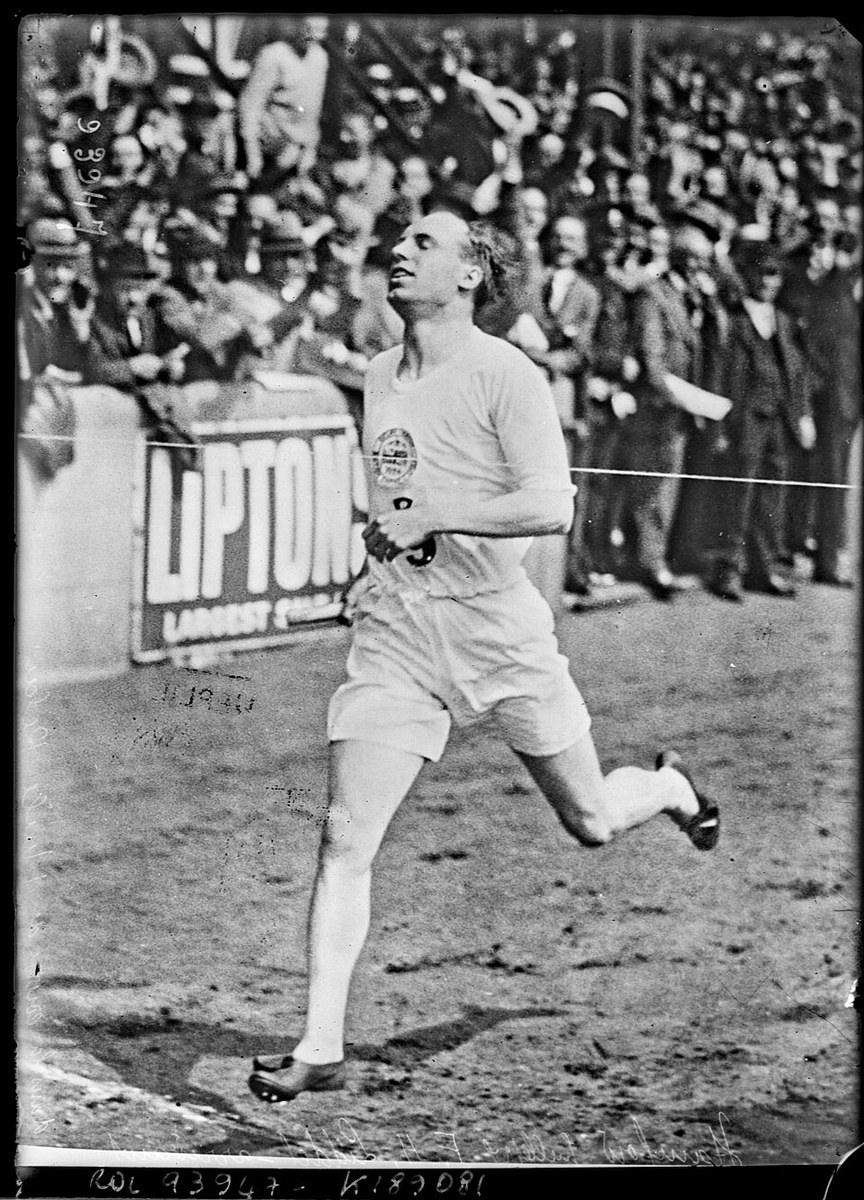

Agence Rol (photographer unknown), July 1924, Bibliotheque nationale de France, Gallica, public domain · Agence Rol press photograph 'Stamford, juillet 1924, F. [i.e. Eric] H[enry] Liddel [i.e. Liddell] arrivant dans la course de 1 mille relais' (Rol 93947), glass negative 18 x 13 cm, Bibliotheque nationale de France, departement Estampes et photographie, EI-13 (1132); catalogued by the BnF with the subject Liddell, Eric (1902-1945) and captioned 'Liddell' on the negative; shown on Gallica as public domain. Original scan 6122 x 8498 pixels; this copy downscaled to 864 x 1200 (never enlarged). · Public domain (BnF Gallica item-level statement 'domaine public'; 1924 press photograph by an agency)
운동선수 · 20세기
에릭 리델
1902–1945
주요 업적 분야
아직 성격 매칭에 포함되지 않았습니다 — 기록된 근거가 성격 모델 전체를 다루기에는 충분하지 않습니다. 이 페이지의 다른 모든 내용은 자유롭게 확인하실 수 있습니다.
핵심 특성
주요 업적
1924년 파리 올림픽 400m에서 47.6초의 올림픽·유럽·영국 신기록으로 금메달을 땄고 200m에서도 동메달을 획득했다.
일요일에 예선이 열린다는 이유로 가장 자신 있던 100m를 포기하고 400m 중심으로 올림픽 준비를 바꿨으며, 이 일은 영화 '불의 전차'의 모티브가 되었다.
1925년 육상을 떠나 중국 톈진의 영중학원에서 선교사 교사로 일했고, 1943년부터 웨이셴 수용소에 억류되어 1945년 숨질 때까지 아이들을 가르치고 활동을 이끌었다.
삶의 장면들
1924년 올림픽 일정에서 100m 예선이 일요일로 잡히자 그는 출전을 거부했고, 한 친구는 훗날 기자들이 집 앞에서 그를 배신자라 불렀지만 그가 그것이 자신의 신념이며 달리지 않겠다고 말했다고 회상했다.
이는 대중의 압박 속에서도 인기 없는 입장을 지키는 모습과 일치한다. 갈등 감내
100m를 포기한 뒤 이 거리에서 국제 경험이 거의 없었음에도 400m에 나서 준결승에서 자신의 최고 기록을 1초 넘게 앞당겼고 결승에서 47.6초로 우승했다.
이는 짧은 시간에 새로운 종목을 중심으로 계획을 다시 세우는 모습과 일치한다. 적응력
전환점
1925년 마지막 스코틀랜드 선수권 직후 몇 주 만에 에든버러를 떠나 아버지를 따라 선교사로 중국에 갔고 톈진 영중학원에서 가르쳤으며, 1941년 영국인에게 철수 권고가 내려졌을 때도 중국에 남았다.
이는 계속되는 운동선수로서의 명성보다 오래 계획해 온 봉사의 길을 택하는 모습과 일치한다. 영향 창출 동기
비슷한 인물
전체적인 프로필이 이 사람과 닮은 사람들이에요.


마하트마 간디

왕가리 마타이

제인 구달

말랄라 유사프자이

B. R. 암베드카르
출처
- Eric Liddell (Q317422), verified live via the Wikidata API (2026-11-02): label 'Eric Liddell', description 'Scottish athlete, sprinter, Olympian, Protestant missionary (1902-1945)', born 1902-01-16, died 1945-02-21, Korean label 에릭 리델, Olympedia id 69245. Orientation only; not used as support for any row.
- Encyclopaedia Britannica, 'Eric Liddell' (Britannica Editors), read in full. CANONICAL SIGNIFICANCE SOURCE: a British runner born in Tientsin to Scottish missionaries, winner of the 400 m gold in record time (47.6 s) and the 200 m bronze at the 1924 Paris Olympics; he dropped the 100 m, his strongest event, because the final was on a Sunday; he returned to China a year later to do missionary work with his father and died of a brain tumour in a Japanese internment camp; his story with Harold Abrahams was portrayed in Chariots of Fire (1981). Concise reference, admiring in tone.
- Olympedia, 'Eric Liddell' athlete biography and results, read in full: brilliant all-round sportsman at Eltham College and Edinburgh University, seven rugby caps for Scotland and four tries, five successive Scottish sprint titles from 1921, AAA 100 yards and 200 yards wins in 1923 with a 9.7 s British record that stood 35 years, gave up rugby for 1923-24 to concentrate on Olympic preparation, dropped the 100 m because the heats were on a Sunday, 200 m bronze and 400 m gold in 47.6 s (Olympic, European and British record) after improving his personal best by more than a second in the semi-final, returned to China as a missionary in 1925, interned in March 1943 and died in captivity aged 43. Standard Olympic results archive.
- Greg McKevitt, 'It's complete surrender' - Olympics hero Eric Liddell and the true story behind Chariots of Fire, BBC Culture / In History (8 July 2024), read in full: schooling at Eltham College, seven rugby caps 1921-23, the Sunday heats known months in advance (unlike the film), a friend's 1984 recollection of press hostility ('traitor to his country') and Liddell's calm reply, a fellow Scottish athlete's account of his 400 m tactics and head-back style, the 47.6 s final, his return to China and teaching at the Anglo-Chinese College in Tianjin, his decision to stay in China in 1941, 'Uncle Eric' at Weihsien teaching and organising activities for children, his death from a brain tumour, and a daughter's recollection. Press feature built on archive interviews; includes a critical note on the film's inaccuracy.
- Simon Burnton, '50 stunning Olympic moments: No8 Eric Liddell's 400 metres win, 1924', The Guardian (4 January 2012), read in full, including quoted Guardian reports of 12 July 1924 and 1945: a 'true amateur' who never intended sport to fill more than a few years, whose first race was in 1921 and last in 1925, who in those years took a pure-science degree, became a nationally known religious speaker, won two Olympic medals and seven rugby caps; the 1945 obituary calls him probably the ugliest runner to win an Olympic title and says his 1924 heats style drew ribald laughter; Harold Abrahams' remark that 'he gets there'; the 1923 Stoke race in which he fell and still won; the 1924 report that his Sunday refusal aroused curiosity. Independent national press with a critical note on his style.
- Scottish Athletics, 'Eric Liddell - the life of an athletics legend' (Arnold's Archive), read in full: Edinburgh debut in 1921 and five national sprint doubles, 100 yards in 9.7 for a British record and the 1923 Harvey Memorial Cup, the Sunday decision and the switch to the 400 m at which he was 'virtually inexperienced' internationally and had never broken 49 seconds, the 47.6 final with a 22.2 first half, the later IAAF review that replaced his 400 m world record with an earlier 440-yard mark, preaching in Scotland, teaching chemistry and English at the Anglo-Chinese College in Tianjin, itinerant evangelical work in the war years, internment at Weihsien in 1943 and death in 1945, and Harold Abrahams' tribute. Governing-body history, admiring but detailed.
- St Stephen's Church, Philadelphia, 'Friday Reflection: Eric Liddell II - Humanity Revealed in Internment' (2021), read: a church historian's essay on Weihsien that quotes, at second hand, Langdon Gilkey's 1966 memoir Shantung Compound (an American professor and fellow internee who calls Liddell as close to a saint as anyone he met), Duncan Hamilton's For the Glory and the missionary David Michell on Liddell's camp work (managing teenagers and children, organising sports and square dances, allowing Sunday games, tending the sick, leading a camp congregation). The original books were not opened (lending-only), so these camp details are second-hand; the essay is a devotional secondary source and is used with low weight.
- The Eric Liddell Community, Edinburgh, 'New exhibition Eric Liddell and Weifang opens' (2024), read: states that at the Weihsien camp, among over 1,500 civilians including about 500 children, he organised sports activities to boost morale and taught the children who called him 'Uncle Eric'. Memorial institution and a Weifang museum partner, so admiring and institutional; used only to corroborate the camp teaching role.
- The Edinburgh Reporter, 'Posthumous honorary degree awarded to Eric Liddell' (July 2024), read: the University of Edinburgh awarded him a posthumous honorary doctorate a century after his 400 m gold and his BSc in pure science, recognising his contribution to sport and humanity. Local news report of a university honour; used only for later recognition.