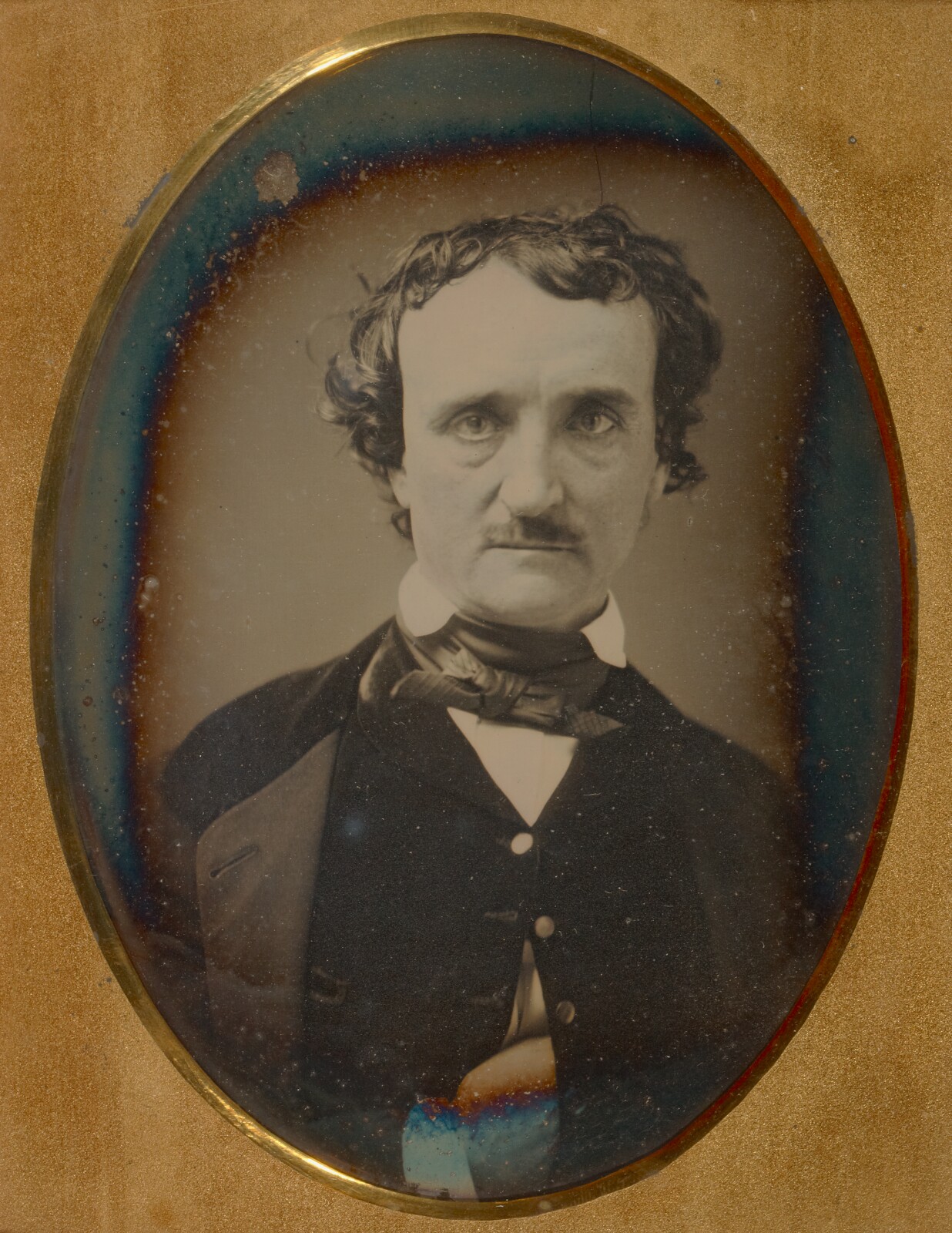

Unknown maker, American, Portrait of Edgar Allan Poe, late May-early June 1849, daguerreotype, 84.XT.957, J. Paul Getty Museum, Los Angeles · J. Paul Getty Museum, Los Angeles, 'Portrait of Edgar Allan Poe' (the 'Annie' daguerreotype), accession 84.XT.957, Open Content digital image via the Getty IIIF service · Public domain (daguerreotype by an unknown American maker, late May-early June 1849; Getty collection record: Public Domain / No Copyright)
작가 · 19세기
에드거 앨런 포
1809–1849
주요 업적 분야
아직 성격 매칭에 포함되지 않았습니다 — 기록된 근거가 성격 모델 전체를 다루기에는 충분하지 않습니다. 이 페이지의 다른 모든 내용은 자유롭게 확인하실 수 있습니다.
핵심 특성
주요 업적
포의 단편에는 『버튼스 젠틀맨스 매거진』 1839년 9월호에 실린 「어셔 가의 몰락」과 『그레이엄스 매거진』 1841년 4월호에 실린 「모르그 가의 살인」이 있다. 포의 전집을 편집한 T. O. 마벗(Mabbott)은 「모르그 가의 살인」이 '최초의 탐정 소설이라고까지는 할 수 없더라도' 탐정 소설로 의식하고 쓴 최초의 작품이며 이후 모든 작품의 직계 조상이라고 평가한다. 로웰(Lowell)은 1845년에 「어셔 가의 몰락」 하나만으로도 작가가 천재임을 보이기에 충분하다고 썼다.
「갈까마귀」는 1845년 1월 29일 뉴욕 『이브닝 미러』에 N. P. 윌리스의 추천 글과 함께 실렸고, 곧이어 『아메리칸 휘그 리뷰』 2월호에 '쿼를스(Quarles)'라는 가명으로 실렸다. 우드베리(Woodberry)는 어떤 짧은 시도 이만큼 빠르고 널리 자리 잡은 적이 없다고 썼고, 윌리스는 이 시가 상상력을 즐기는 독자들을 '전율시켰다'고 묘사했다.
포는 생계의 상당 부분을 잡지 비평가이자 편집자로서 마련했다. 1835년부터 『서던 리터러리 메신저』에 서평을 썼고(우드베리는 그가 있는 동안 이 잡지의 발행 부수가 500부에서 3,500부로 늘었다고 전한다), 1839년 7월부터 1840년 6월까지 『버튼스』의 서평 대부분을 썼으며, 1841년부터 『그레이엄스』를 편집했고, 1845년 10월 25일에는 『브로드웨이 저널』의 '편집인 겸 소유주'가 되었다. 로웰은 그의 비평이 미적 감각에서는 한계가 있지만 '과학적 정밀함과 논리의 일관성'이 두드러진다고 보았다.
삶의 장면들
1846년 포가 『고디스 레이디스 북』에 연재한 '문인들(Literati)' 인물평이 찰스 F. 브릭스와 토머스 던 잉글리시의 공격을 받자, 포는 반박문을 냈고 이 글은 1846년 7월 10일 필라델피아 『스피릿 오브 더 타임스』에 실렸다. 7월 23일에는 뉴욕 『이브닝 미러』가 잉글리시의 글을 포함한 공격문들을 실었다는 이유로 편집인과 소유주를 명예훼손으로 고소했고, 1847년 2월 17일 225달러의 배상 판결을 받았다.
공개적인 공격에 침묵하지 않고 반박문을 내고 소송까지 한 것은 공개적인 갈등을 견디는 성향과 부합한다. 다만 옳고 그름은 다툼이 있다. 브릭스와 잉글리시는 적대적이었고 포 자신의 인물평이 이들을 자극했으므로, 이 일은 그가 맞서 싸울 의지가 있었음을 보여 줄 뿐 그가 옳았다는 뜻은 아니다. 갈등 감내
포는 자신의 잡지 『스타일러스(Stylus)』 자금을 마련하려고 우주에 관한 강연을 공고했고, 1848년 2월 3일 폭풍우 치던 밤에 뉴욕 소사이어티 도서관에 60명가량이 모였다. 강연으로는 돈이 충분히 모이지 않자 그는 전문을 출판업자 조지 퍼트넘에게 보여 주었고, 퍼트넘은 이를 『유레카: 산문시』로 받아들여 500부를 찍어 1848년 여름에 펴냈다.
『스타일러스』 자금을 대려던 강연을 책으로 바꾼 것은 1840년부터 이어 온 계획을 포기하지 않는 끈기와 부합한다. 그래도 『스타일러스』는 끝내 창간되지 못했으므로, 자료가 보여 주는 것은 성공이 아니라 오랜 시간에 걸친 노력이다. 끈기
전환점
1835년부터 남의 잡지를 편집해 온 포는 『브로드웨이 저널』을 인수했고, 1845년 10월 25일자에는 '편집인 겸 소유주 에드거 A. 포'라는 문구가 실렸다. 마벗은 그가 이를 위해 여러 사람에게 돈을 빌려야 했다고 적는다. 1845년 12월 3일 그는 찰스 레인에게 지분 절반을 넘겼고, 이 신문의 마지막 호는 1846년 1월 3일에 나왔다.
여러 해 동안 남의 소유주 밑에서 일한 끝에 신문을 직접 소유한 것은 1843년 편지에서 밝힌 '편집 전반에 대한 완전한 통제'를 바란다는 뜻과 맞는다. 신문은 몇 달 더 이어졌을 뿐이어서, 같은 열망이 그에게 안정된 자리를 남겨 주지는 못했다. 자율성 욕구
비슷한 인물
전체적인 프로필이 이 사람과 닮은 사람들이에요.


세쿼야

무스타파 케말 아타튀르크

베티 데이비스

메리 울스턴크래프트

지그문트 프로이트
출처
- Edgar Allan Poe (Q16867) -- verified live via Special:EntityData (2026-10-08): en label 'Edgar Allan Poe', description 'American writer and literary critic (1809-1849)', born 1809-01-19, died 1849-10-07, ko label '에드거 앨런 포'. Orientation only; not used as support for any row.
- George E. Woodberry (Columbia literature professor), 'The Life of Edgar Allan Poe, Personal and Literary', vol. 1 (Houghton Mifflin, 1909; Internet Archive scan lifeofedgarallan0000geor) -- SCHOLARLY but period biography (Poe's first serious biographer, partly sympathetic, partly moralising; it prints much of Poe's correspondence). Read chapters V-VII selectively (Southern Literary Messenger years 1835-37, the Burton's Gentleman's Magazine quarrel of 1840, the Graham's period and the 1841 cryptography and Barnaby Rudge papers); its remarks on drinking and temperament were deliberately NOT used.
- George E. Woodberry, 'The Life of Edgar Allan Poe, Personal and Literary', vol. 2 (Houghton Mifflin, 1909; Internet Archive scan lifeedgarallanp00unkngoog) -- same period biography, vol. 2. Read the chapters on the Stylus plan (1843), 'The Raven' and the Broadway Journal, 'The Literati' (the 1846 quarrel with Thomas Dunn English and the libel suit), Eureka (1848 lecture) and the Notes; Poe's own letters are quoted extensively and are counted as a separate self source below. Its speculation about drinking and illness was NOT used.
- Thomas Ollive Mabbott (Poe's modern scholarly editor), 'Annals', in The Collected Works of Edgar Allan Poe, vol. I: Poems (Harvard/Belknap, 1969), pp. 529-572, text hosted by the Edgar Allan Poe Society of Baltimore -- concise scholarly chronology of Poe's life and editorial posts, independent of Woodberry. Read in full; its remarks on his habits and the circumstances of his death were not used.
- James Russell Lowell, notice of Poe's life and writings, first printed in Graham's Magazine (February 1845) and reprinted with alterations in The Works of the Late Edgar Allan Poe, vol. 1 (J. S. Redfield, New York, 1850; Internet Archive poeworks01) -- CONTEMPORARY FRIEND and fellow poet; written at Poe's own request, so partial; includes the judgment of Poe as a critic ('scientific precision and coherence of logic') and as an analytic writer. Read in full.
- N. P. Willis (editor of the Evening Mirror and Home Journal), 'Death of Edgar A. Poe' (Home Journal, October 1849), as reprinted in The Works of the Late Edgar Allan Poe, vol. 1 (Redfield, 1850) -- FIRSTHAND employer's account of Poe as critic and sub-editor at the Evening Mirror (1844-45); friendly to Poe and written in reply to Griswold's obituary. Read in full; the passages on drinking and 'insanity' (hearsay) were not used.
- Rufus W. Griswold, unsigned obituary of Poe, New-York Tribune (October 1849), as quoted in Willis's notice in The Works of the Late Edgar Allan Poe, vol. 1 (Redfield, 1850) -- HOSTILE, unreliable source (Griswold, Poe's rival and self-appointed literary executor, later shown to have distorted Poe's biography). Used ONLY to document the post-death fight over Poe's reputation; it supports no scored row and none of its characterisations is repeated.
- John Neal (Portland writer and early champion of Poe's poems), 'Edgar A. Poe', Daily Advertiser (Portland, Maine), 26 April 1850, hosted by the Edgar Allan Poe Society of Baltimore -- sympathetic contemporary who never met Poe, defending him against Griswold; used for its view that Poe's magazine ventures were commercially unrealistic and for the reputation fight. Read in full.
- Charles F. Briggs (Poe's former co-editor at the Broadway Journal), 'Mr. Poe and the New York Literati', Evening Mirror (New York), 26 May 1846, hosted by the Edgar Allan Poe Society of Baltimore -- ADVERSARIAL contemporary review of Poe's 'Literati' papers (disputes their fairness and independence and attacks Poe personally; its personal remarks were not used). Read in full.
- Thomas Dunn English (writer and former associate of Poe), 'A Card: Mr. English's Reply to Mr. Poe', Evening Mirror (New York), 23 June 1846, hosted by the Edgar Allan Poe Society of Baltimore -- HOSTILE contemporary counter-attack in the 1846 'Literati' quarrel; its accusations (money, conduct, drinking) are contested and were not used as evidence of any trait, only to document that the dispute and Poe's published reply happened. Read in full.
- Edgar A. Poe, 'The Philosophy of Composition' (Graham's Magazine, April 1846), as printed in The Works of the Late Edgar Allan Poe, vol. 2 (Redfield, 1850; Internet Archive poeworks02) -- SELF source: Poe's own account of how he claims to have composed 'The Raven'. Read the opening pages in full; the later analysis of the poem was skimmed. Not used as the sole support for any row, and whether it truthfully records his procedure is disputed.
- Edgar A. Poe's own letters to John P. Kennedy (1835-36), F. W. Thomas (1843), James Russell Lowell (1843) and others, as printed in Woodberry's 'Life' (1909) -- SELF source, a single perspective; used only for dated statements of his plans (editorial control, the Stylus partnership) and never alone.