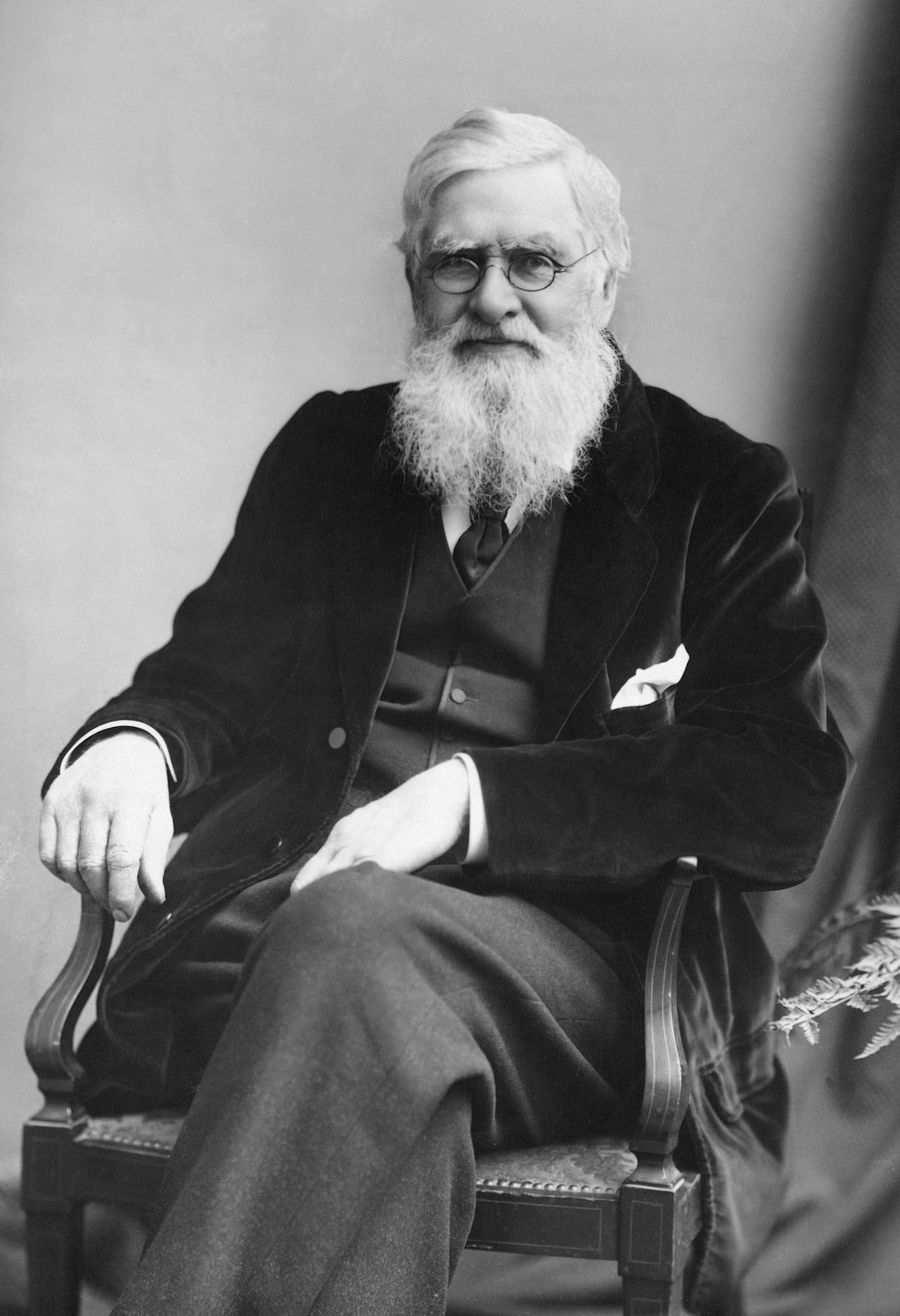

London Stereoscopic and Photographic Company, c. 1895 (first published in Borderland Magazine, April 1896) · London Stereoscopic and Photographic Company studio photograph, first published in Borderland Magazine, April 1896, via Wikimedia Commons · Public domain
핵심 특성
주요 업적
월리스는 1854년부터 1862년까지 동남아시아에서 전문 표본 수집가로 일했다. 그는 사라왁 출신의 알리를 비롯해 시기에 따라 구성이 바뀌는 현지 조수 팀과 함께 다니며 여러 차례 탐사를 했고, 1869년에 이 여행을 기록한 《말레이 제도》를 출간했다.
월리스는 1858년 2월 테르나테에서 쓴 글을 다윈에게 보내면서, 다윈이 충분히 새롭고 흥미롭다고 판단하면 찰스 라이엘에게 전해 달라는 뜻을 밝혔다. 1858년 7월 1일 런던 린네 학회는 이 글을 다윈의 글 발췌문과 함께 낭독했는데, 두 사람 모두 그 자리에 없었고 월리스는 몰루카 제도에 있었다.
1867년 2월 다윈은 헨리 월터 베이츠의 조언에 따라 일부 애벌레가 왜 화려한 색을 띠는지 월리스에게 물었다. 월리스는 눈에 띄는 색이 새들에게 맛이 없다는 신호가 될 수 있다고 답하며 실험을 제안했고, 존 제너 위어가 1867년과 1868년 여름에 그 실험을 수행했다.
삶의 장면들
1854년 2월 왕립지리학회 사무총장 헨리 노턴 쇼는 외무부에 편지를 보내, 월리스가 정부의 우편선 여객 제공 제안을 받아들이겠으며 그의 어린 조수도 포함되기를 바란다고 전하고, 목적지를 오스트레일리아 대신 싱가포르로 해 달라고 요청했다. 결국 P&O 증기선편이 마련되어 월리스와 십대 소년 찰스 앨런을 태운 배가 1854년 3월 4일 사우샘프턴을 출항했다.
이 일화는 1860년 앨런과 맺은 협약에서도 나타나듯, 제도적 인맥과 위임된 수집 작업을 현장 조사의 실질적 수단으로 바꾸는 경향과 일치한다. 자원 활용 성향
1869년 3월 월리스는 다윈에게 곧 나올 《쿼털리 리뷰》 기고문에서 처음으로 자연선택의 힘에 한계를 두겠다고 알렸고, 4월 14일 다윈은 인간에 관한 대목에 '크게 이견'이 있으며 '추가적이고 직접적인 원인'을 끌어들일 필요를 보지 못한다고 답했다. 다윈은 동시에 그 글에 '무척 흥미를 느꼈다'고 하며 월리스의 자연선택 설명을 '흉내 낼 수 없을 만큼 훌륭하다'고 평했다.
이 주고받음은 월리스가 가까운 동료와 다른 입장을 유지한 사례를 보여 준다. 그 입장이 옳았는지는 여기서 평가하지 않는다. 독립적 사고
전환점
1852년 월리스가 아마존에서 영국으로 돌아오던 배에 불이 나 개인 수집품 대부분이 소실되었는데, 런던의 대리인 새뮤얼 스티븐스가 그 수집품을 약 200파운드에 보험에 들어 둔 상태였다. 영국에 돌아온 지 약 18개월 뒤 그는 정부 지원 항해편으로 다시 표본 수집을 위해 떠났고, 이번에는 동남아시아로 향했다.
이 시간 순서는 큰 손실 뒤에도 현장 조사로 돌아간 태도와 일치하지만, 자료는 그의 속마음을 설명하지 않으므로 해석은 날짜순으로 확인되는 사실의 범위에 머문다. 끈기
비슷한 인물
전체적인 프로필이 이 사람과 닮은 사람들이에요.
출처
- Alfred Russel Wallace -- orientation only (dates, field summary); English intro extract read via the MediaWiki API; Korean article title confirmed via the ko.wikipedia API. Not used as support for any scored row.
- Alfred Russel Wallace (Q160627) -- identity verified live via the wbgetentities API: en label 'Alfred Russel Wallace', description 'British naturalist, explorer, geographer, anthropologist and biologist (1823-1913)', born 1823-01-08, died 1913-11-07, citizenship Q174193 (UK), ko label '앨프리드 러셀 월리스', P18 'Alfred-Russel-Wallace-c1895.jpg'. Orientation only.
- Darwin Correspondence Project, letter DCP-LETT-2192, Charles Darwin to A. R. Wallace, 22 December 1857 (full transcript and editorial notes read). FIRSTHAND, contemporaneous, non-self (Darwin): replies point by point to Wallace's letter of 27 Sept 1857 -- on his attention to distribution, his differing view of former land connections of oceanic islands, his question whether Darwin would discuss 'man', and his expectation of staying 3-4 more years in the East; DCP note 12 records that he returned in 1862 after eight years.
- Darwin Correspondence Project, letter DCP-LETT-2285, Charles Darwin to Charles Lyell, 18 June 1858 (full transcript and notes read). FIRSTHAND, non-self (Darwin): reports that Wallace 'has to day sent me the enclosed & asked me to forward it to you' (Lyell) and that Wallace does not say he wishes it published; DCP note 3 records that Wallace's covering letter and manuscript are missing and that the date of receipt is debated by scholars (that debate is not used here).
- Darwin Correspondence Project, letter DCP-LETT-2299, Joseph Dalton Hooker and Charles Lyell to the Linnean Society, 30 June 1858 (full transcript and notes read; the original manuscript is lost and the DCP text is from the 1859 Journal of the Proceedings of the Linnean Society). FIRSTHAND, non-self (Lyell and Hooker, counted as one perspective): says Wallace's essay was written at Ternate in February 1858 for Darwin and sent 'with the expressed wish that it should be forwarded to Sir Charles Lyell, if Mr. Darwin thought it sufficiently novel and interesting', and calls both authors 'original thinkers in this important line of inquiry'.
- Darwin Correspondence Project, letter DCP-LETT-2405, Charles Darwin to A. R. Wallace, 25 January [1859] (full transcript and notes read). FIRSTHAND, non-self (Darwin): acknowledges Wallace's letters to him and to Hooker, thanks him for offering to look after horses' stripes, is 'delighted' Wallace has collected bees' combs and asks for specimens; DCP note 9 records that Wallace apparently sent bee specimens.
- Darwin Correspondence Project, letter DCP-LETT-5416, A. R. Wallace to Charles Darwin, 24 February [1867] (full transcript and editorial notes read). The letter itself is Wallace's own (SELF, one perspective) and is used only for what he proposed (conspicuous caterpillar colours as a signal of distastefulness, and two experiments); the independent support is the DCP editorial notes (note 4: John Jenner Weir ran the experiments in the summers of 1867 and 1868 and read a paper on them in 1869-70; Descent 1: 417).
- Darwin Correspondence Project, letter DCP-LETT-5420, Charles Darwin to A. R. Wallace, 26 February [1867] (full transcript and notes read). FIRSTHAND, non-self (Darwin): 'I never heard any thing more ingenious than your suggestion'; notes he had 'failed to convince' Wallace that sexual selection was the main agent forming human races; DCP note 1 records that Bates advised Darwin to ask Wallace and that Descent 1: 416 credits Wallace with 'an innate genius for solving difficulties'; note 5 records Darwin's 1864 attempt to convince Wallace on the same point.
- Darwin Correspondence Project, letter DCP-LETT-6684, Charles Darwin to A. R. Wallace, 27 March [1869] (full transcript and notes read). FIRSTHAND, non-self (Darwin): comments on Wallace's letter of 24 March 1869 and his forthcoming Quarterly Review article, and says Wallace would not deviate 'a hair's breadth from his conviction to please any Editor in the world'.
- Darwin Correspondence Project, letter DCP-LETT-6706, Charles Darwin to A. R. Wallace, 14 April 1869 (full transcript and notes read). FIRSTHAND, non-self (Darwin): reacts to Wallace's Quarterly Review article (a review of Lyell's Principles and Elements of Geology, with Cuvier extracts, Croll on glacial dating, denudation and the age of the earth, Lamarck, natural selection and remarks on man); 'As you expected I differ grievously from you'; also praises Wallace's exposition of natural selection.
- Darwin Correspondence Project editorial essay 'Darwin in letters, 1869: Forward on all fronts' (section 'Natural selection and humans: differences with Wallace' read). Editors' summary that in the Quarterly Review article Wallace argued certain human capacities could not have arisen by natural selection and invoked a guiding power, that Darwin 'differ[ed] grievously', and that the two kept a cordial correspondence. Same DCP editorial perspective as the letter notes; used to corroborate, not as an independent second author.
- Linnean Society of London, 'The 160th anniversary of the presentation of On the tendency of species to form varieties' (Eleanor Marshall, intern, 1 Jul 2018) -- institutional retelling used ONLY for the meeting facts (read on 1 July 1858; neither Darwin nor Wallace present; Wallace 'away in the Moluccas'); the page's own summary of the essay's arrival repeats the DCP account and is not counted as an independent perspective. Fetched and read in full.
- Henry Walter Bates, The Naturalist on the River Amazons (1863), Project Gutenberg #2440 HTML edition (full text downloaded; the passages mentioning Wallace located by search and read in context: the 26 April 1848 departure, the 26 Aug 1848 Tocantins excursion, the June 1849 separate trips, the Barra reunion and the Rio Negro / Solimoens division of routes in 1850). FIRSTHAND, non-self (Bates, Wallace's travelling companion). The book was not read end to end.
- John van Wyhe, 'Alfred Russel Wallace. A biographical sketch', Wallace Online (wallace-online.org) -- scholarly biographical essay by the historian of science who edits Wallace Online; read in full. NON-SELF, secondary, but draws on Wallace's own notebooks, letters and My Life; covers the 1848 Amazon plan, the 1852 ship fire and its insurance, the 1854 government-funded passage, the 1858 essay and its sending to Darwin, and later divergences from Darwin (1869-70, 1878, 1880, 1889). Its polemical passages about 'hero worship' and about the Bedford Level and spiritualism are not used.
- John van Wyhe and Gerrell M. Drawhorn, ''I am Ali Wallace': The Malay Assistant of Alfred Russel Wallace', Journal of the Malaysian Branch of the Royal Asiatic Society 88(1) (2015): 3-31 -- scholarly reconstruction of Wallace's assistants, itinerary and accounts from his journals (Linnean Society MS178), field notebooks (NHM), published book and letters; PDF text-extracted and read in full except the reference list. NON-SELF, secondary; much of its narrative traces back to Wallace's own records, so it is a scholarly reading of Wallace's documents, not an independent eyewitness.
- Kees Rookmaaker and John van Wyhe, 'In Alfred Russel Wallace's Shadow: His Forgotten Assistant, Charles Allen (1839-1892)', JMBRAS 85(2) (2012): 17-54 -- scholarly article quoting the Royal Geographical Society letterbook (H. N. Shaw to Lord John Wodehouse, 16 Feb 1854) and Wallace's Notebook 5 accounts for Allen's 1860-62 collecting. PDF text-extracted; the introduction, the 1854 passage, the Borneo years, the 1860-62 arrangement and the accounts sections were read; the later-life sections on Allen were only skimmed. NON-SELF, secondary (same scholarly circle as src_wallace_ali_paper and src_wallace_vanwyhe_sketch).
- Henry Fairfield Osborn, 'Alfred Russel Wallace, 1823-1913', Popular Science Monthly (December 1913), 523-537, transcription/scan hosted on Charles H. Smith's Wallace site at Western Kentucky University -- contemporaneous obituary essay by a Columbia University zoologist; PDF text-extracted and read in full. NON-SELF, secondary; some biographical passages quote Wallace's My Life (self), which are NOT used -- only Osborn's own assessments of the breadth and originality of Wallace's published work (colouration, zoogeography, glacial erosion, anthropology) and of his divergence from Darwin.