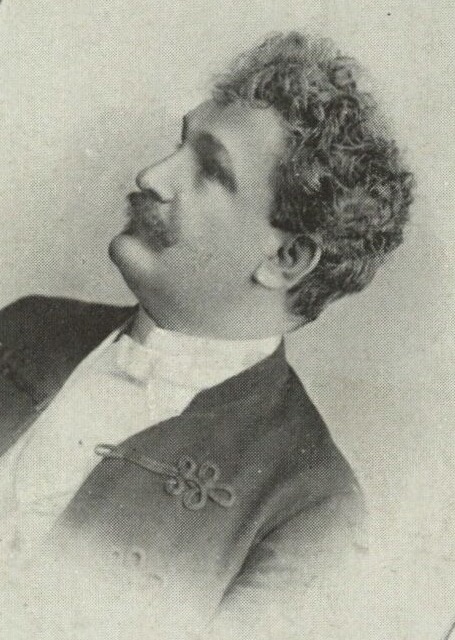
Unknown photographer, 1899, in 'Narodni album' (Prague: Jos. R. Vilimek, 1899), p. 183; National Library of the Czech Republic digital library (cropped) · Photographic portrait of Leoš Janáček (profile view, looking up) as reproduced on page 183 of the printed album 'Narodni album: Sbirka podobizen a zivotopisu ceskych lidi prac a snahami vynikajicich i zaslouzilych' (Prague: Jos. R. Vilimek, 1899), where the sitter is named by the printed caption 'Leos Janacek'. The album page shows five composers and writers within a decorative frame; the photographer of this portrait is not credited on the page and is treated as unknown. The image was cropped from the National Library of the Czech Republic's Kramerius digital scan (4108 x 3358 pixel page, access policy 'public'); the crop is 455 x 640 pixels at original resolution with no scaling or upscaling, and the decorative frame was cropped away. Rights basis: the image was published in Prague in 1899, so it is in the public domain in the United States by publication date (any work published before 1931 is, and works of that age were not restored by the 1996 copyright restoration), and the Czech copyright term for an anonymous photograph of that age has expired; this is a basis by age and publication date, not an institutional licence, and the library's record states only an access policy and no reuse terms. Caveat recorded honestly: a still-living-in-1996 photographer cannot be excluded for Czech law, but the 1899 publication fixes the United States status. · Public domain (published in Prague in 1899; photographer unknown)
composer · 20th Century
Leoš Janáček
1854–1928
Known For
Not yet included in personality matching — the documented evidence doesn't yet cover enough of the personality model. Everything else on this page is fully available.
Trait Constellation
Key Achievements
A Czech composer who built a distinctive operatic language from the inflections of spoken Czech and the scales of Moravian folk music; Jenufa (premiered in Brno in 1904) established his international reputation, which Britannica ranks among his most important operas.
In the last decade of his life, after Jenufa reached Prague in 1916, he wrote his most celebrated works: the operas Katya Kabanova, The Cunning Little Vixen, The Makropulos Case and From the House of the Dead, along with the Sinfonietta, the Glagolitic Mass and two string quartets.
Beyond composing he founded the organ school at Brno in 1881 (later the Brno Conservatory), founded the periodical Hudebni listy, collected Moravian folk songs, and from 1897 notated speech melodies in 56 surviving notebooks, a body of work later scholars still debate.
Moments That Reveal Them
From the summer of 1897 until 1928 he went on notating overheard speech, adding the time, place and situation to many entries; 56 of his notebooks survive, and the Brno festival counts more than three thousand recordings, including animal sounds.
This is consistent with a long, self-directed habit of listening and recording, though scholars disagree about how objective the notation was. Curiosity
In 1881 he founded an organ school in Brno and directed it for decades, and in the 1880s he also founded and edited Hudebni listy, the first musical periodical in Moravia.
This is consistent with a person who built the institutions around him rather than waiting for them to exist. Proactive Agency
Turning Points
Jenufa took nearly ten years to write and was premiered in Brno in 1904 after the Prague National Theatre refused it; when it was finally staged in Prague in 1916 it was a great success and took him to Vienna, Berlin and New York, opening the last, most productive decade of his life.
This is consistent with sustained commitment to his own work through long neglect, rather than a change of direction to win acceptance. Persistence
Similar People
People whose overall profiles resemble theirs.
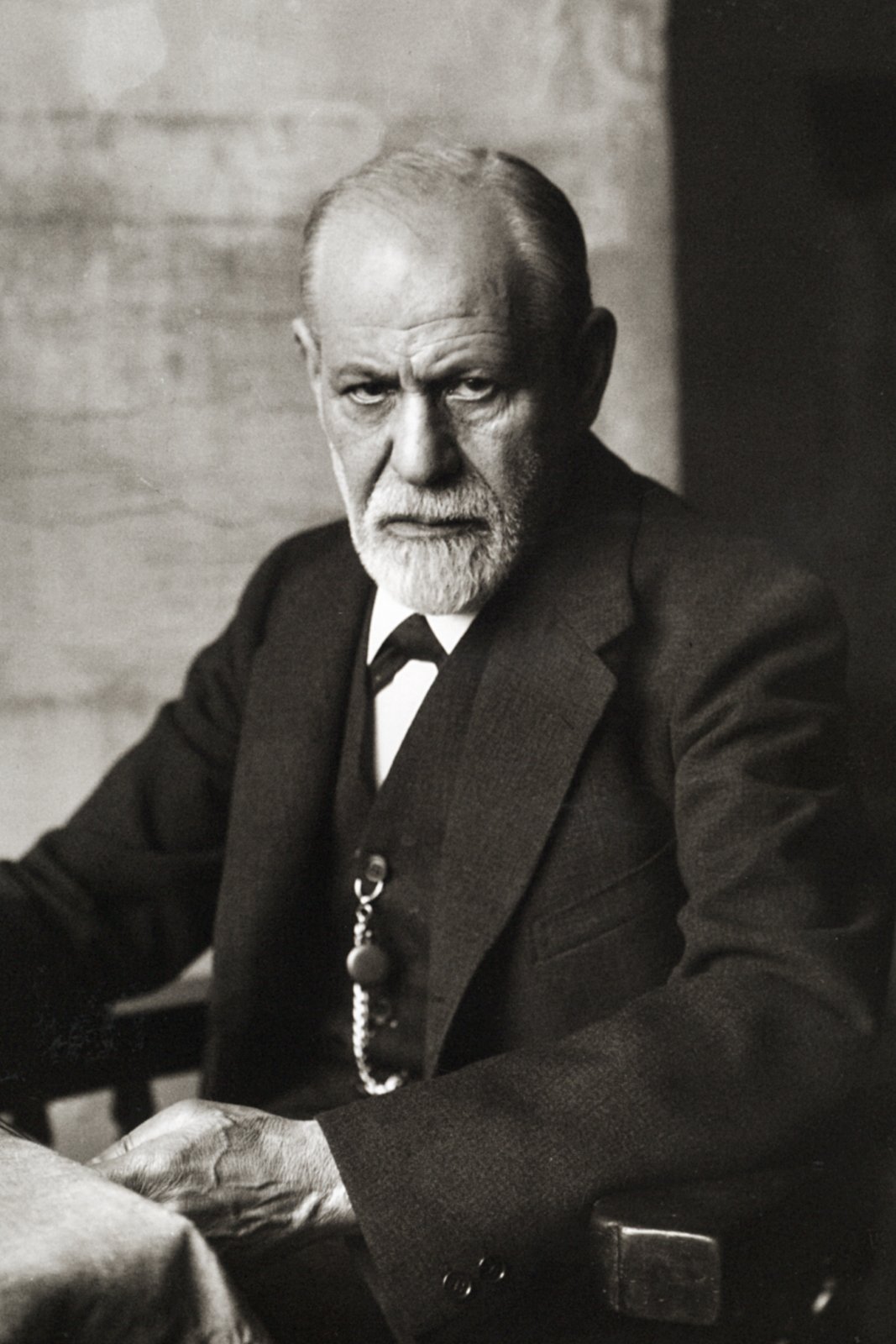

Sigmund Freud

Mark Twain

Catherine the Great

Abraham Lincoln

Jane Goodall
Sources
- Leoš Janáček (Q184933), verified live via the Wikidata API (2026-11-02): label 'Leoš Janáček', description 'Czech composer (1854-1928)', born 1854-07-03, died 1928-08-12, Korean label 레오시 야나체크. Orientation only; not used as support for any row.
- Encyclopaedia Britannica, 'Leoš Janáček' (full article read, about 500 words). CANONICAL SIGNIFICANCE SOURCE: composer, one of the most important exponents of musical nationalism of the 20th century; founded the organ school at Brno in 1881 and directed it until 1920; collected folk songs with Frantisek Bartos and published the journal Hudebni listy; in his later operas developed a distinctly Czech style tied to the inflections of native speech and the scales of Moravian folk music; Jenufa (1904) established his international reputation; also The Makropulos Case, From the House of the Dead, The Cunning Little Vixen, the Glagolitic Mass, song cycles; style 'highly individual and original'.
- Jiri Zahradka, 'Leos Janacek', Janacek Brno festival (the Leos Janacek International Music Festival; page read in full, about 1,600 words). Detailed institutional biography: choirboy at the Augustinian abbey in Brno, teacher-training institute, choir conductor, the Prague Organ School, brief Leipzig and Vienna study, founding of the periodical Hudebni listy, field collection of folk songs and dances from 1888, the systematic notation of speech melodies from 1897 (more than three thousand recordings including animal sounds), Jenufa finished after almost ten years of effort, its refusal by the Prague National Theatre, the Brno premiere of 21 January 1904, a further twelve years' wait for Prague, international fame from 1918, and the last prolific decade including oversight of the transformation of the Brno Organ School into the Conservatory. Passages on marriage, children, a muse and the circumstances of his death were read and are not used. Written by the festival named for him, so treated as admiring.
- Royal Ballet and Opera, London, 'Leos Janacek' biography (page read in full, about 450 words). 'A late developer': fifty when he completed his first mature opera Jenufa; his earlier operas Sarka (unperformed for decades), The Beginning of a Romance (little impression) and Osud (declared un-performable) had limited success; Jenufa a local triumph in 1904 but it took more than a decade and an ardent campaign by his admirers to reach Prague's National Theatre in 1916; contract with Universal Edition in Vienna; the fertile last years 1920-28. Remarks on a personal attachment were read and are not used.
- Alexandra Wilson, 'Leos Janacek', London Symphony Orchestra composer guide (page read in full, about 850 words). Czech composer whose language transformed 20th-century opera; inspired by the rhythms of spoken Czech and Moravian folk traditions; music barely known outside Moravia until the belated Prague performance of Jenufa in 1916; many celebrated works (Sinfonietta, Glagolitic Mass, string quartets, four major operas) written in the last decade of his life; 'one of the most original opera composers of the 20th century'. Personal-life paragraphs were read and are not used.
- English National Opera, 'An Introduction to Jenufa' (page read in full, about 650 words). Jenufa took nearly ten years to write, premiered in Brno in 1904 after repeated rejections by Prague's National Theatre management, was a great success in Prague in 1916 and soon reached Vienna, Berlin and New York; working-class village subject and the 'speech-melody' method of following the cadences of everyday speech after recording ordinary people speaking Moravian. Personal dedication remark was read and is not used.
- Marketa Vlkova (Masaryk University), 'Between Science and Art: The Speech Melodies of Leos Janacek', Fourth International Workshop on the History of Speech Communication Research, Prague, 27-28 August 2021 (ISCA Archive; full paper read, about 4,000 words). CRITICAL / COUNTER-VOICE: reports that from the summer of 1897 until 1928 he notated overheard speech in 56 preserved notebooks with circumstances of time, place and the speaker's state of mind (more than 6,000 surviving items estimated), that his 'theory' is an unstable set of observations rather than a consistent theory, and that later musicologists stress stylization and subjectivity, quoting John Tyrrell that the melodies 'reflect much more of him than they did of their speakers'.
- National Library of the Czech Republic, Kramerius digital library, 'Narodni album: Sbirka podobizen a zivotopisu ceskych lidi prac a snahami vynikajicich i zaslouzilych' (Prague: Jos. R. Vilimek, 1899), page 183 (record and image read through the library's API; access policy 'public'). Used for the portrait only, not for any trait row.