Catherine the Great
89% Profile Match
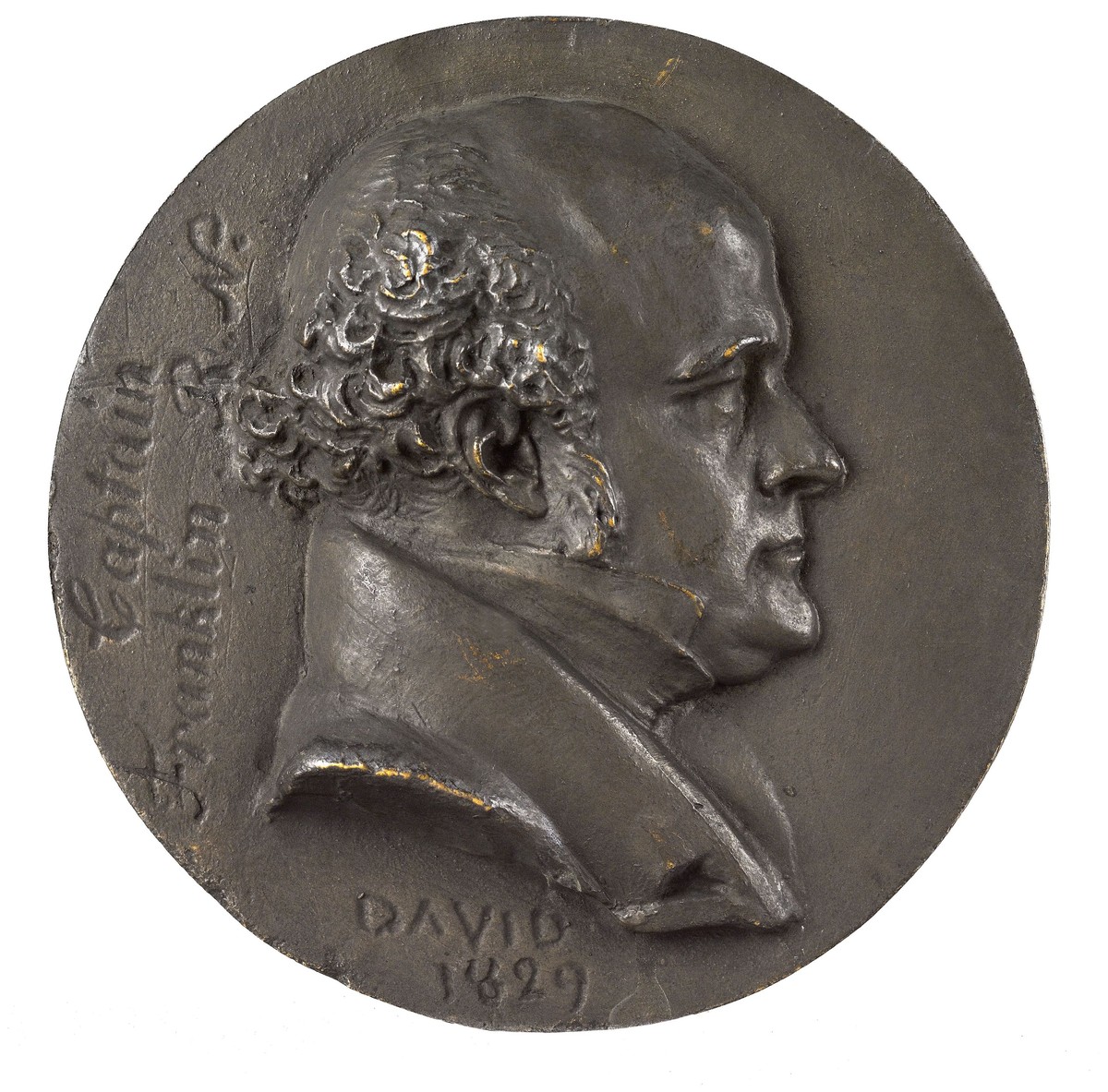
Pierre-Jean David d'Angers, bronze medallion of Captain Franklin, 1829 (cast by Louis Richard); Musee Carnavalet - Histoire de Paris (S1873); photograph Eric Emo / Paris Musees, CC0, cropped and downscaled from the original · Musee Carnavalet - Histoire de Paris (Paris Musees Collections), record S1873, 'Portrait de Sir John Franklin (1786-1847), marin et explorateur anglais': bronze medallion by Pierre-Jean David d'Angers (1788-1856), signed 'DAVID / 1829' and inscribed 'Captain / Franklin R.N.', cast by Louis Richard, 12.5 cm in diameter, purchased by the museum in 1882; the museum's own record states 'CC0 Paris Musees / Musee Carnavalet - Histoire de Paris' and offers the image for download, with no conflicting restriction, and the Wikimedia Commons file of the museum's photograph (photographer Eric Emo, original 2942 x 3000 pixels) is tagged CC0. The record does not say whether Franklin sat for the medallion. The photograph was cropped only to remove the white margin and downscaled once to 1200 x 1183 (never upscaled). · CC0 1.0 (Paris Musees / Musee Carnavalet record states CC0; 1829 bronze medallion by a sculptor who died in 1856)
explorer · 19th Century
1786–1847
Not yet included in personality matching — the documented evidence doesn't yet cover enough of the personality model. Everything else on this page is fully available.
Franklin led two overland expeditions that charted Canada's northern coast: from 1819 to 1822 down the Coppermine River and eastward along the Arctic shore, and from 1825 to 1827 down the Mackenzie River, with one party going west and another east to the Coppermine. Richard Davis credits parties under his command with more than 2,800 km of previously unknown coastline, and the Dictionary of Canadian Biography ranks his contribution to knowledge of Canada's coasts second only to George Vancouver's.
In 1845 he commanded HMS Erebus and HMS Terror in a renewed attempt to chart the Northwest Passage. Both ships were lost and all 129 men died, which Royal Museums Greenwich calls the worst disaster in the history of British polar exploration, and the Victory Point note records Franklin's death on 11 June 1847. More than 30 search expeditions followed, which Parks Canada says helped map the Canadian Arctic; working with Inuit oral history, Parks Canada found Erebus in 2014 and Terror in 2016.
The account of the first expedition, published to great acclaim in 1823, made him a public hero, and geographers and scientists judged the second expedition an unqualified success, with important magnetic, geological and zoological observations among its results. He was elected a Fellow of the Royal Society, knighted in 1829, and given an honorary degree by Oxford and the gold medal of the Societe de Geographie de Paris.
Franklin began the northern journey to the Coppermine in July 1821 with inadequate provisions and, according to the Dictionary of Canadian Biography, pushed on along the coast until 21 August, when it was too late to return by the same route; eleven of the twenty men died before the survivors were rescued. The dictionary names his failure to turn back soon enough as the main point on which his leadership merits criticism, noting that his orders set no conditions for abandoning the mission, while Davis writes that the advanced season and a mutinous crew forced him back at Point Turnagain.
This is consistent with an expedition leader who kept pressing toward the objective under orders that gave no point of retreat, at a heavy cost, though the two scholars differ on how far the decision was his own. Persistence
On 16 August 1826, with his boats delayed by ice and fog and the supporting ship Blossom not yet met, Franklin concluded, remembering the catastrophe of 1821, that the point beyond which perseverance would be rashness had been reached, and ordered the party back; everyone reached Fort Franklin safely. He later learned that a boat sent out from the Blossom had been about 160 miles away.
This is consistent with a leader who revised his own limit for risk after 1821, though the same decision meant missing a meeting with Beechey's party. Belief Updating
After the 1819-22 disaster, Franklin prepared the second expedition differently: the Dictionary of Canadian Biography credits his careful planning and boats specially built for the Mackenzie journey, Parks Canada says he made preparations well in advance and sent supplies ahead to Hudson's Bay Company posts, and Davis describes four sturdy boats rowed by seamen in place of the frail bark canoes of the first expedition. No serious hardships occurred, and geographers and scientists judged it an unqualified success.
This is consistent with a leader who changed his method after a failure, though the dictionary also credits the support of the now-merged Hudson's Bay Company as part of the difference. Planning Orientation
People whose overall profiles resemble theirs.