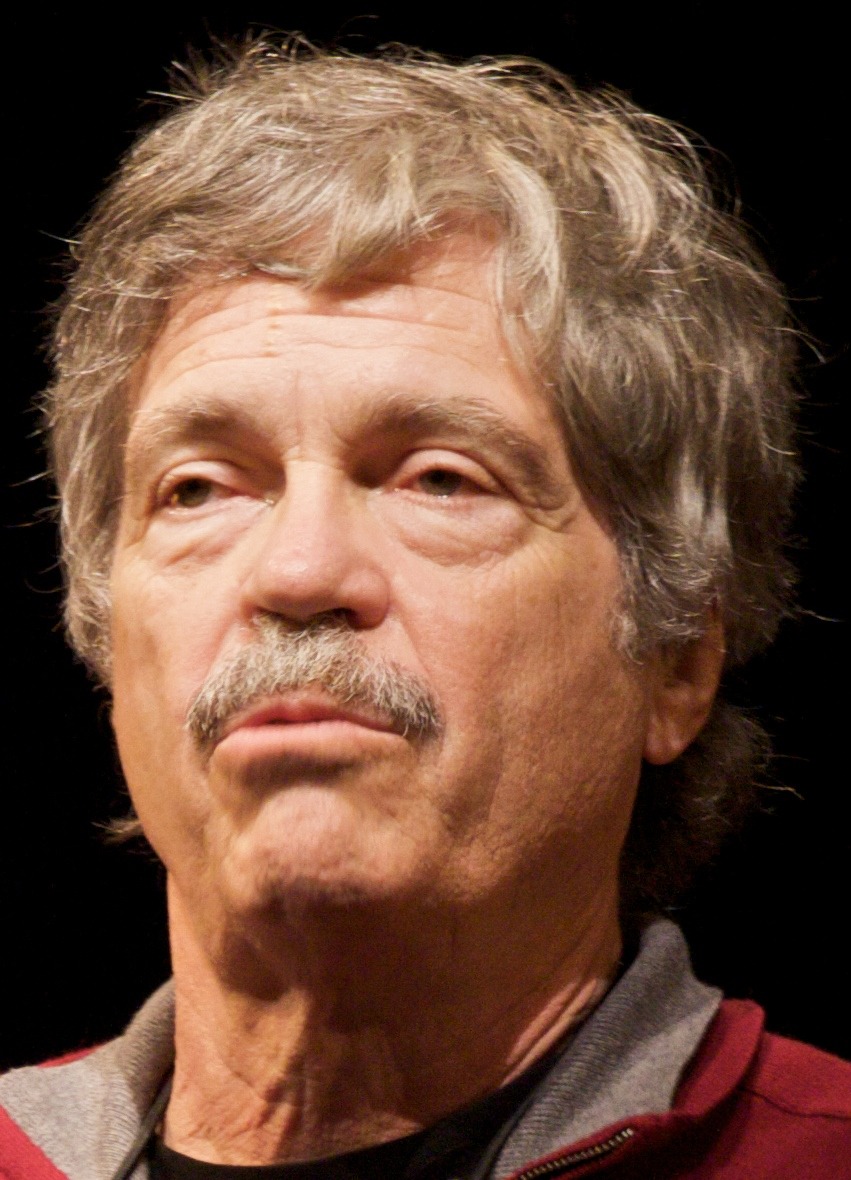
Photo: Marcin Wichary, 2008, CC BY 2.0 · Wikimedia Commons 'Alan Kay (3097597186) (cropped).jpg' (derivative of 'Alan Kay (3097597186).jpg'), photograph by Marcin Wichary, 9 December 2008, originally from Flickr (photo 3097597186), tagged CC BY 2.0 and Flickr-reviewed by the File Upload Bot on 5 February 2009; the live Flickr page currently shows the Attribution licence (CC BY 2.0). Saved at the Commons cropped size of 851 x 1180 pixels with no resizing or upscaling; the uncropped original is 4752 x 3164. · CC BY 2.0
computer scientist · Contemporary
Alan Kay
b. 1940
Known For
Not yet included in personality matching — the documented evidence doesn't yet cover enough of the personality model. Everything else on this page is fully available.
Trait Constellation
Key Achievements
Proposed the Dynabook, a portable, networked personal computer that anyone, including children, could use, at a time when computers were getting larger; Britannica notes he never built it, but its ideas later appeared in laptops and tablets.
Led Xerox PARC's Learning Research Group, which with Dan Ingalls, Adele Goldberg and others developed Smalltalk from 1972, an object-oriented programming and authoring environment that fed into graphical personal computing.
Received the 2003 ACM Turing Award for object-oriented programming languages and personal computing, and later founded Viewpoints Research Institute, a non-profit for children and learning.
Moments That Reveal Them
After Jerry Elkind criticised his 1972 proposal and Bill English advised him to write research plans and budgets, Kay drafted a detailed plan for a smaller first step and won a $230,000 appropriation, according to Hiltzik.
This is consistent with revising his approach in response to criticism while keeping his larger goal. Belief Updating
Learning Research Group colleagues recalled that Kay had programmers play recorders, violas and ukuleles so they would understand what it was like to be a beginner.
This is consistent with a team-building style aimed at keeping systems usable by non-experts. Collaboration
Turning Points
In 1972 Kay joined Xerox PARC and worked on Smalltalk for educational applications, moving his earlier FLEX and Dynabook ideas into a team-built working system.
This is consistent with a shift from individual concept work toward team-based implementation aimed at learners. Impact Motivation
Similar People
People whose overall profiles resemble theirs.

Elizabeth Cady Stanton

Chinua Achebe

George Orwell
Fela Kuti

Mark Twain
Sources
- Alan Kay (Q92742) -- verified live via the Wikidata API (2026-10-23): English label 'Alan Kay', description 'American computer scientist (born 1940)', born 17 May 1940, no date of death, Korean label '앨런 케이', P18 image 'Alan Kay (3097597186) (cropped).jpg'. Orientation only; not used as support for any row.
- Encyclopaedia Britannica, 'Alan Kay' (britannica.com), read in full: winner of the 2003 A.M. Turing Award for contributions to object-oriented programming languages including Smalltalk and to personal computing; work on the FLEX machine and the influence of Douglas Engelbart led him to devise the Dynabook, which Britannica says he never built although its ideas later found fruition in laptops and tablets; interest in how children could use computers; joined Xerox PARC in 1972 and worked on Smalltalk for educational applications; left Xerox in 1983, Apple Fellow from 1984, Disney fellow 1996-2001, Hewlett-Packard 2002-05; shared the 2004 Draper Prize with Lampson, Taylor and Thacker. CANONICAL SIGNIFICANCE SOURCE. Britannica's credit to his interface design for Mac OS and Windows was not carded.
- Computer History Museum, 'Alan Kay' Fellow profile (1999 Fellow), read in full: quotes the ACM Turing Award citation ('for pioneering many of the ideas at the root of contemporary object-oriented programming languages, leading the team that developed Smalltalk, and for fundamental contributions to personal computing'), the Draper Prize citation and the Kyoto Prize citation; states that the work was done 'in the rich context of ARPA and Xerox PARC with many talented colleagues'; lists his roles at Utah, PARC, Atari, Apple, Disney and HP, and the 2001 founding of Viewpoints Research Institute, a non-profit dedicated to children and learning. The profile is in part supplied by Kay himself, so its self-description is treated as self-account. Institutional profile; the ACM citation page itself was blocked from automated access.
- Inamori Foundation, '2004 Kyoto Prize Laureates: Alan Curtis Kay' (kyotoprize.org), achievement digest and citation read in full: in the second half of the 1960s he proposed the personal computer as a tool for individuals' intellectual work; the Dynabook concept (portable, networked, usable by children); principal designer contribution to the Alto at Xerox PARC including overlapping windows; led the invention of Smalltalk; much of his work dedicated to computer education for children; 'more than 30 years of personal dedication' to the vision. Award-body citation, retrospective and admiring.
- Computer History Museum, 'Smalltalk at 50' (computerhistory.org blog on the 1 September 2022 'Making Smalltalk' reunion and public programme), read in full: Smalltalk was pioneered in 1972 by Kay, Dan Ingalls, Adele Goldberg and other Learning Research Group members; members recall the group culture of play and trust; Ted Kaehler recalls Kay making programmers play recorders, violas and ukuleles so they would understand what it was like to be a beginner; Dan Ingalls and Ted Kaehler implemented the early Smalltalk versions; Adele Goldberg explored how children used Smalltalk and expanded the programme into a local school; some 1970s scientists thought Kay crazy and others wanted to order a Dynabook as if it were a shipping product; the team struggled to find a workable business model. Museum event report; participants' recollections are retrospective and friendly.
- Michael Hiltzik, 'Dealers of Lightning: Xerox PARC and the Dawn of the Computer Age' (1999), read only through one reader's chapter-by-chapter notes that reproduce long verbatim passages (github.com/maryrosecook/book-notes), the Kay passages read in full; the book itself was NOT opened. Reports: his 1969 FLEX thesis, Bob Taylor's view of him as a 'soulmate and a profound thinker' and that computer scientists were split between thinking him a crackpot and a visionary; Kay as 'a compulsive promoter' of the personal computer in articles and abstracts; his 1972 miniCom pitch picked apart by Jerry Elkind as speculative and outside PARC's mandate; Bill English's advice that PARC management saw him as a dreamer lacking credibility and that he should write research plans and budgets, which Kay took to heart, winning a $230,000 appropriation; Lampson and Thacker's Alto becoming his 'interim Dynabook'; Lampson regularly out-arguing him; the Pendery Papers forecast of flat-screen displays by 1980 as 'perhaps wishfully' early. Journalistic history with named colleagues and critics; independent of Kay.
- I Programmer, 'Alan Kay' (i-programmer.info history of people), read in full: a critical, popular-history profile arguing that it is hard to separate what Kay did from what he inspired others to do, that Adele Goldberg figures large in Smalltalk and Thacker and Lampson in the Alto, that Kay took Smalltalk to children in classrooms, and that the Dynabook concept 'looks misguided' from today's perspective as too tied to improving on paper. NOTE: the page contains factual errors on his birth year and birthplace, so it is used ONLY as a counter-view on credit and concept, never for dates or support of any score.
- Wikimedia Commons file pages 'Alan Kay (3097597186) (cropped).jpg' and its parent 'Alan Kay (3097597186).jpg' (wikitext and API record), plus the live Flickr photo page, checked for the portrait's licence: photograph by Marcin Wichary, 9 December 2008, original 4752 x 3164, tagged CC BY 2.0 with a Flickr licence review by the File Upload Bot (Magnus Manske) dated 5 February 2009; the Flickr page currently shows licence code 4 (Attribution, CC BY 2.0); the cropped derivative is 851 x 1180. Not used for any scoring.