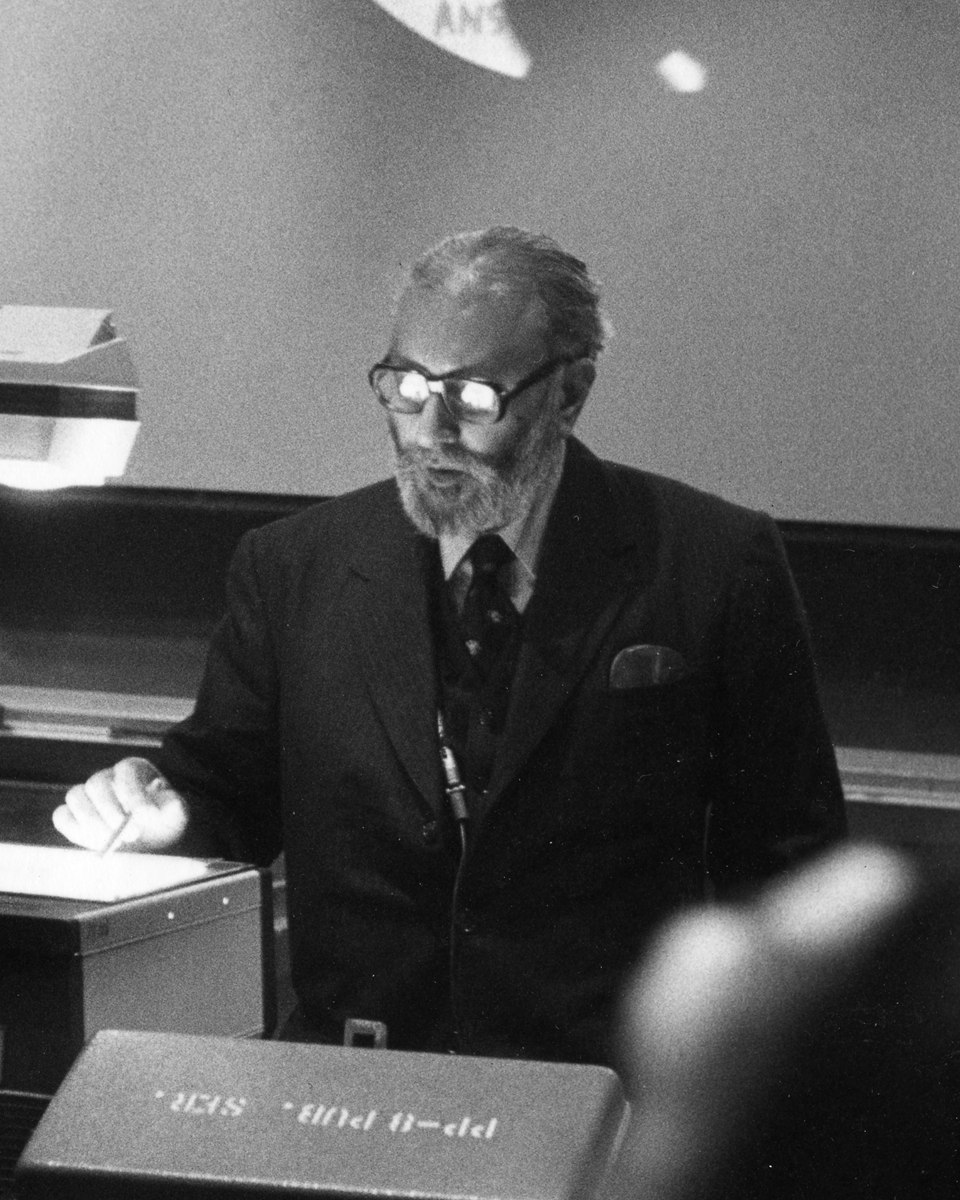

Photograph by Emilio Segre, courtesy of AIP Emilio Segre Visual Archives, Segre Collection, c. 1979, CC BY 4.0 (cropped) · Photograph 'Abdus Salam lecturing at Stanford circa 1979' by Emilio Segre, AIP Emilio Segre Visual Archives, Segre Collection (repository item 122245), uploaded to Wikimedia Commons as 'Abdus Salam lecturing at Stanford.jpg' (original 3704 x 2421) with the AIP statement that American Institute of Physics is the copyright holder and freely gives permission to use the image with the credit line, consistent with the AIP archive's published copyright guide. Cropped to the lecturer (region 1600 x 2000 of the original) and downscaled to 960 x 1200; no upscaling. The AIP repository page itself returned HTTP 403 to automated requests, so the 'copyright holder' line could not be seen on the AIP page directly; the basis rests on the Commons page quoting AIP plus the AIP guide. · CC BY 4.0
physicist · 20th Century
Abdus Salam
1926–1996
Known For
Not yet included in personality matching — the documented evidence doesn't yet cover enough of the personality model. Everything else on this page is fully available.
Trait Constellation
Key Achievements
He shared the 1979 Nobel Prize in Physics with Sheldon Glashow and Steven Weinberg for the theory unifying the weak and electromagnetic interactions, each having developed it in separate work.
In 1964 he founded the International Centre for Theoretical Physics in Trieste and directed it for three decades, creating associateships for young physicists from developing countries.
At Imperial College he built a leading theoretical physics group, identified the SU(2) x U(1) symmetry with John Ward in 1964, and proposed a grand unified model with Jogesh Pati in 1973.
Moments That Reveal Them
In 1956 he proposed that a massless left-handed neutrino fits parity violation; after Pauli rejected the idea, his paper appeared only after the experimental results.
This is consistent with an unorthodox idea that was held back by deference to an authority. Independent Thinking
In 1984, after the Green-Schwarz preprint, he had his ICTP group examine consistency in lower-dimensional models and submitted a 6-dimensional model less than ten weeks later.
This is consistent with a habit of moving quickly into new research areas. Execution Speed
Turning Points
After returning to Pakistan in 1951 he concluded that research in theoretical physics was impossible there, left in 1954, and later proposed the ICTP so others would not face that choice.
This is consistent with turning a personal setback into an institution-building project. Proactive Agency
Similar People
People whose overall profiles resemble theirs.


Maya Angelou

Nellie Bly

Akio Morita

Sequoyah

Abraham Lincoln
Sources
- Abdus Salam (Q28189) -- verified live via the Wikidata API (2026-10-26): English label 'Abdus Salam', description 'theoretical physicist, and Nobel Prize in Physics recipient', born 1926-01-29, died 1996-11-21, Korean label present, P18 image 'Abdus Salam 1987 (cropped).jpg' (rejected for the portrait, see notes). Orientation only; not used as support for any row.
- Nobel Foundation, 'The Nobel Prize in Physics 1979' (prize summary page), read in full. CANONICAL SIGNIFICANCE SOURCE: the prize was awarded jointly to Sheldon Lee Glashow, Abdus Salam and Steven Weinberg, one third each, 'for their contributions to the theory of the unified weak and electromagnetic interaction between elementary particles, including, inter alia, the prediction of the weak neutral current'. Award-body statement: authoritative on what was recognised, admiring in nature.
- Nobel Foundation, 'Award ceremony speech, Nobel Prize in Physics 1979' (presentation by the Royal Swedish Academy of Sciences), read in full: explains that the theory, developed in separate works by the three prizewinners in the 1960s, shows the weak and electromagnetic forces as aspects of one electroweak interaction, that it implies neutral currents, and that experiments in the 1970s fully confirmed that prediction. Explanatory, retrospective, admiring.
- Nobel Foundation, 'Abdus Salam - Biographical' (written at the time of the award by Miriam Lewis, a former staff member of the ICTP), read in full: schooling and Cambridge degrees, the return to Lahore and departure abroad when research there proved impossible, Professor at Imperial College from 1957, director of the ICTP from 1964, the ICTP Associateships for young physicists from developing countries, and that he spent his Atoms for Peace award and his Nobel share on funds for physicists from developing countries. Insider and admiring; political-adviser roles and personal-life passages were read and excluded from scoring.
- ICTP, 'News from ICTP 82 - Features - Abdus Salam: The Man and the Mission' (1997 newsletter, reminiscences by ICTP physicists Seifallah Randjbar-Daemi and Faheem Hussain), read in full: Salam's range of interests, his work on supersymmetry and superspace with John Strathdee, the speed with which he moved into superstrings after Green and Schwarz in 1984, that some of his speculative ideas 'were great successes' and others 'quite big' failures, why he proposed the ICTP, and Hussain's view that he implanted science in some developing countries 'but not as much as he or others would have liked'. Institutional and affectionate, with some candid critical remarks by colleagues.
- Imperial College London, 'Professor Abdus Salam (1926-1996), Nobel Prize in Physics 1979' (Nobel winners page), read: 1957 appointment and build-up of the theoretical physics group with Paul Matthews and Tom Kibble, the 1964 SU(2) x U(1) electroweak symmetry with John Ward, the 1967 incorporation of the Higgs mechanism with unpublished lectures and a 1968 Nobel Symposium publication, comparable work by Weinberg, the 1973 Pati-Salam grand unified model, and the ICTP. Institutional pride page; the Pakistan-government and religion passages were not used.
- Pervez Hoodbhoy, review of Gordon Fraser's 'Cosmic Anger: Abdus Salam - The First Muslim Nobel Scientist' (Physics Today, August 2009), read in full: Imperial group-theory work and students (Ne'eman, Shaw), Pauli's rejection of Salam's parity/left-handed neutrino proposal, the lack of immediate notice of his 1968 electroweak talk, Salam's three passions, the failure of his Islamic science foundation scheme, and the reviewer's criticism that Fraser's book is partly hagiographic and skips controversial issues. Review by a Pakistani physicist; COUNTER-VOICE. Pakistan-politics, nuclear-programme and religion passages were read and excluded.
- Mark Alford, 'Review of Cosmic Anger by Gordon Fraser' (Washington University in St. Louis, January 2009), read in full: summary of Fraser's account of the parity-violation and massless-neutrino episode, Salam's 'furious inventiveness', 'tireless traveling and lobbying' to create the ICTP, and Fraser's three-goal verdict: a 'lukewarm verdict' on his fundamental discoveries ('did not help our knowledge move forward any faster than it would have without him'), the ICTP a 'resounding success', and the Islamic-countries goal a failure; the reviewer also disputes Fraser's framing of the publication delay. Independent physicist reader; COUNTER-VOICE. Religion, family and UNESCO-campaign passages read and excluded.
- AIP Emilio Segre Visual Archives, Segre Collection, 'Abdus Salam lecturing at Stanford circa 1979' (photograph by Emilio Segre), the Wikimedia Commons file page 'Abdus Salam lecturing at Stanford.jpg' (licence CC BY 4.0 with an AIP statement), and the AIP guide 'Determining Copyright and Permissions'. Checked for the portrait only.