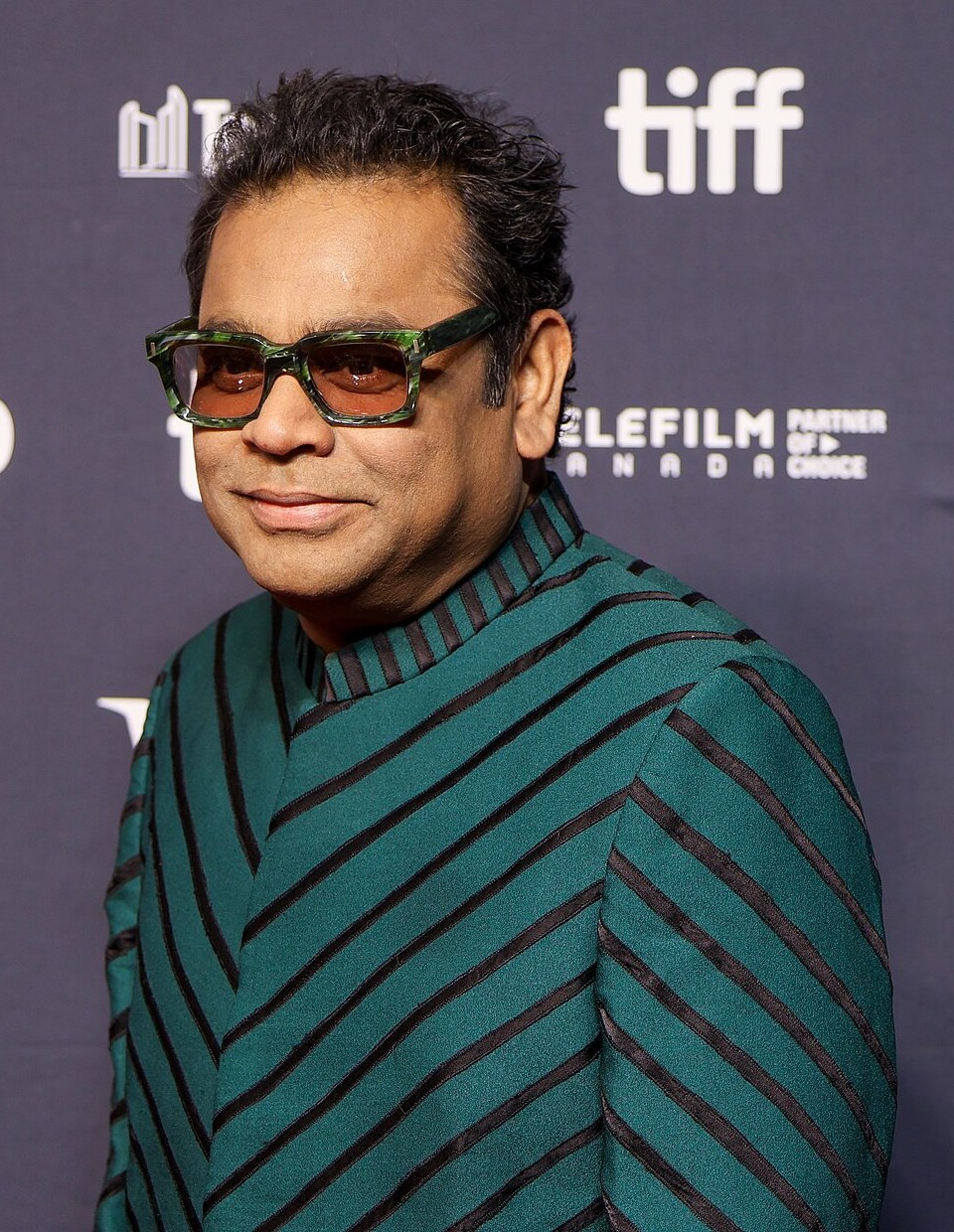

Photo: Desmond Herzfelder, 2025, CC BY 4.0 (cropped) · Wikimedia Commons, 'A.R. Rahman at the 2025 Toronto International Film Festival.jpg' -- photograph by Desmond Herzfelder, taken 6 September 2025 at the Toronto International Film Festival (WikiPortraits campaign), uploaded to Commons by the photographer himself ('Own work') under CC BY 4.0. Original 6000 x 4000 pixels (SHA-1 fdf9a65098f678859943ce19d0f2549cf44b2c46); saved as a 960 x 1240 crop from a downscaled 1920 x 1280 rendition of the original, never upscaled. The lead's first-listed lead image (Silverscreen Media, 'Marvel Anthem Launch', CC BY-SA 3.0) was checked and not chosen: it is a press-outlet event photograph whose Commons page cites the outlet's website gallery as source and rests on a licence review, whereas the chosen file is the photographer's own upload. · CC BY 4.0
composer · Contemporary
A. R. Rahman
b. 1967
Known For
Not yet included in personality matching — the documented evidence doesn't yet cover enough of the personality model. Everything else on this page is fully available.
Trait Constellation
Key Achievements
Rahman scored Mani Ratnam's 1992 Tamil film Roja, his debut as a film composer, and won the National Film Award for music direction. The Fukuoka Prize profile notes that Time later rated the soundtrack among its all-time top ten.
He composed the score and songs for Slumdog Millionaire (2008) and won two Academy Awards in 2009, for Best Original Score and Best Original Song, plus a BAFTA, a Golden Globe and two Grammys.
Rahman became music director for over 50 films, including work for Mani Ratnam and other Indian directors, wrote the stage musical Bombay Dreams with Andrew Lloyd Webber, and founded the KM Music Conservatory in Chennai in 2008.
Moments That Reveal Them
For Slumdog Millionaire's Jai Ho sequence, filmed to a different song, Rahman wrote an original track to fit the footage, and when Danny Boyle asked for more strings he reportedly arranged them and played them back the same day.
This account, which is Rahman's own, is consistent with a collaborator who works fast and adjusts to a director's notes. Collaboration
After his 2010 Commonwealth Games theme drew widespread criticism, he rearranged the song days before the event, according to a 2022 retrospective.
The episode is consistent with a composer who reworks a piece under criticism, though the reception of such work was uneven. Adaptability
Turning Points
After Mani Ratnam visited his studio and then stayed silent for months, he offered Rahman Thiruda Thiruda and then Roja; Roja became a national phenomenon and his film debut.
The sequence is consistent with a jingle composer whose self-built studio and body of work created the opening for his film career. Proactive Agency
Similar People
People whose overall profiles resemble theirs.

Duke Ellington

Akio Morita

Maya Angelou

Abraham Lincoln

Alexander Hamilton
Opposite Profile
Not a rival — a different profile shape worth a look.
Bertrand Russell
Sources
- A. R. Rahman (Q108560) -- verified live via the Wikidata API (2026-10-23): English label 'A. R. Rahman', description 'Indian composer and musician', Korean label 'A. R. 라만', citizenship India, no date of death; date of birth is recorded twice (6 January 1966 and 6 January 1967). Orientation only; not used as support for any row.
- Fukuoka Prize 2016 Grand Prize laureate profile, 'A. R. Rahman' (fukuoka-prize.org, PDF of the laureate page), read in full: composer, songwriter and singer, born 6 January 1967 in Chennai; played keyboard with various orchestras and composers 1987-92; more than 300 advertising and television jingles; the 1992 score for Mani Ratnam's Roja (National Film Award and Tamil Nadu State Film Award for music direction), music director for over 50 films by directors including Mani Ratnam, Shaad Ali, Ashutosh Gowariker and S. Shankar; Bombay Dreams for Andrew Lloyd Webber; Time rating the Roja soundtrack among its all-time top-10 movie soundtracks and the Guardian listing the Bombay soundtrack in its 1000 albums to hear before you die; founder of KM Music label, the KM Music Conservatory and the A. R. Rahman Foundation; two 2009 Academy Awards, a BAFTA, a Golden Globe and two Grammys for Slumdog Millionaire; Padma Shri 2000 and Padma Bhushan 2010; the SuperHeavy band project. CANONICAL SIGNIFICANCE SOURCE (with the Berklee page). Prize-body profile, admiring; the 2016 award is a recognition document, not an assessment.
- Berklee College of Music, 'A. R. Rahman awarded honorary doctorate' (college.berklee.edu, October 2014), read in full: honorary doctor of music presented 25 October 2014 for professional achievement and contributions to contemporary music; describes him as performer, producer and multi-instrumentalist who began with advertising jingles and drew wide attention with the 1992 Roja score; lists Bombay, Dil Se, Lagaan, Slumdog Millionaire and 127 Hours and collaborations with Nusrat Fateh Ali Khan, Andrew Lloyd Webber and the Black Eyed Peas; credits him with founding the KM Music Conservatory in Chennai; praise from Alan Silvestri and Hans Zimmer on his influence. CANONICAL SIGNIFICANCE SOURCE (with the Fukuoka Prize page). Institutional honour page, admiring; its remarks on family background, philanthropy and performances for officials were not used.
- Trinity Laban Conservatoire of Music and Dance, 'Honorary President A.R. Rahman' (trinitylaban.ac.uk), read in full: describes him as composer, multi-instrumentalist, educator and producer; works named include Slumdog Millionaire, 127 Hours, a 2012 London Olympics song, Bombay Dreams and a stage version of The Lord of the Rings; the KM Music Conservatory, established in 2008 in Chennai and offering education in all aspects of music and music technology; the Sunshine Orchestra (2008) giving free musical training to disadvantaged children; Honorary Fellowship of Trinity College London (2009); a 2024 partnership agreement between Trinity Laban and the conservatory after years of exchange. Institutional page, admiring; its UN-ambassador, charity-fundraising and family passages were not used.
- The News Minute, 'AR Rahman may have been jamming in US night clubs had Mani Ratnam not discovered him' (4 April 2017; excerpt from Kamini Mathai's book 'A. R. Rahman: The Musical Storm'), read in full: the early-1990s sequence in which Mani Ratnam's cousin and her husband, who knew Rahman's jingle work, pitched him to the director; Ratnam visited the young composer's studio and then said nothing for months before offering Thiruda Thiruda and then Roja; another director signed him with an advance; Roja became a national phenomenon and won him the National Award, while Thiruda Thiruda was a box-office failure though its score is still rated among his best; he has kept scoring one director's commercially unsuccessful films, at times unpaid. Biographer's excerpt carried by a news site: outside voices, but a single narrative; the passages about his family circumstances and study plans were not used.
- David Benjamin, 'A.R. Rahman Talks Slumdog Millionaire Music', The Playlist, 14 November 2008 (summarising Rahman's New York magazine interview), read in full: Danny Boyle approached Rahman, who was committed to other Indian film work and had to leave another project; Boyle wanted a driving, pulse-heavy, unsentimental score (Rahman quotes his 'no cello' instruction); the score pairs modern Indian sound with 1980s Hindi film soundtrack styles; about two months of planning and about two weeks of completion, compared with around six months for his usual Indian musicals; the track O... Saya made with M.I.A. by exchanging files by email, she recording vocals in England and he finishing the rest in India. Contemporaneous trade-blog summary of a self-interview: the process details are Rahman's own account (self), so used only with corroboration.
- Areeba Hashmi, 'AR Rahman secretly made Slumdog Millionaire's Oscar score in 3 weeks', Gulf News, 10 September 2026 (reporting Rahman's YouTube interview with Hasan Minhaj), read in full: Boyle approached him, his agent warned that Boyle might discard a score; he left a prior commitment and kept the project quiet; about three weeks for the score, composed in New York, Mumbai and Chennai and mixed in London; Boyle visited each evening to hear new material and give notes; the Jai Ho dance sequence had been filmed to another song, so he wrote an original track to fit the footage, and Boyle asked for more strings, which Rahman arranged and played back the same day. Retelling of a self-interview (self); the timeline (three weeks) differs from the two-month-plus-two-weeks account of 2008, which is noted rather than reconciled. Not used alone for any row.
- Arkadev Ghoshal, 'From Isai Puyal to Oscar-winner and beyond: 30 years of AR Rahman', The South First, 15 August 2022, read in full: career chronology (Roja 1992, Rangeela 1995 and the Hindi breakthrough, the Mani Ratnam films, Lagaan shortlisted for the Oscars, Bombay Dreams with Andrew Lloyd Webber in London and on Broadway, Elizabeth: The Golden Age, the Slumdog Millionaire wins); remarks by collaborators quoted or cited (Asha Bhosle on recording for him with only a flute track, Ram Gopal Varma initially hearing a Carnatic concert in a requested song that later grew on him, Shekhar Kapur's 'slow poison' description of his music, Gulzar, Karan Thapar on his brief interview answers); a song delivered to Varma on cassette within a few days; and a critical section: the 2010 Commonwealth Games theme widely panned as below his usual standard (rearranged days before the event) and its fee criticised, a lukewarm reception for a 2019 Avengers: Endgame song, and a collaboration judged forgettable. Independent journalist's retrospective with collaborator voices and a critical counter-voice. Its passages on religion and his father were not used.
- Wikimedia Commons file page 'A.R. Rahman at the 2025 Toronto International Film Festival.jpg' (with the Commons API record) -- checked for the portrait: own work of photographer Desmond Herzfelder, taken 6 September 2025 at the Toronto International Film Festival under the WikiPortraits campaign, licence CC BY 4.0. Rights-basis page; no person-specific claim rests on it.